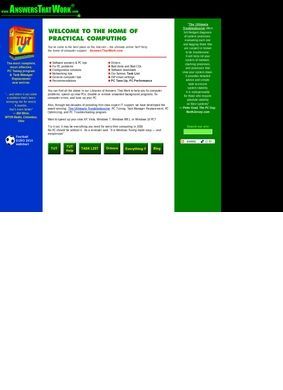
Answers That Work built two things: a paid Windows diagnostics tool called The Ultimate Troubleshooter, and one of the better free reference databases on what every running process on a PC was actually doing. The site came out of London, built by a developer named Maurice McElroy, and for years it was a name technically minded users passed around when they wanted to figure out why a machine was behaving strangely.
The Ultimate Troubleshooter tool
The paid product, usually shortened to TUT, scanned every process and service running on a Windows system and graded them. It told you which were safe, which were unnecessary, and which looked like malware or were fighting something else for resources. The pitch was simple and the execution was practical: instead of staring at a task manager full of cryptic filenames, you got a plain-English verdict on each one.
Pricing and trial availability
The license sold for around thirty-five US dollars, and the software shipped as a trial you could run before paying. The last version on record is 4.92, with the most recent release dated to the middle of the last decade. Answers That Work also ran a large free companion resource it called the Task List, a catalogue of hundreds of Windows processes indexed by filename, each with a written explanation of what it does and whether you should worry about it. For a long stretch that page was genuinely useful on its own merits, the sort of thing you landed on after typing a mysterious .exe name into a search engine at two in the morning. A subdomain, searchtasks.answersthatwork.com, handled those process lookups directly.
Military and academic deployments
The customer list is more impressive than the modest price tag implies. According to what is on record, the software was used by the US Army, the US Department of Agriculture, and universities including Queensland and Connecticut. That mix of military, government, and academic users tells you the diagnosis it produced was trusted in places where a wrong call has consequences. A tool does not get into those environments on marketing alone, and Answers That Work evidently cleared whatever bar those procurement processes required.
Community reception
Outside reputation is positive but quiet. On the Spiceworks community, where IT professionals trade notes, the product is listed with user reviews that praise its process-diagnosis abilities, and the tone there is favourable even if no hard rating count is shown. The Globe and Mail ran a positive editorial mention at one point. Download trackers such as UpdateStar and DownloadSource carry version 4.92 but without user scores attached. A search of Google, Trustpilot, the BBB, and Yelp turns up nothing for this specific site, and no negative reviews surface anywhere. For a niche utility aimed at technicians, that quiet-but-warm pattern is about what you would expect: the people who used it were the type to talk about it in forum threads rather than consumer review platforms.
The TUT name still appears in older technical forum threads in a favourable light, and the absence of any negative feedback after all this time points to a tool that rarely let people down. That is a fair summary of what Answers That Work built: something quiet, useful, and trusted by the people who depended on it. The free process database was the kind of public reference that quietly saved people hours, and it is a genuine loss that it sits behind a dead link now.
Checking the current state
This is where Answers That Work runs into a wall. The site and most of its subpages are currently unreachable, with some showing nothing more than an Under Construction placeholder. The newest software release dates back several years, and Windows has moved on considerably since then. Because the site is down, there is no way to test how the download or the Task List behave at the moment. The only contact detail on record is an email address for Maurice McElroy, published in a press release back in 2007. No phone number and no physical address turned up. With the site offline, contact visibility cannot be judged the way it could be on a working page.
Why the software is obsolete now
Answers That Work earned a real reputation among people who fix computers for a living, but what it earned is a historical record, not a live destination. If you want to download a maintained, supported diagnostics tool for a modern Windows machine, Answers That Work is no longer the place to get it, and the dated final release would give pause even if the download worked. The software was built for a version of Windows that has since been superseded more than once, and process databases age badly because the threats they describe keep changing. Abandoned security tooling does more than go stale; it can be actively misleading when applied to current systems, because the threat landscape it describes no longer maps to what is out there.
If, on the other hand, you are researching the history of Windows troubleshooting tools, or you remember the Task List and want to understand what it was, the record around Answers That Work is worth the time. The provenance is clear, the named developer and London origin are documented, and the institutional users lend Answers That Work a credibility that a lot of shareware from the same era never earned. You can trace its lineage through the download archives even where the original pages no longer load.
For practical purposes, this is the entry for a product that did its job well and then stopped being maintained. The thirty-five dollar license, the version 4.92 marker, the army and university deployments: these are facts about something that worked, written in the past tense now. Answers That Work left a clean record behind it. The product is in the archives, the reviews that exist are kind, and the credentials are documented, but the lights are off and the last meaningful release is years in the rear-view mirror.