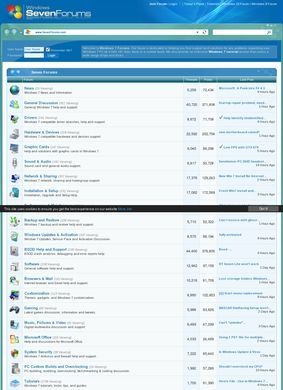
Most general tech forums treat Windows 7 as a footnote now. Seven Forums went the opposite direction and stayed there. It is a community-run site built around a single operating system, and the narrow scope produced real depth. Threads cover installation snags, driver conflicts, hardware that refuses to cooperate, networking failures, and the specific work of reading a BSOD dump file to work out what actually failed.
Community focus on a single operating system
The site makes no claim to any relationship with Microsoft. It states plainly that it is independent, unauthorized, and unapproved by the company, which is the honest framing for a peer support project. The answers come from people who ran Windows 7 daily, broke it, fixed it, and wrote down what they learned, rather than from a script aimed at closing a ticket. That shows in the tone: the forum includes cases where the only honest answer was that a part had failed and needed replacing.
Independent peer support without Microsoft affiliation
Seven Forums splits its material into dedicated sub-sections for distinct problem types, so a question about a failed driver does not get buried under one about a slow boot or a crashing application. There are areas for installation and setup, hardware compatibility, performance tuning, security, networking, and the application crashes that accumulate on any aging system. Someone walking in with a precise symptom can usually land in the right corner without wading through unrelated noise.
Organization and searchable content
Alongside the discussion threads sit tutorials and how-to guides written by members. These age well. A clear walkthrough for a clean install, a system image backup, or a repair procedure stays useful long after the original poster has moved on to newer hardware, and the forum format keeps follow-up questions attached underneath where the next reader can find them. Screenshots and step numbering are common, which helps when a procedure has a dozen stages and one wrong click undoes the rest. That layering of step-by-step material with the back-and-forth of people who hit the same wall is something a polished knowledge base rarely captures.
Member-written tutorials with lasting value
Access costs nothing. Threads are readable without an account, which matters when you are mid-crisis and just want to confirm whether a fix is safe before trying it. Posting requires registration, a reasonable gate that keeps the place tied to real contributors. The audience Seven Forums draws reflects the subject: home users nursing an old laptop, enthusiasts who valued the control Windows 7 gave them, and IT staff who still maintain those systems in places where upgrading is not a simple decision. That mix shows in the threads, where a hobbyist question and a more technical one can sit side by side and both get serious replies.
Free access for readers and registered contributors
The obvious limit is the operating system itself. Windows 7 reached end of life and no longer receives security patches, so anyone relying on Seven Forums is by definition working with software Microsoft has stepped away from. The forum cannot change that, and it does not pretend to. What it can do is keep the collective troubleshooting knowledge of a large user base in one searchable place, which is genuinely valuable for people who, for compatibility or cost reasons, cannot or will not move on. Answers vary in quality, as they do on any open forum, but the dedicated focus raises the floor compared with a general tech site where Windows 7 is an afterthought.
Limitations of Windows 7 support
That focus is also why searching the existing archive often beats posting a new question. Years of accumulated threads mean most common problems have already been described, diagnosed, and resolved, frequently in several variations. Treating Seven Forums as a reference library first, and a place to ask second, gets the most out of it. The diagnostic threads on blue screens are a clear example: contributors learned to ask for dump files, walk through the analysis, and explain the reasoning, so the discussion teaches the method rather than just delivering the one-off fix. Once a reader can interpret a dump independently, the next crash is far less alarming, and the skill carries forward to other diagnostic work too.
Archive as reference library for diagnostics
Microsoft Answers spans every current product and is the place to go for supported, modern Windows. Its Windows 7 section lost contributors as the platform aged and official attention moved elsewhere. Seven Forums went the other way: one operating system, examined at length, with an archive that was never diluted by the next release. For a persistent Windows 7 problem, the concentrated history here usually has the edge. That is the case for keeping Seven Forums bookmarked even now that the platform it covers has been left behind by its own maker.