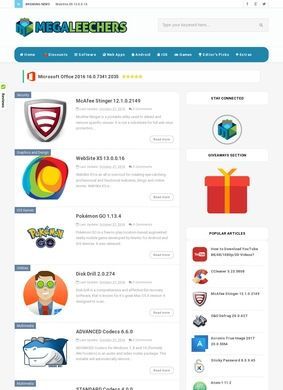
Megaleechers is a software tracking and news site that follows the latest builds and version bumps of trending desktop and web applications. It sorts programs by platform first, so a visitor can stay inside the Windows world, or jump to Mac or Linux, then drill into a category. The category set is wide without being padded: Drivers, Internet Tools, Business and Office, Graphics and Design, Multimedia, Security, Programming, Linux Distributions, and Utilities, plus separate streams for Freeware and Web Apps. Each program entry carries its current version number, which is the whole point of a site like this. A small set of community likes and comments sit alongside it.
Version tracking across platforms
That focus on version numbers is what separates Megaleechers from a generic download portal. Plenty of places host installers; far fewer keep a clean running log of which release is current and when it changed. Someone who already runs a particular utility and just wants to know whether build 4.2 has landed gets a fast answer here. Someone shopping for a new tool in the Graphics and Design bucket can browse what is active and trending instead of typing blind queries into a search engine. The two use cases are different, and the platform handles both without forcing one to dominate the layout.
Breadth of software categories
The breadth is the strongest argument for bookmarking the site. Driver pages, security software, programming tools, and Linux distributions rarely live under one roof, and lumping them together means a single visit can cover a developer's toolchain, a designer's working set, and the system housekeeping that keeps a machine running. The Freeware and Web Apps sections widen that further, pulling in things that never touch a traditional installer at all.
Daily updates and software news
Daily updates are the other selling point. Megaleechers frames itself, on its About page, as a place to explore and stay updated with the latest and top-rated apps, and the cadence backs that up: this is meant to be checked often, treated as a recurring stop rather than a one-time read. The named audience is a reasonable fit for the mix on offer, casual users who want to find something new plus professionals in design, programming, and business who are tracking software they already depend on. A blog section runs software news on top of the version tracking, and a Deals area, run in partnership with shareware.deals, adds discounted licences for anyone who reaches the point of paying for a tool they tried.
None of this is exotic. It is a well-organised aggregator of a kind that has existed since the early days of the download-site era, and the value rests entirely on whether the data stays current. Version trackers go stale quietly, and a stale one is worse than none because it misleads by omission. The daily-update promise is the thing a returning visitor should keep an eye on over a few weeks.
Safety assessments from automated scanners
For a site that exists to send people toward software downloads, the safety question is more pressing than usual, and the picture is mild but positive. Scamadviser lists megaleechers.com as legit and safe, though it stops short of a numeric score. The closely related domain megaleecher.net carries a small batch of reviews, eleven of them, averaging around 4.4 stars, which is a decent showing even if it does not strictly speak to the .com address. An automated assessment on EasyCounter also flags the site as safe, again without any user-supplied ratings behind it.
What that adds up to is reassurance from automated safety scanners and very little from actual users. No reviews turned up on Google, Trustpilot, Yelp, Facebook, or Glassdoor, so anyone hoping to read first-hand accounts of the download experience will come away empty. The machine checks say the site is clean; without a human review trail, a visitor is largely taking Megaleechers on its own presentation and on those automated all-clears.
Commercial model and disclosure
The Deals partnership and the disclaimer page together hint at an honest-enough commercial model: Megaleechers points to software, some of it discounted through a third party, and is upfront that it is a pointer rather than the publisher. That is the right posture for an aggregator. A reader should still apply the usual caution any download intermediary warrants, checking the destination before installing anything, but the site is straightforward about what it is, and the disclaimer spells that role out in plain terms.
Comparison with larger download sites
Weighed against a heavyweight like Softpedia, the comparison is honest about scale. Softpedia carries deeper editorial write-ups, its own malware scanning of hosted files, and a far larger user-review base, and a cautious downloader will lean on those before clicking install. Where Megaleechers competes is on the tidy, platform-first version feed and the daily rhythm, which make it a quicker stop for a specific question than a long research session. The trade is clear: less depth, faster answers. As a fast tracker Megaleechers does that narrow job well. As a sole source before installing unfamiliar software it comes up short against the established alternatives, and the empty user-review trail is the reason to keep Softpedia or a similar second opinion within reach when the download itself carries safety implications the version number alone cannot settle.