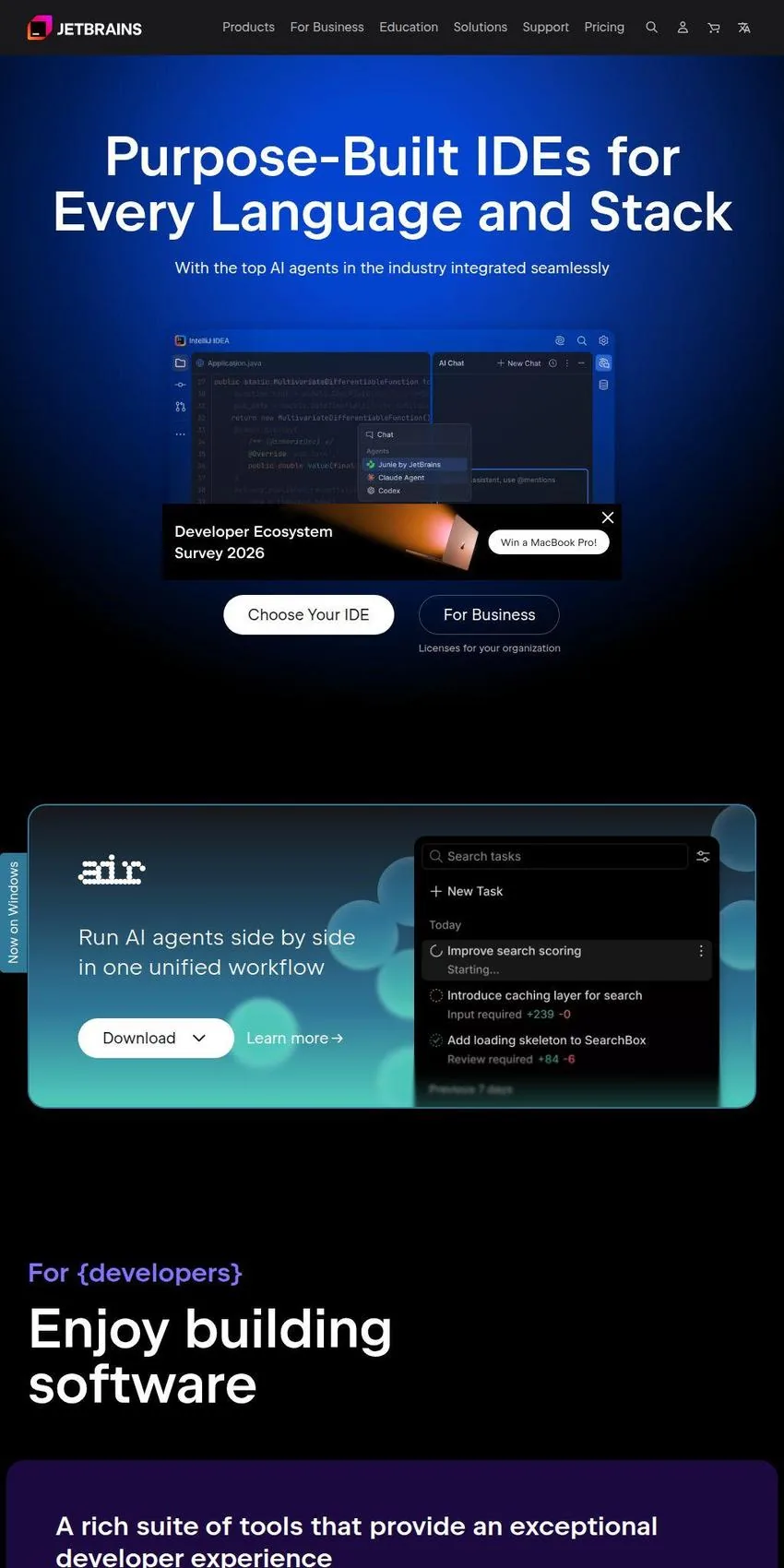
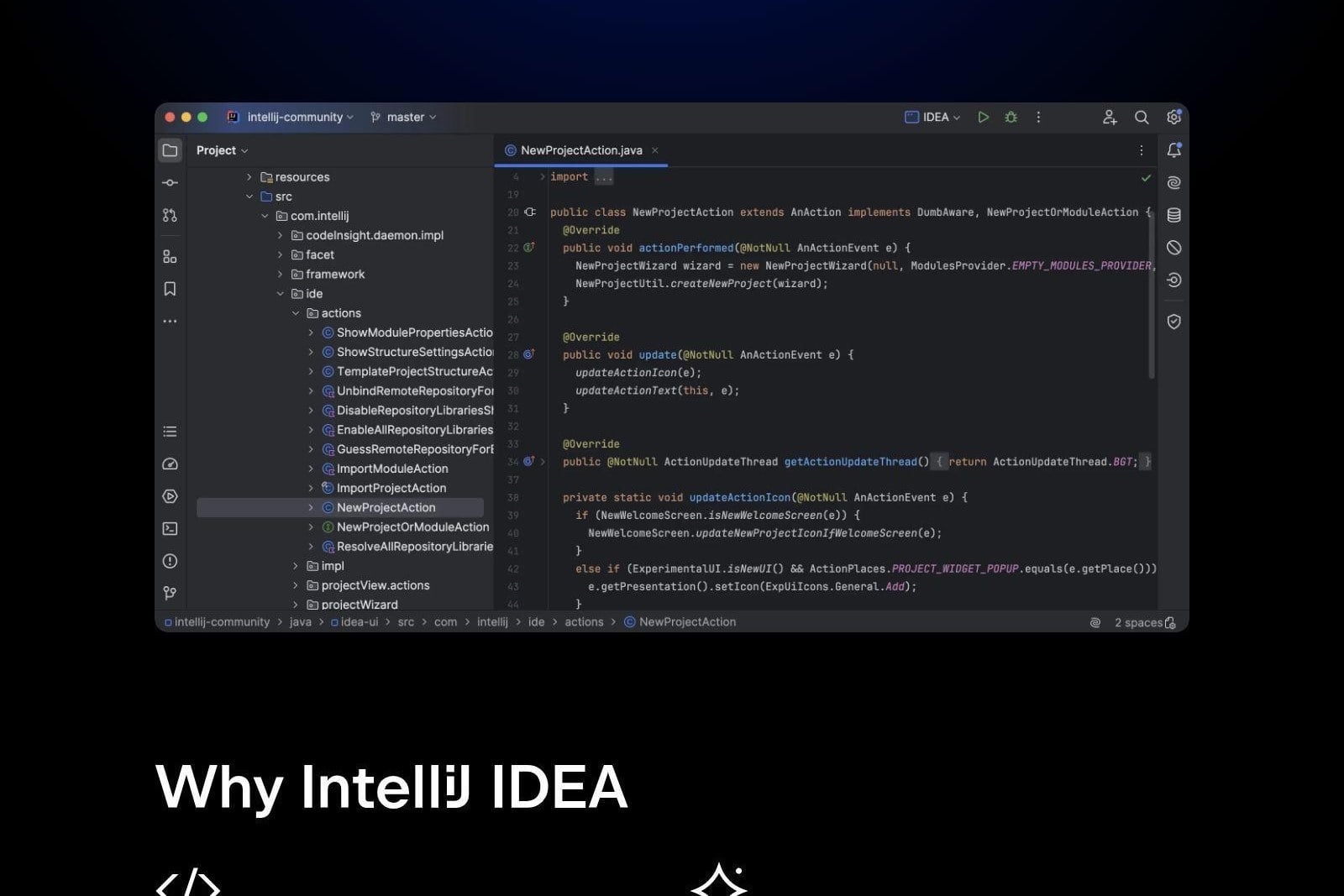
Open a Java project that has grown past a few hundred files and the small questions start stacking up fast. Where does this method get called? Will renaming this class quietly break something two packages away? IntelliJ IDEA, the flagship editor from JetBrains, was built to answer that sort of question, and the company calls it the leading Java IDE right on the product page. Everything else in the catalog grows out of the same premise, an editor that reads your source as a structure it understands.
The firm behind it has been at this a long stretch. JetBrains s.r.o. works out of Prague and started life as IntelliJ Software, and it has spent the years since turning one strong Java editor into a wide bench of language-specific tools.
A workbench built around the IDE
The catalog is broad, and it has an obvious center of gravity. Almost everything here sits within arm's reach of a code editor. The desktop IDEs come first, then the utilities that install and manage them, the AI features folded inside them, and the licensing and learning pieces wrapped around the edges.
There is more going on than editors, to be fair. The company also builds YouTrack for issue tracking and Space for team collaboration. It runs a learning platform with a catalog of over a hundred courses too, and keeps up a company blog under the tagline The Drive to Develop. The About area carries the usual company pages, People, Customers and Awards, and a section titled Our commitment. But the editors are what the whole operation orbits, and they are where any honest look should start.
Ten editors under one roof
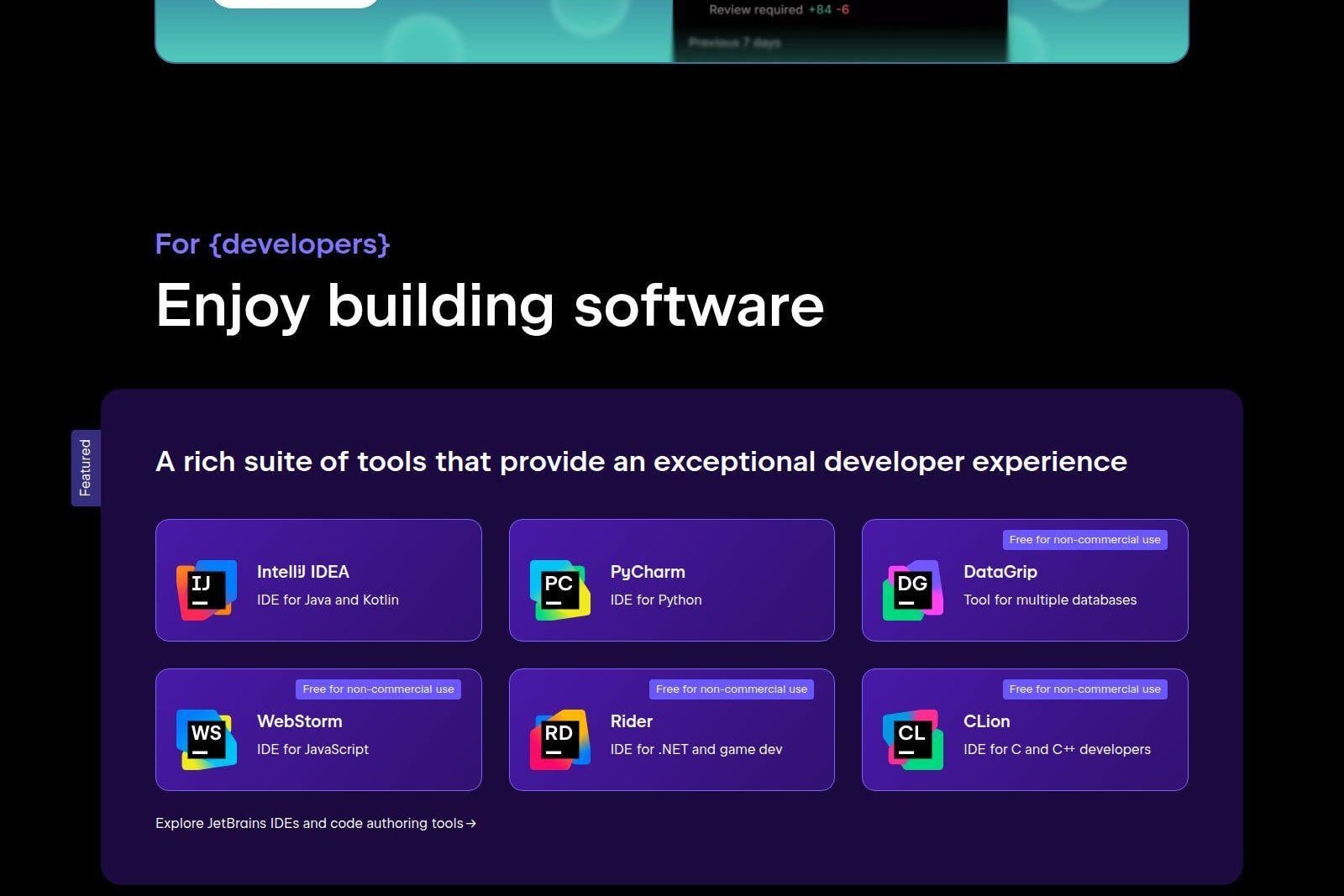
The site pulls the desktop editors together under an All IDEs section, and the spread covers most of what a working programmer touches. PyCharm handles Python, WebStorm covers JavaScript and TypeScript, PhpStorm takes PHP, CLion does C and C++, GoLand does Go, RubyMine covers Ruby, and RustRover is the recent addition for Rust. DataGrip is the database client, and Rider handles .NET. Each is the IntelliJ engine retuned for one language and its ecosystem, which is why a Python developer and a Go developer can share the same muscle memory across two different products.
For .NET developers there is a whole cluster beyond the Rider IDE: ReSharper and ReSharper C++ as Visual Studio extensions, plus profiling and inspection tools like dotCover, dotMemory, and dotPeek. It is a reminder that the company sells into established Microsoft shops as readily as into open-source ones. Ten editors also means ten things to install and keep current, and JetBrains answers that with the Toolbox App, a small manager that updates every tool and lets you run several versions side by side. It removes a real, dull chore. Anyone juggling several IDEs across two or three machines will feel the difference right away.
Kotlin and the research bench
The company's reach goes past editors into the languages people write in them. JetBrains created Kotlin and still maintains it as an open-source project. Kotlin has grown into a widely used language in its own right. That is an unusual spot for a tools vendor to hold: the same firm selling you the IDE also stewards a major language you might build your whole stack on. A Research section sits on the site as well, with work listed in programming languages, machine learning, and developer productivity. For a commercial shop, keeping a visible research arm says something about where the priorities really sit.
The AI line and Junie
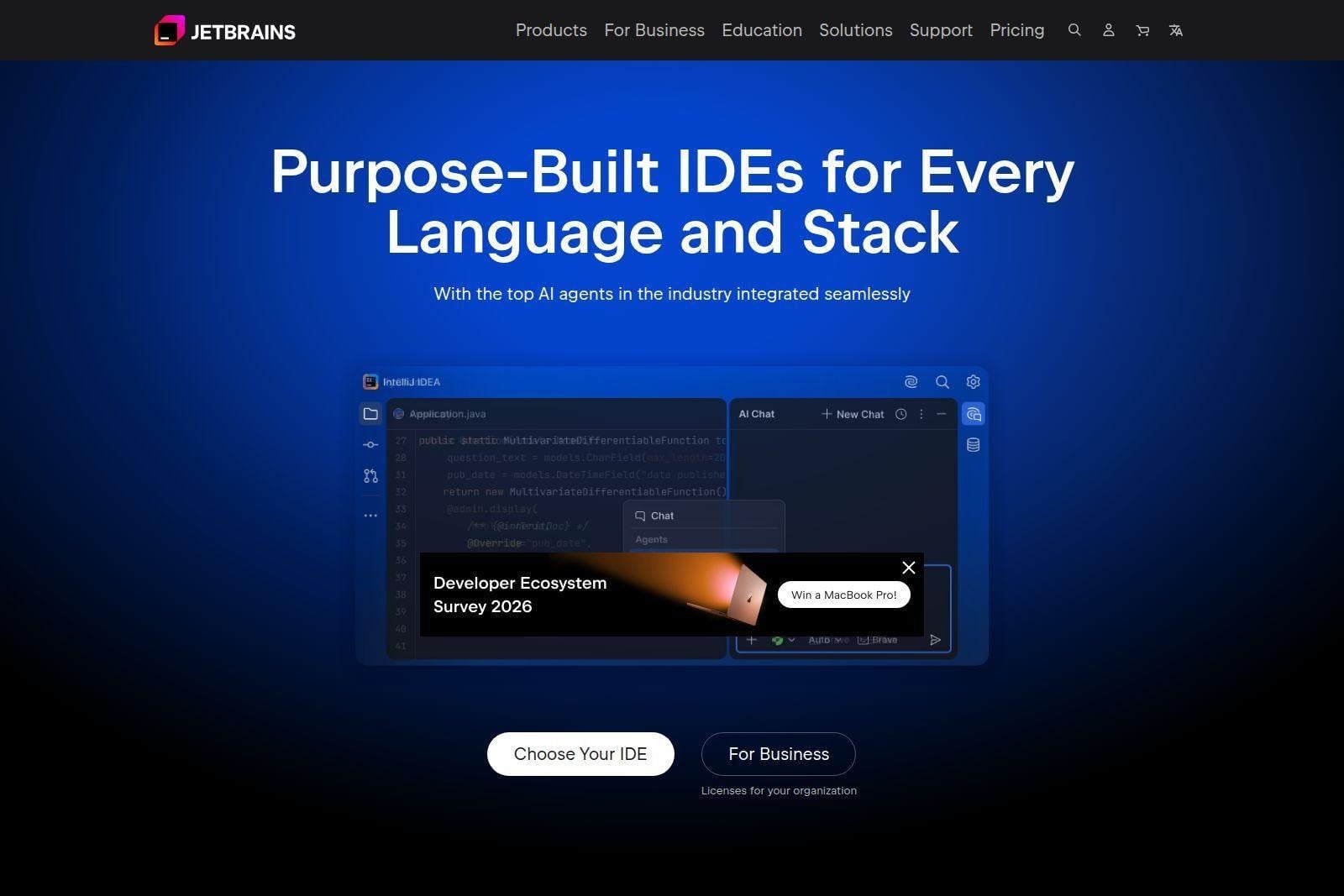
Like most of the industry, JetBrains has pushed hard into AI, and it treats the effort as a distinct product line several tools deep; the site lists AI in IDEs, a coding agent called Junie, plus Air, ACP, and a model named Mellum. Whether all of that holds together or splinters into too many overlapping names is a fair worry, and the branding is busy. What helps is that folding an assistant into an editor that already parses your code gives these features real context to work from.
Licensing through the store
None of this comes free, for the most part. The JetBrains Store sells personal and business licenses on subscription, billed monthly or yearly, and the divide between an individual buying one editor and a company kitting out a whole team runs right through the site. A separate For Business section speaks to teams and enterprises, and a JetBrains for Data page targets analysts and scientists. Pricing is public and the store is easy to reach, which is more than a few vendors in this space can say.
Outside opinion backs the products up. On G2, JetBrains holds about 4.5 out of 5 from something like five thousand reviews pooled across its tools, a strong mark in a field where developers argue over their editors with real heat.
That figure spans many separate products, so it reads less as buzz around one hit and more as steady satisfaction across a catalog.
Getting in touch is straightforward. There is a Prague head office address, a phone line, and separate sales contacts listed for the Czech Republic, the United States, Germany, Russia, and China, so a buyer in most major markets has a direct route in. For a company selling worldwide, spelling out who to call in each region is a sensible touch. One caveat is worth naming. The public pages lean heavily on JavaScript, and details like the address and the navigation live in embedded data rather than plain page text, so the site can feel oddly hollow if the scripts fail to load.
Set against Visual Studio Code, the free Microsoft editor that has swallowed an enormous share of the market, the trade becomes clear. VS Code is lighter, endlessly extensible, and costs nothing, and for quick work it is tough to beat. What JetBrains offers instead is depth: language understanding switched on by default, refactoring you can lean on, and a paid product with a company behind it. A developer who lives in one language all day and wants the editor to truly grasp the code will usually see the subscription pay for itself. Someone who hops between languages and wants free and fast will still reach for VS Code. That is the line to weigh before you pull out a card.



Business address
JetBrains s.r.o.
Na H?ebenech II 1718/8,
Praha 4,
140 00
Czechia
Contact details
Phone: +420-2-4172-2501
A year ago, we introduced the first wave of PhpStorm’s open-source sponsorships. We truly believe in the power of open source and…
In this post, I’ll share how we designed and built the new TeamCity integration for Kotlin Multiplatform. Our guided onboarding…
What is Small Talk? Small Talk is our short Q&A with founders from the JetBrains Startup Program. They answer a handful of…
100 Exercises to Learn Rust is our adaptation of Mainmatter’s course of the same name, written by Luca Palmieri, Principal…