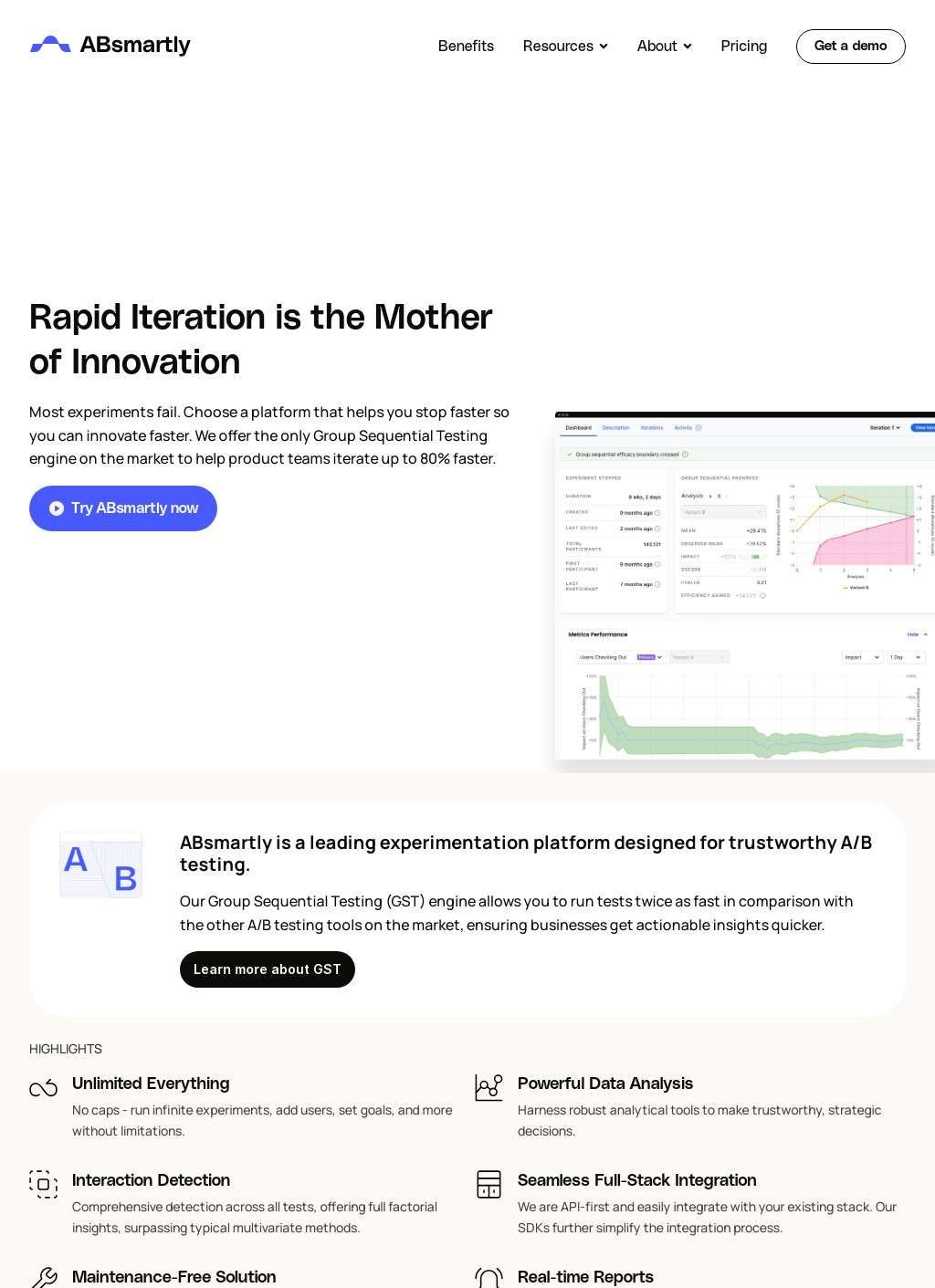
ABsmartly is a cloud-based A/B testing and experimentation platform run by ABsmartly B.V. out of Amsterdam, built for product, engineering, and data teams inside larger B2C companies in e-commerce, healthcare, and finance. The pitch is narrow and technical, which suits the audience. This is not a casual marketing widget you bolt onto a landing page; it is aimed at organizations running experiments as a regular part of how they ship features.
Group sequential testing with real-time monitoring
The headline feature in ABsmartly is Group Sequential Testing, a statistical method that lets teams call experiments earlier than a fixed-horizon test would allow, without inflating false positives the way naive peeking does. Pairing that with real-time data monitoring is a sensible combination, since the whole point of stopping early is being able to watch results as they accrue. The platform also ships an Experiment Documentation Hub for recording what was tested and what was learned, plus Program Reporting dashboards that track experimentation velocity across teams. That last pair tells me the product is designed for companies past the stage of running one test at a time and into the messier territory of governing dozens of experiments owned by different people.
Governance through documentation and velocity tracking
That governance angle is easy to undersell. Plenty of teams can run a single test; far fewer can keep a record of what every test taught them or measure whether they are shipping experiments faster this quarter than last. By building the documentation hub and the velocity reporting into the core product, ABsmartly treats experimentation as a program to be managed, which is a different problem than getting one result.
Multi-channel experiments across apps, websites, email
Coverage extends past the website. ABsmartly runs experiments on native apps, websites, email and CRM campaigns, and algorithmic systems. For a product team whose users touch several channels before converting, that unified surface is worth having. Treating an email send and a ranking algorithm as testable surfaces under one roof is more ambitious than the typical client-side splitter.
Server-side deployment for backend logic testing
Deployment runs both server-side and client-side, with SDKs spanning multiple programming languages. Server-side support is the detail that separates tools built for engineers from tools built for marketers, because it lets teams experiment on backend logic, pricing, and APIs where a JavaScript snippet cannot reach. For regulated buyers, the GDPR and HIPAA compliance claims are not decorative; a healthcare or finance team cannot seriously evaluate a vendor that lacks them, so listing both up front clears an early hurdle.
There is depth behind the product pages too. The site carries a blog, case studies, FAQs, and full developer documentation at its own docs subdomain. Separate, maintained developer docs usually mean the SDKs work and get support, not an afterthought stapled onto a sales site.
From Booking.com founders to enterprise reputation
The founding story is worth weighing. ABsmartly was started by people who built A/B testing architecture at Booking.com, a company whose experimentation program is something of a reference point in the field. That background lines up with the product on offer: sequential testing, velocity reporting, and multi-channel coverage are exactly the concerns of a team that has already run experimentation at scale and felt the limits of off-the-shelf tools.
On reputation, the review volume is modest but what exists leans favorable. G2 carries around 14 reviews, with support rated 9.7 out of 10, which is a strong number on any sample size. Gartner Peer Insights lists ABsmartly with reviews from verified enterprise users, though the exact count is unclear from search results. TrustRadius has the product listed but too few reviews to score it, and it also appears on Capterra, GetApp, and SoftwareAdvice without visible counts. For an enterprise tool sold through a sales process, low public review totals are expected; companies buying at this level rarely post public ratings. The support score is the most concrete data point available, and it points in the right direction.
Evaluating ABsmartly through sales and demos
Getting in touch follows the pattern most enterprise software vendors use. A "Get Demo" page sits in the main navigation, and the company lists a physical address on Keizersgracht in Amsterdam. There is no public phone number or general email, and pricing is gated behind a sales conversation. That funnel will frustrate anyone hoping to compare costs in five minutes, but it is standard for a quote-based platform serving regulated enterprises, and the address plus a clear demo route give it enough transparency to proceed with evaluation.
The absence of public pricing is the one practical friction a smaller team will hit immediately. Combined with the enterprise framing and the demo-only entry point, ABsmartly reads as a tool you reach for when experimentation is already a budgeted function with engineering behind it, not when a single marketer wants to test two button colors. The product breadth and the Booking.com lineage point the same direction, and ABsmartly seems comfortable with that narrower audience instead of chasing the broad self-serve market. A team evaluating it can read the docs, study the case studies, and book a demo, but they will be talking to sales before they see a number.
Business address
ABsmartly
Keizersgracht 520 H,
Amsterdam,
North Holland
1017EK
Netherlands