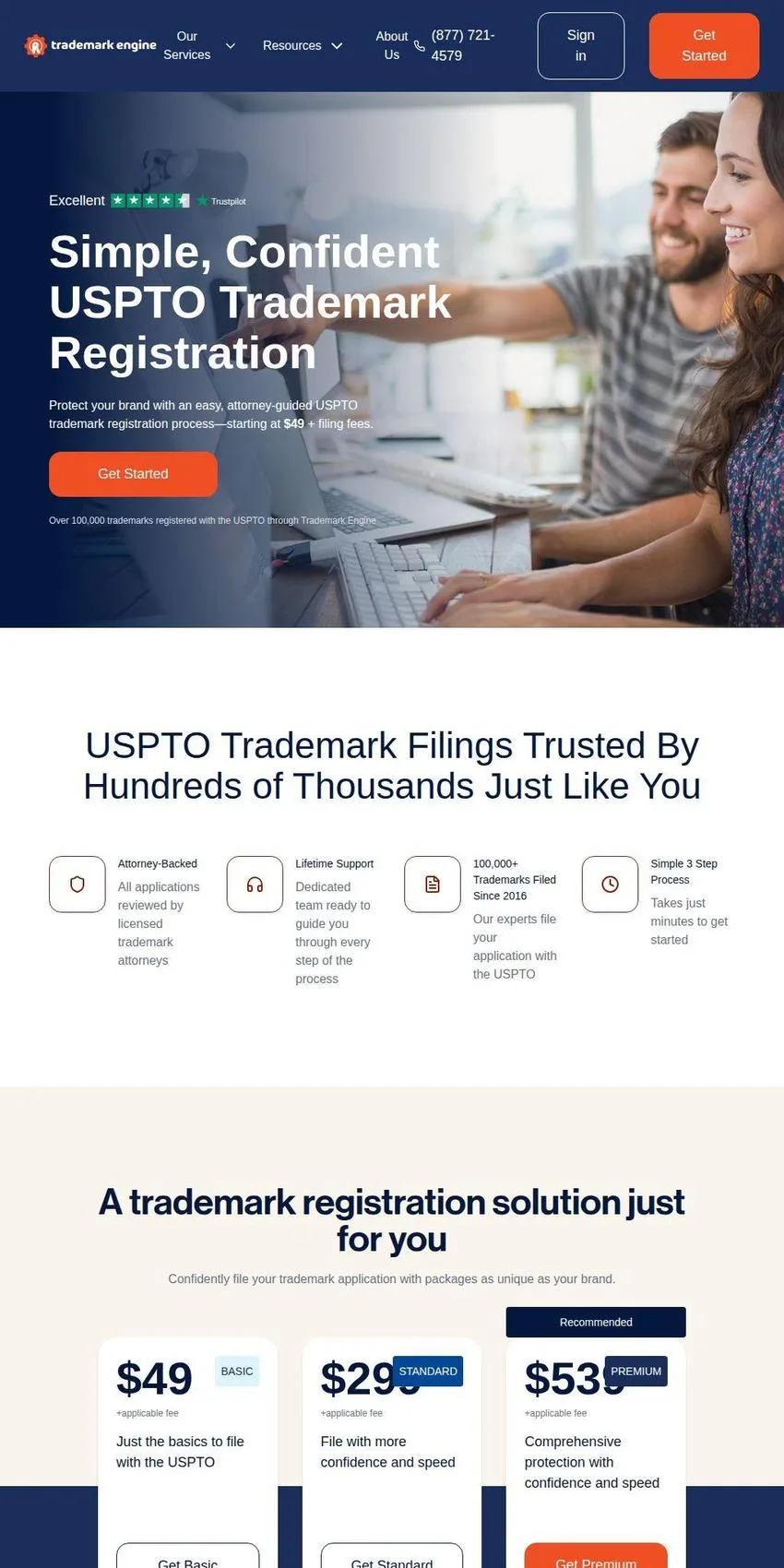
What does the $49 that Trademark Engine advertises cover? Preparation, an attorney review, and the act of filing, and nothing else. The checkout adds what the fine print calls applicable fees: $350 per class for the USPTO plus a $100 charge for services and platform access, so the smallest real bill for one class is $499, rising to $699 when the goods description falls outside the USPTO's preset ID Manual and the government fee jumps to $550. The arithmetic matters, because the gap between the banner price and the first card charge drives a good share of the complaints about this company.
What the $49 price actually includes
Trademark Engine is an online trademark filing service run out of Houston. By its own count it has put more than 100,000 marks through the USPTO in roughly a decade, alongside 6,000 plus copyright filings and about a thousand renewals. Around the core product sit a free direct-hit search tool, a paid comprehensive search, a quarterly monitoring subscription, copyright registration, and an office action response service.
Three filing tiers with different service levels
Filing comes in three tiers. Basic at $49 covers a federal and common law search for direct matches, review by a US-licensed attorney, and submission. Standard at $299 adds a dedicated attorney, a 15-minute consultation, and rushed processing. Premium at $539 stretches the consultation to a full hour and promises next-day handling. Every tier still carries the government and platform fees above.
The attorney and business structure
The legal plumbing deserves a close look. The homepage sells an attorney-guided process with every application reviewed by licensed trademark attorneys, while the footer states that Trademark Engine provides information and software only and takes part in no legal representation, with responsibility for actual legal services assigned to Swyft Legal, an affiliated firm licensed under Arizona's alternative business structure program, the arrangement that lets nonlawyers own law practices. The BBB file lists Travis Crabtree as owner, and the footer links out to a parent brand called 360 Legal. Older complaint responses reference a discontinued DIY package with no attorney at all, so the attorney layer is a later addition to the model.
How the basic search compares to full clearance
Buyers should also understand what the Basic search is. A direct-match check against federal and common law records is roughly what anyone can run free in the USPTO's own database; the sound-alikes and near-misses that get applications refused need the comprehensive search, which costs extra. The pitch page puts a traditional firm's clearance and filing at around $2,500, citing an AIPLA economic survey, and that spread is the whole sales argument.
Customer satisfaction on filing volume
On volume, the crowd is mostly happy. The Trustpilot profile holds close to nine thousand reviews in the platform's Excellent band, and the praise is oddly specific: reviewers thank support reps by name (Rosa, Ben, Grethel, Ella) for walking them through statements of use, ownership transfers, and filing extensions. The homepage even embeds one review whose author insists he is rating the rep's manners, expressly not the company, since his file is still unfinished. The blog, for its part, publishes comparisons of Trademark Engine against Rocket Lawyer, Markavo, and Flat Fee Trademark, all written in-house and all concluding, gently, in its own favor.
Monitoring subscription bundled with filings
Almost all of them trace to one product. Trademark filings come bundled with a free trial of a brand monitoring subscription that renews at roughly $175 to $199 per quarter unless cancelled, and cancellation happens by phone only, which the company frames as a security measure. Reviewers describe cancel buttons in the dashboard that do nothing.
Complaints about auto-renewal charges
The one and two star layer on Trustpilot repeats this theme almost to the exclusion of anything else, and the BBB record for Trademark Engine, LLC echoes it in harsher terms: enrollment without clear consent, quarterly charges under an unfamiliar billing name, one reviewer tallying four charges totaling $796 and reporting that a card updater service found his replacement card while a dispute was open. Another complainant authorized $99 and watched $450 land an hour later. The bureau marks a couple of complaints as unresolved.
Company responses to billing disputes
The company's answers follow a pattern too: the filing fee is displayed at checkout, a reminder email goes out before each trial converts, and refunds are in fact issued in a number of threads, sometimes quickly. Both stories can be true at once. The charges are disclosed somewhere on the way through, and the banner promising flat fees with no surprises reads very differently once a $100 platform charge is riding inside "applicable fees" and a subscription trial is riding inside the filing.
Contact options before purchase
Reaching the company before buying is easy: a Houston street address on the page, a toll-free line answered weekdays from nine to six Central, and a contact form. The friction arrives on the way out, which is worth knowing in advance. As a verdict: for a distinctive name in a single class, bought by someone who reads the checkout line by line and phones in the monitoring cancellation before the trial lapses, Trademark Engine files real applications with real attorney review for several hundred dollars less than a law firm would charge.
When Trademark Engine makes financial sense
For a descriptive mark, a crowded field, or anything likely to draw an office action or an opposition, the disclaimer in the footer is the honest guide: this is software with an attorney checkpoint, no one's counsel, and the money saved up front has a way of migrating to the back end. A qualified yes, with the first bank statement treated as part of the paperwork.
Business address
Trademark Engine
1814 N Memorial Way,
Houston,
Texas
77007
United States
Contact details
Phone: (877) 721-4579