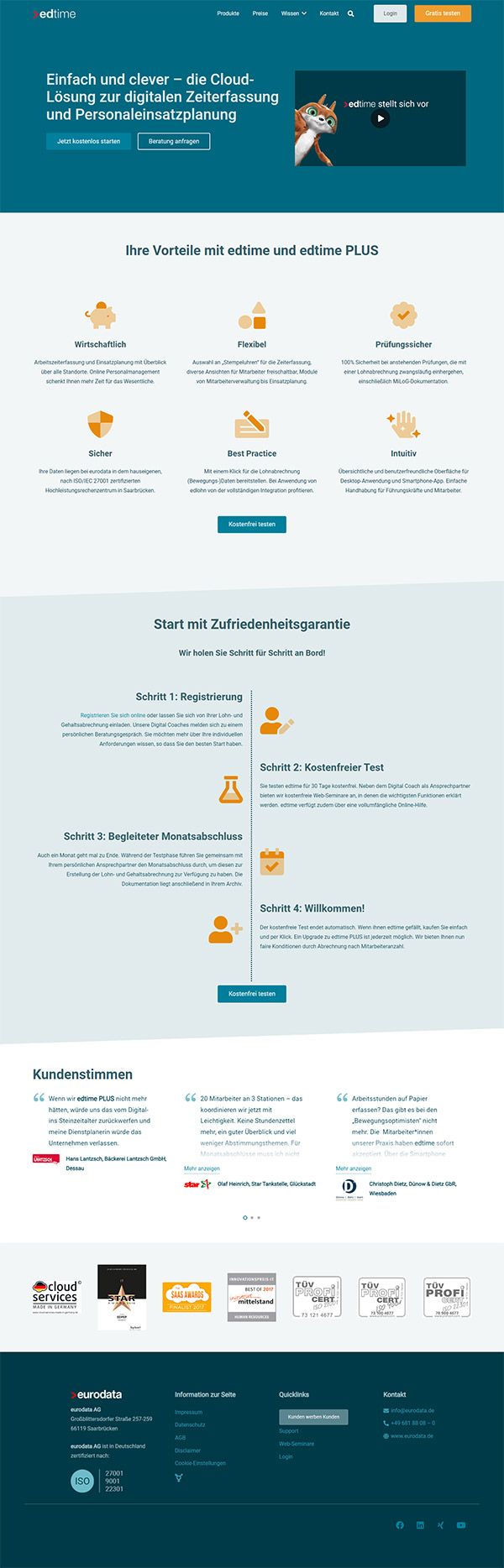
A restaurant manager juggling shift rotas across three locations, a logistics firm trying to prove its drivers were paid for every hour, a retailer that needs clean records when an auditor asks about minimum wage compliance: these are the people who land on edtime.de. The product answers a narrow but persistent headache, which is knowing exactly when staff started and stopped work, and being able to defend those numbers later. It is a cloud time tracking and staff planning tool built and run by eurodata AG out of Saarbrucken, and it stays close to that brief instead of sprawling into a general HR suite.
Time recording and shift scheduling features
The structure of edtime.de is split into two tiers, and the split is sensible. The base tier handles digital time recording: employees clock in through several methods, a mobile app for both iOS and Android lets them stamp from where they actually are, and absences and holidays are tracked in one place. edtime PLUS adds shift and staff scheduling on top, which is the piece a hospitality or retail operation with rotating teams will care about most. Two further modules, a Document Manager and Task Management, sit alongside, so the platform can hold more than raw hours without forcing every customer to pay for parts they will not touch.
German compliance and payroll integration
Where edtime.de gets specific is in the German regulatory detail, and that is its strongest selling point. It produces MiLoG documentation, the records German employers must keep to show compliance with minimum wage law, and the reporting is built to stand up when someone official wants to see it. That compliance angle is not decoration. For a business that has been through a wage audit, having clock data already formatted for inspection is the difference between a stressful afternoon and a non-event. The tie-in with eurodata's own edlohn payroll software closes the loop further, since the hours recorded can flow into payroll without a manual re-entry step.
Data security in a certified facility
Data handling is worth a mention because the company is plain about it. Records for edtime.de sit in an ISO/IEC 27001-certified data center in Saarbrucken, so a German firm wary of where employee information ends up gets an answer it can verify. For staff data, which is sensitive by definition, that certification reassures the people who have to sign off on a new system.
Transparent pricing with guided onboarding
Pricing is laid out in a way that respects the reader's time. There is a base fee, and then 1.75 euros per additional user per month, which makes the cost easy to model for a small team or a growing one. A 30-day free trial is offered with no credit card required, which lowers the barrier to actually testing it against a live week of shifts before any money changes hands. Onboarding is not left to a help article either: edtime.de provides a named "Digital Coach," runs web seminars, and offers guided assistance for month-end closing, the moment when most time-tracking setups either prove themselves or fall apart.
Multi-site operations across hospitality, transport, retail
The customer base edtime.de points to spans businesses of different sizes that share one trait, namely people working across multiple sites. The documented use cases line up with that: hotels and restaurants, transport companies, retail chains, and service firms, all of which deal with staff spread out and shifts that change week to week. That focus tells you who will get the most from it. A single-location office with fixed nine-to-five hours could use edtime.de, but it would be using a fraction of what the PLUS tier and the scheduling tools are built for.
Direct contact with the parent company
Reaching the company behind the product is straightforward. eurodata AG is named openly, with a full street address in Saarbrucken, a phone number, and an email for general enquiries. There is no ambiguity about who you are signing up with or how to reach a human if the trial raises questions, and for a software purchase that will hold your payroll-adjacent data, that transparency counts.
Limited independent reviews available online
The thinner part of the picture is outside validation. On the platforms where business software usually accumulates ratings, edtime.de has very little to show. OMR Reviews lists it but says there are not yet enough reviews to display an overview. SoftwareWorld has a page with no aggregated score.
The Apple App Store entry for the edtime Stempeluhr app has too few ratings to surface a number, and the Google Play listing for the employee app shows nothing in search results. A listing on botw.org carries no reviews either. None of this points to anything negative; it reads as a product that is either young in the public review cycle or simply used by firms who do not write reviews. But a buyer who likes to weigh dozens of independent opinions will not find that crowd here, and the sensible move is to lean harder on the free trial to fill that gap.
Taken together, edtime.de is a focused, credible tool for a clearly defined job, with a parent company that is easy to find and a feature set aimed squarely at German employers who have compliance on their minds. The reservation is the quiet review trail, which means you are judging it more on what it offers than on what peers say about it. For an operations or HR lead at a multi-site hospitality, transport, or retail business in Germany, the practical next step is to start the 30-day trial across one real scheduling cycle and ask the Digital Coach directly how the MiLoG reporting and edlohn handoff would work for your own payroll setup. That single test will tell you more than any star rating could.
Business address
eurodata AG
Großblittersdorfer Str. 257-259,
Saarbrücken,
Saarland
66119
Germany
Contact details
Phone: +49 681 88 08 – 0
Fax: +49 681 88 08 – 300