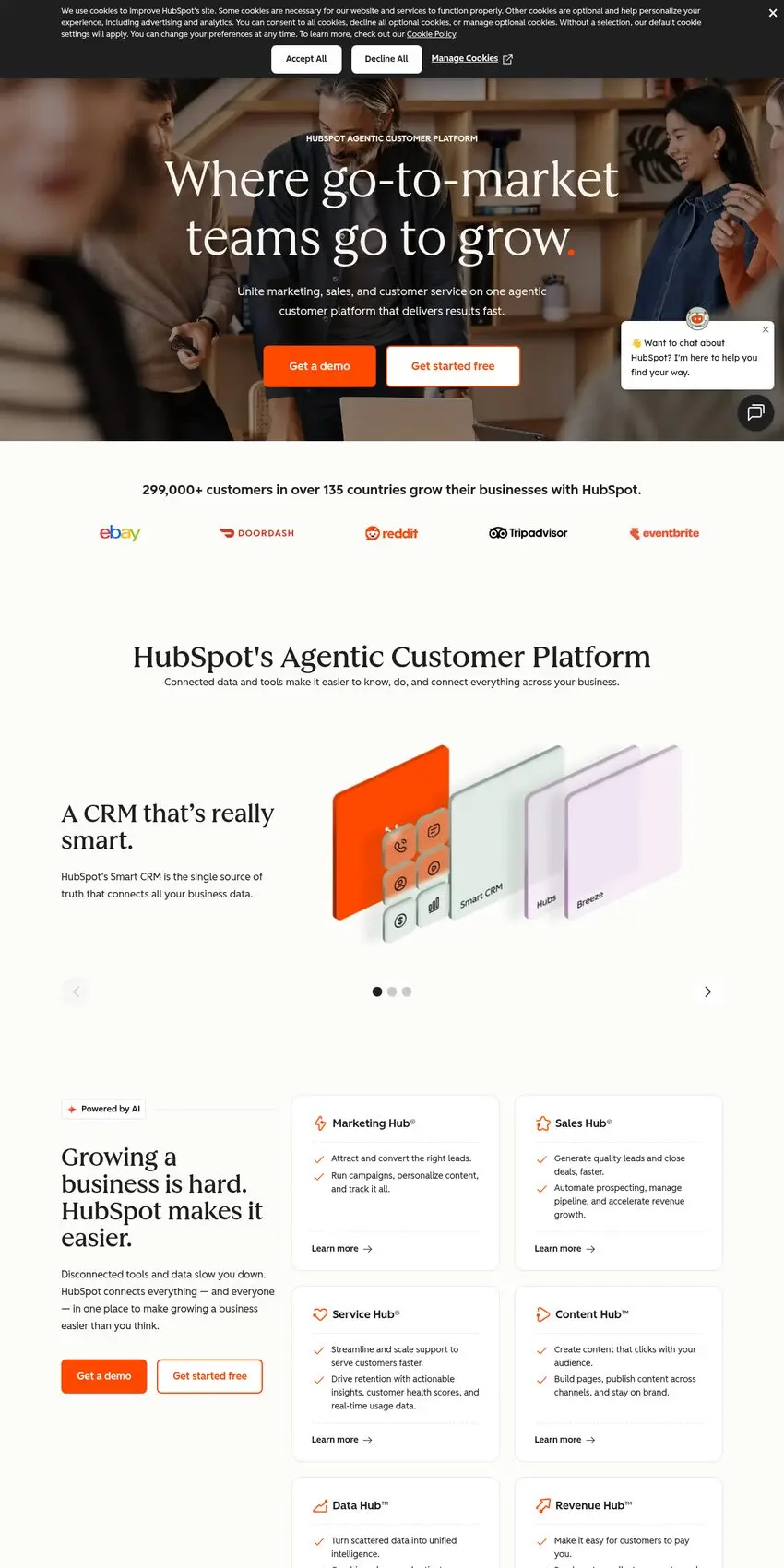
HubSpot is one of the defining software companies of the inbound era, and for a generation of marketers its name is shorthand for an entire methodology. Founded in 2006 by Brian Halligan and Dharmesh Shah, two MIT graduate students who argued that businesses should earn attention with useful content rather than buy it with interruptions, the company grew from a marketing tool into a full customer platform spanning marketing, sales, service, content and operations.
It went public in 2014, serves over two hundred thousand paying customers in more than a hundred and thirty-five countries, and runs from its headquarters at 2 Canal Park in Cambridge, Massachusetts, a short walk from the university where the idea was born.
Platform architecture and product tiers
The product architecture is easy to grasp. At the center sits a CRM that is genuinely free, unlimited users, up to a million contacts, no trial clock, which is the widest funnel entrance in business software. Around it HubSpot sells its Hubs: Marketing Hub for email, automation, forms and ads; Sales Hub for pipelines, sequences and forecasting; Service Hub for tickets and help desks; Content Hub for the website and blogging side; and Operations Hub for data sync and quality.
CRM at the core
Each comes in tiers from free through enterprise, so a two-person shop and a thousand-seat company technically run the same platform. In recent years the company has threaded AI through the suite under the Breeze branding, agents for content, prospecting and service that draw on the CRM record, which is where the platform bet pays off: the data is already in one place.
Pricing structure
Pricing deserves the honest paragraph every HubSpot review owes its reader. The free tier is real and the entry paid tiers are affordable, but costs climb steeply with contact counts and premium tiers, and companies that grow into the enterprise levels sometimes experience the renewal conversation as a shock. The counterargument is consolidation: firms replacing four or five point tools with one platform often come out even or ahead, and the total cost debate versus assembling a stack from separate vendors fills forums on both sides. A buyer should model their contact growth before committing, which is exactly the kind of advice HubSpot's own content, to its credit, tends to give.
Content and community
What makes hubspot.com more than a software brochure is the content and education operation around it. The HubSpot Blog publishes daily across marketing, sales and service topics and ranks for an astonishing share of business-software queries; it syndicates through standard feeds and functions as a free trade publication.
HubSpot Academy certifications
HubSpot Academy offers full certification courses, inbound marketing, content strategy, sales enablement, that hundreds of thousands of professionals have completed and list on their profiles; the certifications have become a modest currency in marketing hiring. None of it requires being a customer. This education flywheel is the company's own inbound thesis applied to itself, and two decades of results suggest it works.
Company transparency
The corporate layer is unusually transparent for the sector. The management page lists the executive team with photographs, the company publishes its culture code publicly, offices and phone numbers are on the contact page, Cambridge headquarters included, and the investor relations section carries the filings a NYSE-listed company owes the record. The social channels are among the largest in business software, with followings in the millions, carrying the educational content rather than pure promotion.
Ecosystem and integrations
The ecosystem around the platform is a business in itself. The App Marketplace connects HubSpot to well over a thousand third-party tools, the standard integrations a stack needs plus the long tail, and the Solutions Partner program sustains thousands of agencies worldwide that implement, migrate and run HubSpot for clients, a channel that both extends the product's reach and employs a small industry of specialists.
INBOUND, the company's annual conference in Boston, has grown into one of the marketing world's marquee events, drawing tens of thousands of attendees and keynote speakers from far outside software. And the community forums, user groups and the developer platform give the platform the durability that pure features never do: when a tool has this many practitioners invested in it professionally, switching costs run in both directions, and buyers weighing HubSpot against newer rivals should count the ecosystem as part of what they are buying.
Within a software category, HubSpot is an anchor entry: a household name in its segment, verifiable in every practical dimension, with a free product a visitor can adopt the same afternoon and an education library worth the visit on its own. The fair comparison set runs from Salesforce above it to a crowd of point tools below, and HubSpot's pitch, one platform, one record of the customer, adoption an actual human can manage, has held up well enough to build a multi-billion dollar company on. For a small or mid-sized business evaluating its first serious CRM, or a marketer building skills between jobs, hubspot.com is one of the few software sites that repays the visit whether or not any money changes hands.






Business address
HubSpot, Inc.
2 Canal Park,
Cambridge,
MA
02141
United States
Contact details
Phone: +1 888 482 7768
An AEO checker tells you whether the AI answers your buyers rely on actually mention your brand. People increasingly ask ChatGPT…
This Scrunch vs. Peec AI comparison evaluates how both tools measure AI answer engine representation across different buyer…
In 2025, most of the major answer engines made an almost identical update. Claude, ChatGPT, Gemini, and many others started to…
Few phenomena within the creator economy have moved as fast as AI’s embrace. What was once treated with anxious suspicion is…