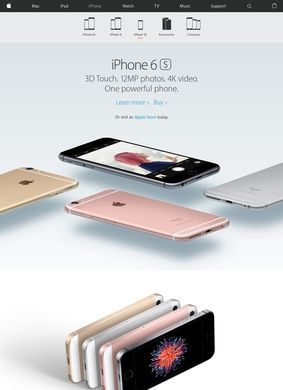
Right now the headline on Apple: iPhone is an Air model the company calls its thinnest phone ever, fitted with internals it puts on par with the Pro tier. That is a strange thing to lead a lineup with, because thinness usually means compromise somewhere, and the page is upfront about exactly how it is selling the trade. The rest of the current range spreads out around it: the iPhone 17 Pro at the top, the standard iPhone 17, an entry-level 17e pitched as feature-dense at a lower price, and last year's iPhone 16 still on sale. Five active lines is a lot to keep straight, and Apple: iPhone does a decent job of separating them by what each one is for.
Five models across the lineup
The Pro is where the spec sheet goes hardest. A heat-forged aluminum unibody, the A19 Pro chip, an 8x optical-quality zoom, 4K video at 120 frames per second in Dolby Vision, and a battery claim of up to 39 hours. Those are concrete numbers, which is more useful than the usual gauzy marketing copy, and the zoom figure in particular is worth checking against independent camera tests before treating it as gospel. The standard 17 steps down to a single A19 chip and 4K at 60fps, but picks up Ceramic Shield 2, which the company says improves scratch resistance threefold. Whether that holds in a pocket full of keys is the open question, but it is at least a claim you can hold them to.
Pro specifications and performance
Across every model the shared baseline is consistent: 5G, the Dynamic Island, the Action button, water and dust resistance, satellite emergency SOS, and Find My. Apple: iPhone treats these as table stakes, which is fair given they have been around for a few cycles. What gets the most floor space is Apple Intelligence, the on-device AI layer running through the whole range.
Shared features on every model
It covers Live Translation inside messaging, a Visual Intelligence feature, a photo Clean Up tool, and a reworked Siri that can hand off to ChatGPT when asked. The privacy framing leans on Private Cloud Compute, the idea being that heavier requests get processed without the data being readable to the company. That is a meaningful distinction if it works as described, and it is the kind of architecture the brand has built a good deal of its recent identity around.
Apple Intelligence on-device AI
Privacy threads through the hardware story too. End-to-end encrypted iMessage, Private Browsing in Safari, Apple Pay that does not expose the card number to the merchant, and a built-in Passwords app are all called out plainly. None of this is new, but having it collected in one place makes the pitch coherent: the phone is sold as much on what it does not leak as on what it can do. Apple: iPhone leans into that framing harder than most product pages from any major manufacturer, and the consistency of the message across five different models is at least a sign they mean it.
Privacy protections in messaging and payments
The buying side of Apple: iPhone is unusually detailed for a product site. Apple Card Monthly Installments at 0% APR, carrier financing through AT&T, T-Mobile, Verizon, and Boost Mobile, and trade-in credits running from $800 to $1,100 for an eligible phone. There is two-hour delivery from a nearby store or free next-day shipping, plus Personal Setup sessions and Guided Shopping with a specialist for anyone who wants a human walking them through the purchase. The trade-in ceiling depends heavily on what you bring in, so the headline figure is best read as a maximum and not a promise.
Financing options and delivery
Where the Apple: iPhone proposition gets stickier is the ecosystem angle. The page makes a point of iPhone Mirroring to a Mac, using the phone as a remote shutter from an Apple Watch, and one-tap pairing with AirPods running Adaptive Audio. These are the small conveniences that quietly lock a buyer in, and the page is candid enough to surface them as selling points rather than burying them in the fine print. If you already own other gear in that ecosystem, this section does most of the persuading on its own.
Ecosystem integration with other Apple devices
The environmental disclosures on Apple: iPhone are specific enough to be useful. The company reports 95% recycled lithium in its batteries, packaging that is now 100% paper, and a stated net-zero target for 2030. The recycled-lithium figure is genuinely high for the consumer electronics industry. As with any corporate sustainability claim, the 2030 goal is the one to revisit over time, since targets are easier to announce than to land, and the page does not go into the supply chain detail that would let you assess it fully.
Environmental commitments through 2030
Taken whole, Apple: iPhone is a clearly organized catalog that gives real numbers instead of adjectives, separates five overlapping models without much confusion, and is candid about financing and trade-in mechanics that other manufacturers tend to soften. The pitch is heaviest on AI and privacy, which is where the company is staking its current position, and lightest on giving you reasons to wait.
Trade-in value as the deciding factor
The Air versus Pro comparison is the decision the page does least to resolve for a buyer who has already narrowed down to those two, and the gap in what happens to battery life and heat under sustained load on the thinner chassis is left to a conversation with a specialist. The trade-in estimator is the single most useful tool on Apple: iPhone for anyone upgrading from an older handset, because that one number can move the real out-of-pocket cost more than any spec difference between models.