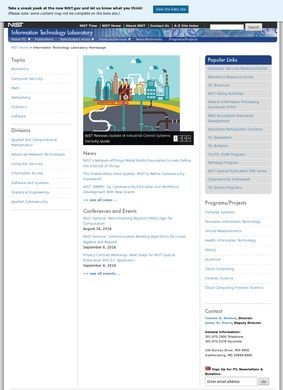
Founded as one of six research laboratories inside the National Institute of Standards and Technology, the Information Technology Laboratory is the U.S. federal measurement agency's operational arm for information technology. Its formal mission is narrow: independent, non-regulatory research, testing, and technical analysis. The practical scope is considerably larger. A large share of the cybersecurity rules American organizations follow, and many that organizations elsewhere borrow, trace back to documents produced here.
Cryptography and security guidance
Start with the cryptography and security guidance, because that is where the lab touches the most people who will never read its name. The Special Publication 800-series is the canonical example. These documents tell federal agencies, and by extension their contractors, how to handle authentication, access control, incident response, and dozens of other controls. Alongside them sit the FIPS cryptographic standards, which decide which algorithms a system can use and still be considered secure under federal rules. When a vendor advertises FIPS validation, the Information Technology Laboratory is the body whose standards they are answering to.
Framing security work for boards and auditors
The Cybersecurity Framework is the other piece most readers will have crossed paths with, even secondhand. It organizes security work into a handful of plain functions that a board or an auditor can follow without a doctorate, and that accessibility is exactly why it spread well past the federal agencies it was written for. Private companies adopted it voluntarily. So did organizations abroad. The framework illustrates how the Information Technology Laboratory tends to operate: produce a reference, keep it free and open, and let adoption follow on merit rather than mandate.
Practical tools for security teams
For most people who arrive here with a real problem, the breadth alone justifies the visit. The National Vulnerability Database is the obvious workhorse, a feed of known software flaws and their severity scores that security teams and tools query constantly. The National Checklist Program supplies hardening baselines for common platforms. The NICE framework maps out the skills and roles that make up a security workforce, which is genuinely useful to anyone trying to hire or train into the field.
Beyond security research divisions
The work also runs wider than security. Beyond the security portfolio, the Information Technology Laboratory keeps research divisions for applied and computational mathematics, statistical engineering, and measurement, and that shows up in resources like the Digital Library of Mathematical Functions, a free and carefully maintained reference for special functions that mathematicians and engineers actually cite. Biometric work is substantial too: fingerprint, face, and iris databases alongside evaluation software used to test how well matching systems perform. The artificial intelligence research, measurement, and standards division has become more visible as the questions around AI testing and trustworthiness have grown louder, and a measurement agency turns out to be a sensible home for that kind of work.
Behind healthcare IT interoperability standards
Healthcare IT gets its own standards and testing resources. The gap in interoperability across medical record systems makes this more consequential than it first appears. Through the National Cybersecurity Center of Excellence, the Information Technology Laboratory runs hands-on projects with private companies and universities, building reference implementations that show how the abstract guidance plays out in a real deployment. That collaboration is the part that keeps published standards from drifting into theory.
Who relies on these standards
The primary audience is U.S. federal agencies, which lean on these standards to meet compliance obligations such as FISMA, but the practical reach is far wider. Private industry uses the same material to harden its own systems, academic researchers cite the measurement work, and international standards bodies often fold the lab's output into their own frameworks. The Information Technology Laboratory also feeds the talent pipeline directly, with internships, postdoctoral fellowships, and university outreach that bring new researchers in.
Check the site before diving in
One fair caution applies: the Information Technology Laboratory's site is deep, technical, and built around documents rather than quick answers. A first-time visitor can feel buried under acronyms and revision numbers, and finding the exact publication you need sometimes takes patience and a search engine. Someone wanting a gentle introduction to a security concept may want a plain-language primer first, then come back here for the authoritative version. The material rewards the effort, but the Information Technology Laboratory makes no attempt to hold your hand through it.
Inside the case for open standards
The depth is also the point of the place, and it is hard to overstate how few organizations produce reference material at this standard and then give it away. The Information Technology Laboratory does measurement, testing, and standards-setting that other institutions cite as the baseline, and the open licensing means a small business and a federal agency are reading the same document. That combination of rigor and access is genuinely rare.
Weighing an alternative framework
Set against a likely alternative, the comparison clarifies what you get here. A team weighing where to ground a security program might also look at the Center for Internet Security and its CIS Controls and benchmarks, which are excellent and notably more prescriptive about specific settings. The two pair well, and many teams use both. Where the Information Technology Laboratory pulls ahead is scope and standing: it covers cryptography, AI, biometrics, and mathematics under one roof, and its standards carry the authority of a federal measurement body, not a single nonprofit's consensus. If you need the source that auditors and other frameworks ultimately point back to, this is it.