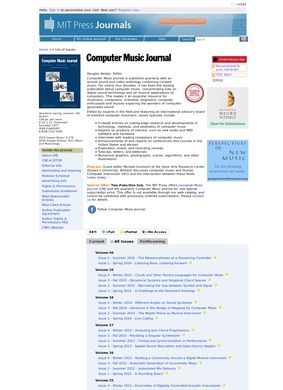
MIT Press Journals is the periodicals arm of the MIT Press, the mission-driven, not-for-profit scholarly publisher that operates as part of the Massachusetts Institute of Technology. Its Journals Division has been running since 1972, and it now puts out more than forty peer-reviewed titles spread across the arts and humanities, the social sciences, and a range of specialized scientific and technical fields.
The address under review complicates the first click, though. The old mitpressjournals.org path ending in loi/comj no longer resolves. It returns a 403 error, and it turns out to be the legacy URL for the Computer Music Journal listing on the previous MIT Press Journals platform. That entire catalog has since moved onto a system the publisher calls the Journals Gateway, hosted at direct.mit.edu. A reader who clicks the listed link lands on a dead end, even though the content behind it is very much alive at the new home.
What sits behind the MIT Press Journals name is a serious catalog, and the title list makes that plain. Computer Music Journal, Computational Linguistics, Artificial Life, African Arts, American Journal of Law and Equality, ARTMargins, and dozens more are browsable by title. The spread is deliberately wide, setting humanities journals beside technical ones under a single publishing operation, which is unusual and says something about the kind of work the press is willing to carry.
Being part of MIT, and running as a not-for-profit, shapes what the catalog is willing to publish. A commercial house tends to chase the fields with the most subscribers, while a university press can keep a low-circulation journal alive because it matters to a discipline, not because it sells. That is the quiet advantage behind a list this varied, and it is why niche titles survive here that would struggle to find a commercial home anywhere else.
What the catalog is built to do
The purpose of MIT Press Journals is narrow and clear. It puts peer-reviewed scholarship in front of the researchers, students, and institutions that need it, in both print and electronic form. That is a different job from a trade publisher chasing a mass audience, and the whole catalog is shaped around it. The reader here is assumed to be working, citing, and building on what they find, so accuracy and standing count for more than reach.
Three features of MIT Press Journals are worth pulling out, because they explain why an academic reader would come to this catalog specifically instead of a general aggregator that pools everyone's work into one searchable pile.
A catalog that crosses disciplines
Range is the first thing. More than forty journals under MIT Press Journals cover arts and humanities alongside social sciences and hard technical fields, so a single publisher carries both African Arts and Computational Linguistics without either feeling out of place. For a university library deciding where to spend a subscription budget, that breadth means one relationship reaches several departments at once, which is a real administrative saving. For an individual researcher, it means a cross-disciplinary search can stay inside one trusted catalog instead of scattering across a dozen publishers of uneven quality and unknown editorial standards.
The mix also tells you the press is not chasing a single lucrative field. A title like ARTMargins and a title like Artificial Life answer to entirely different scholarly communities, and keeping both on the same shelf is a choice about breadth rather than profit.
Standing in specialized fields
Reach counts for little without regard, and here MIT Press Journals has it. Its titles rank highly in fields such as Linguistics and International Security according to recent impact-factor rankings, which is the currency academics actually use when they weigh where to submit a paper and what to cite in one. A journal like Computer Music Journal, the very title the dead link was pointing at, occupies a specific niche that few other publishers serve at all, and its long run gives it a standing that a newer venue cannot simply buy.
That combination, a broad catalog paired with genuine authority in narrow subfields, is what gives the MIT Press Journals name its weight in academic circles.
Impact-factor placement is an imperfect measure, and any honest reader treats it as one signal among several. Still, for a scholar deciding whether a venue is worth the months a submission takes, a strong placement in a serious field is a reasonable proxy for the quality of the review process behind it.
For a doctoral student weighing where to place a first paper, that ranking is one of the few external signals available before the review process even begins, and a serious placement suggests editors and referees who take the work seriously. The listing that started this, Computer Music Journal, is a fair emblem of the whole catalog: a specialized title sitting at the meeting point of music and computing, exactly the sort of cross-field venue that needs a publisher willing to back a narrow, committed readership. That it happens to be the title behind the broken link is almost fitting.
Print, electronic, and the move to the Journals Gateway
Format is the practical piece. MIT Press Journals delivers its content in both print and electronic form, useful for institutions that still archive physical volumes and for readers who want a downloadable article at midnight before a deadline. Neither format is an afterthought, and a library can build its holdings around whichever suits its patrons.
The larger recent change is structural. The catalog migrated off the old mitpressjournals.org platform and onto the Journals Gateway at direct.mit.edu, which is a genuine improvement in access but leaves a trail of broken links behind it. Anyone holding an old bookmark, an old citation, or a directory entry like the one reviewed here has to update the address, because the legacy paths no longer carry through to anything. The catalog survived the move intact. The URLs did not, and that mismatch is exactly what trips a reader arriving from an older listing.
The migration carries a cost that outlives the launch. Years of citations, syllabus links, and saved bookmarks were written against the old mitpressjournals.org addresses, and every one of those now needs a reader to hunt down the new path on direct.mit.edu. Well-run scholarly platforms usually keep redirects in place for exactly this reason, and the 403 the reviewed link returns suggests the old paths are simply gone rather than forwarded, which is the sort of housekeeping detail that quietly frustrates researchers years after the fact.
The audience is worth being precise about. MIT Press Journals is built for people who need peer review to mean something: graduate students learning the standards of a field, faculty citing sources that will hold up under scrutiny, and libraries building collections their patrons depend on. A casual reader wandering in for a quick answer is not who the catalog is for, and the print-and-electronic delivery reflects that, since institutions and serious readers are the ones who still value a permanent, archived version of record.
Judged as a scholarly publishing operation, MIT Press Journals is close to a known quantity. The affiliation with MIT, the not-for-profit footing, the half-century publishing history, and the field rankings all point the same way, and nothing in the record contradicts them. This is precisely the sort of catalog a researcher can cite without a second thought about whether the venue is legitimate, which is more than can be said for a great deal of what circulates online.
The half-century track record matters too, because longevity in scholarly publishing is itself a signal: journals that cut corners on peer review tend not to survive decades of scrutiny from the very academics they publish.
The one real knock is the broken front door. A directory that still lists the loi/comj address is aiming readers at a 403, and the entry would serve them far better pointed at the Journals Gateway on direct.mit.edu. The catalog is strong. The link that is supposed to reach it is stale, and that gap is the only thing standing between a curious reader and everything the publisher actually offers.
A student, a librarian, or a researcher chasing a specific title does best to skip the legacy link entirely and search the current platform, where the MIT Press Journals catalog still lives in full.