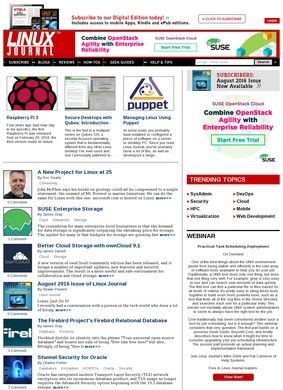
You hit a wall configuring a container runtime, or you need to understand a kernel change before it lands on your production servers, and the surface-level blog posts that fill a search result are too shallow to help. That is the moment Linux Journal aims at. It positions itself as a publication written by and for people who already work in Linux and open source, not for newcomers looking for a first install guide. The depth is the pitch, and most of the time the depth holds.
Topic categories and publication history
Linux Journal runs under Slashdot Media and claims more than twenty-five years of continuous output, calling itself the original magazine of the global open-source community. That heritage line is the sort of thing I usually distrust when a publication prints it about itself, but the archive backs it up, because the brand genuinely predates most of the sites currently competing for the same readers. Content sits in clearly drawn topic areas: Cloud, Containers, Desktop, Kernel, Mobile, Networking, Privacy, Programming, Security, Servers, and System Administration. Those are not decorative labels. Each one maps to a working concern that a sysadmin or developer would carry into their day, and the structure makes it easy to ignore the categories you do not care about and live in the two or three you do.
Coverage for infrastructure readers
The breadth of those categories tells you what kind of reader Linux Journal expects to keep. A site that only chased desktop tweaks would never bother with a Kernel section or a dedicated Servers track. By spreading across networking, privacy, and system administration, the publication is after the person who runs infrastructure, not the person who skins their desktop on a weekend. Privacy as a standing category caught my attention, since plenty of technical outlets treat it as an occasional feature rather than a permanent beat. Keeping it in the front rank says something about the editorial values behind the masthead.
News features and eBooks
What Linux Journal publishes falls into a few shapes. There are news pieces tracking events in the ecosystem, longer technical features that go past the announcement and into the mechanics, and downloadable eBooks for readers who want something more cohesive than a feed of articles. Recent coverage gives a fair sense of the editorial range: a Linux Kernel 7.1 release, governance changes inside the Fedora project, and Ubuntu ARM certification. That mix tells you who the editors write for. The kernel item is the kind of low-level material a serious reader expects, the Fedora governance story shows the publication watching the politics and process of open source, beyond the release notes, and the Ubuntu ARM piece points at where the hardware story is heading.
Reading options across formats
A reader can take the material three ways: straight off the website, through RSS feeds for anyone who still curates their own reading, or as eBooks. The RSS support is a telling sign that Linux Journal knows its audience and has not tried to trap them inside a single app. The eBook format does something the article feed cannot, pulling a subject into one place so a reader can sit with it end to end instead of chasing related posts across a category page. For a working professional who wants a reference on, say, containers or security practice, that packaging is the difference between skimming and learning. It also gives the publication a way to keep older material useful long after it scrolls off the news list.
The intended reader is specific. Linux Journal writes for developers, system administrators, and open-source professionals worldwide, the people who treat a kernel changelog as bedtime reading. That focus is the publication's strength and also its ceiling. If you are trying to learn what Linux is, this is the wrong door. If you already run it and want informed writing from people who do too, the fit is close. There is no attempt here to be a general technology portal, and that discipline keeps the content from drifting into the gadget-roundup filler that pads out so many tech sites.
Credibility signals from ACM reviews
On credibility, the picture around Linux Journal is genuinely mixed. The Association for Computing Machinery indexes the journal, which is a meaningful endorsement, since ACM does not lend its catalog to throwaway content. That indexing alone separates Linux Journal from the broad field of self-published Linux blogs, because it means a recognized professional body treats the title as part of the technical record. A review on DannyReviews.com singles out the writing and editing quality as high, and that tracks with how the features themselves read. Trustburn carries several written user reviews in a positive tone, though without an aggregate score to anchor them, so they amount to scattered approval more than a clear verdict. The site keeps a presence on YouTube, Facebook, and Twitter, which gives readers somewhere to follow updates outside the feed.
Reddit doubts about subscription value
The honest dissent comes from Reddit. In r/linux, long-term subscribers have questioned whether the paid subscription is worth it, and some who go back years describe a decline in quality after the publication shifted to online-only. That is not a fatal charge, since plenty of print institutions stumbled in the same transition, but it deserves to sit in plain view next to the praise. A prospective subscriber should read a stretch of current articles before paying, because the audience that knows this title best is the one raising the question. Weigh the ACM indexing and the editorial polish against that community skepticism, and what you get is a publication worth sampling carefully before any money changes hands.
Reaching Linux Journal is functional but spare. There is a contact form on the site, and the footer carries social links, so a reader who wants to reach the publication has a route. A phone number and physical address are not published anywhere obvious, which is unremarkable for a digital magazine. The form covers what most readers need.
So where does Linux Journal land. As a topical reference for working Linux people the case is solid: the categories are sensible, the recent coverage is current and technically literate, and the ACM index plus the editorial praise give Linux Journal standing that a fresh content farm could not buy. The dissent is worth naming. The subscription value is contested by the very readers who would know, and the heritage claim, while true, does some of the talking that the recent archive should be left to do on its own. A reader weighing whether to pay should treat the free articles as the real test and let those, not the twenty-five-year banner, settle the decision.
Comparing Linux Journal to Phoronix
Set it beside Phoronix, the obvious alternative for a Linux reader who wants depth, and the comparison sharpens things. Phoronix lives and dies on hardware benchmarking and a relentless stream of performance numbers, free to read and updated constantly, which makes it the better stop for anyone chasing the latest kernel regression or GPU driver test. Linux Journal plays a slower, broader game: governance, security thinking, system administration craft, and the kind of feature writing that explains a shift rather than just clocking it. For raw data and frequency, Phoronix wins. For considered, well-edited writing across the wider open-source world, Linux Journal still holds a real claim on the bookmark.