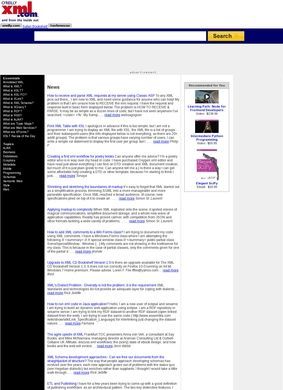
XML.com is a long-running technical publication for people who work with markup languages, run by Textuality Services, Inc. The company belongs to Tim Bray, one of the co-editors of the original XML specification, which tells you something about the editorial pedigree before you read a single article. The site has been a fixture for XML practitioners since the late 1990s, predating a good chunk of the developer documentation hubs that newer programmers grew up with.
Articles on markup technologies
The core of the offering is writing: articles, tutorials, and news that track the technologies orbiting structured markup. The subject coverage is specific in a way the audience will recognize immediately. You will find material on XSLT and XSL-FO for transformation and formatting, XForms for interactive document interfaces, XProc for pipeline processing, and XQuery for querying. There is attention to validation and XML Schema, and the site also covers Invisible XML, a more recent technique for treating arbitrary text as parsable structure. That spread says the editors are keeping pace with where the standards community is actually putting its energy, rather than just maintaining a legacy archive.
What stands out about the topic list is how little of it is filler. The technologies named here are the genuine working parts of the XML world, the ones a content engineer or markup specialist reaches for on a real project. Transformation, querying, schema-driven validation, and pipeline orchestration are the daily concerns of anyone building publishing systems or moving structured data between formats, and the publication treats them as its main beat instead of chasing whatever happens to be trending elsewhere.
The reach extends past the narrow spec-by-spec view into publishing workflows and broader structured-data practice. That framing is useful because XML rarely lives in isolation. It sits inside documentation toolchains, single-source publishing setups, and data interchange between systems, and the articles tend to meet it there. A reader who arrives wanting to understand XSLT in the abstract can leave with a sense of how it fits a working pipeline, which is the harder and more valuable thing to teach.
Writer credentials and editorial standards
Depth like this is also a function of who writes it. The site keeps author profiles and publishes contributor guidelines, so the writing comes from named practitioners rather than an anonymous content mill. For a technical reader, knowing who is behind a tutorial on XProc or XQuery changes how much authority it carries. The editorial gate, combined with Bray's name at the top, is the kind of provenance that separates a reference worth bookmarking from a pile of search-engine bait.
Community channels and job board
Beyond the published articles, the site runs a few mechanisms for staying in the loop. There is a Slack workspace for the XML community, which gives the publication a live counterpart to its written archive and a place where practitioners can trade problems in real time. Email subscription handles notification when new articles land, and RSS feeds are offered for both articles and news, so readers who still run a feed reader, and many engineers do, can pull updates without checking the homepage.
The site also operates a job board aimed at XML-related employment. That is a practical touch and a small sign of health: a publication only bothers maintaining a niche job board if there is a working audience of employers and specialists on both sides of it. For someone whose career runs through markup technologies, having postings concentrated in one trusted place beats sifting general developer boards where XML roles get buried.
The contributor path deserves a mention of its own. Open submission guidelines mean the knowledge base grows from field practitioners, not a fixed in-house staff, and that tends to keep the coverage broad and current as new techniques like Invisible XML gain traction. It is a model that has kept the site relevant across more than two decades, through several waves of competing data formats that were each supposed to make XML obsolete and mostly did not.
Scope and audience fit
Worth noting is what the site is not. It does not try to be a general programming portal or pad its scope with adjacent topics to chase a wider readership. The focus stays on markup, transformation, validation, and the publishing problems that surround them, and that discipline is part of why it remains a credible reference. A specialist site that knows its lane serves its audience better than one that covers everything at surface level.
Continuity across decades
For the reader, the practical value is consistency. The same place that explained XSLT basics years ago is still explaining newer additions to the toolkit with the same editorial care, so a developer can build a mental map of the whole ecosystem from a single source instead of stitching together blog posts of uncertain authorship. That continuity, in a corner of computing where documentation often goes stale or vanishes, is genuinely hard to come by.
If there is a limit, it is the natural one of a focused publication: someone who only occasionally touches XML may find the depth more than they need, and the material assumes a reader who already understands why structured markup has a place in serious work. This is a resource for practitioners, written at the level practitioners expect. That is a feature for its intended audience and simply a poor fit for a casual passerby looking for a five-minute primer.
The practical next step is to browse the article and news archive for the specific XML technology in front of you, subscribe to the RSS or email feed to catch new pieces, and join the community Slack workspace if you want a place to ask the questions the articles do not answer. Two-plus decades in, it remains one of the more reliable places to learn the craft and keep up with where the field is heading.