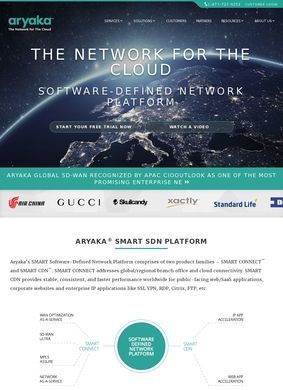
Aryaka's whole pitch rests on one technical choice that sets it apart from most rivals: it does not route enterprise traffic across the public internet. Instead it runs a global private Layer 2 backbone, dotted with Points of Presence around the world, and pushes everything through that. The practical claim is lower latency than the internet-based SD-WAN products that dominate the category. Whether that advantage matters to a given buyer depends entirely on how far their offices and cloud workloads sit from each other, but it is a real engineering distinction and not a positioning trick.
Private backbone architecture
The product line has grown into what the company calls a Unified SASE platform, which bundles several things that enterprises usually buy and stitch together separately. There is SD-WAN, pitched directly as a replacement for legacy MPLS circuits. Alongside it sit a NextGen Firewall, Zero Trust Network Access, and acceleration layers for multi-cloud, SaaS, and more recently AI and GenAI applications. Pulling firewall, secure access, and wide-area networking under one managed roof is the central idea, and the site is careful to frame the whole thing as delivered and operated end to end by Aryaka rather than handed over for the customer's own team to run.
Unified SASE platform
That managed angle shapes who this is for. A company that wants to own and tune every box on its network will find Aryaka confining. A global manufacturer or a logistics operator with sites in a dozen countries and a stretched IT bench is closer to the target. The site names manufacturing, transportation and logistics, and professional services as its core industries, and the emphasis throughout is on multinational organisations with offices that need to talk to each other and to cloud platforms reliably across long distances. Smaller or single-site businesses are not really the audience here, and the material does not pretend otherwise.
Target customers and industries
Beyond the product pages, there is decent substance to work through. A guided product tour lets a visitor see the platform without booking a call first, which is a genuine differentiator, since plenty of enterprise vendors lock everything behind a sales form. Case studies, webinars, and a threat research section round out the picture, the last of those being a sensible inclusion for a company selling firewalls and zero-trust access. There is also a "Secure Networking Academy," which reads as an attempt to teach the underlying concepts and not purely sell against them.
Educational resources and customer support
Operationally, Aryaka points existing customers to a portal at my.aryaka.com and keeps a separate community space for partners. The site runs in eight languages, consistent with a vendor chasing genuinely global accounts. The documentation depth suggests a product that has been in the field long enough to accumulate real reference material, and a prospective buyer can do a fair amount of homework through the business directory listing and the Aryaka site before any conversation with a sales team.
One contact point is fair to note, mostly because it cuts against the "fully managed, we handle everything" message. The homepage carries no phone number and no physical address. Reaching Aryaka means going through a contact form or the "Book A Demo" page, both of which are easy enough to find. For a self-service tool that would be unremarkable. For a vendor whose whole proposition is hands-on operation of your network, a visible phone line would reassure the kind of buyer who wants to know a human picks up. Form-based contact is the norm in B2B, so this is a minor observation.
Comparing verified ratings across platforms
On Gartner Peer Insights, the SD-WAN category gives Aryaka 4.7 out of 5 across more than two hundred reviews. That is a meaningful sample of verified enterprise customers rather than a handful of testimonials, and it is the number prospective buyers should anchor on. The same 4.7 shows up under Global WAN Services, though across only six ratings there, so that figure is far less useful. G2 lists reviews as well, with the exact count not surfacing cleanly from what was accessible.
Employee feedback tells a more mixed story, and it is worth separating from the customer view. Glassdoor shows 3.5 out of 5 on work-life balance with 48 percent of staff recommending the place, and AmbitionBox lands at 3.1 across 63 reviews. Those are middling figures. They say little about whether Aryaka's network performs and more about the experience of working inside the company. A buyer evaluating the platform should weight the customer-side Gartner scores far more heavily than the staff ratings, while being aware that morale and retention can eventually touch the quality of a managed service.
Put together, the case for Aryaka is coherent and unusually consistent: a private backbone instead of the open internet, a single managed platform covering networking and security, strong verified customer ratings, and enough public documentation to evaluate it seriously. The weak points are narrow. Limited contact transparency on the homepage and middling employee sentiment are both real, neither is disqualifying. A large multinational shopping for a managed SASE provider would be remiss to leave Aryaka off a shortlist. The decision ultimately comes down to one question only the buyer can settle from their own traffic data: does traffic travel far enough across enough scattered sites that a private global backbone justifies its premium over a cheaper internet-based alternative.