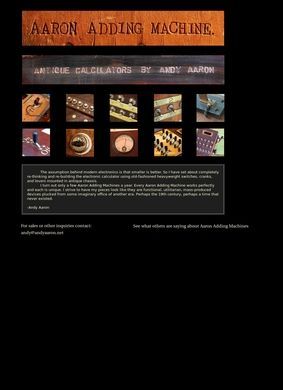
Aaron Adding Machine is a one-man workshop run by Andy Aaron that builds working electronic calculators by hand, sold online through aaronaddingmachines.com. The premise takes a moment to register: these are functioning machines dressed up to look like adding equipment from a past that never existed. Heavy switches, cranks, and levers do the visible work, while modern electronics handle the arithmetic underneath. The result sits somewhere between a calculator, a sculpture, and a prop, and that is exactly the point.
The output is deliberately tiny. Andy Aaron makes only a handful of units in a year, and each one is described as a single object with no twin. That scarcity shapes everything else about the operation. There is no inventory page in the usual sense, no shopping cart stacked with variants, no promise of next-day shipping. What the site does instead is document the pieces that exist or have existed, and let the craftsmanship carry the argument on its own.
Gallery structure and documentation
The documentation behind Aaron Adding Machine runs across ten numbered galleries, each given over to a particular machine. These galleries are the core of the site and the main reason to visit. They show the designs from several angles, which is essential when the whole appeal rests on physical detail: the finish on a lever, the typeface of a label, the heft implied by a chunk of metal switchgear. Anyone drawn to the work needs to see it closely, and the gallery structure is built around exactly that. Ten separate galleries also say something about pacing. This is not a flood of product. It is a slow, sequential record of individual builds, and the numbered structure makes clear that Aaron Adding Machine is an ongoing project rather than a finished catalogue.
Customer reviews on the site
Alongside the galleries there is a customer reviews page, a sensible inclusion for a maker selling rare, high-touch objects to people who will never hold the item before buying. For a product like this, knowing that other buyers received what they expected carries genuine reassurance. The catch is that those testimonials live on the site itself, under the seller's control, so they function more as social proof than as independent verification. A prospective buyer should read them for what they are and weight them accordingly.
Absence of external verification
Looking outside the site itself, the picture is genuinely sparse. A search for Aaron Adding Machine turns up no independent reviews on Google, Trustpilot, Yelp, the BBB, or the usual rating platforms. The names that do surface belong to other businesses entirely: a machine shop in Calgary and the well-known rental chain, neither of which has anything to do with this workshop. Aside from a directory entry, there is no external chatter at all. For a novelty operation that produces a few items annually and never advertises at scale, that absence is not surprising and should not be read as a red flag on its own. It does mean a buyer is working without a public track record to fall back on, and that is worth stating plainly.
Contact and accessibility
Contact is where Aaron Adding Machine shows its size most clearly. The only route offered is a single email address tied to Andy Aaron's own domain. There is no phone number, no street address, no contact page or form. For a one-person workshop making bespoke objects, email-only is a defensible choice, and a missing public phone line is not unusual for a maker who wants to vet enquiries carefully before taking on a build. Still, the absence of any physical address or structured contact route is a real limitation for someone spending serious money on a custom piece sight unseen. There is no straightforward way to confirm where the work is done or to reach the maker if email goes unanswered.
Aaron Adding Machine sets expectations honestly. It does not pretend to be a store with stock on shelves. It presents itself as a collector item and a novelty, the kind of thing bought because it is strange and beautifully made, not because anyone needs another calculator. That framing is the right one, and it keeps the whole presentation coherent. The galleries support the pitch, the limited run supports the pricing logic that such objects usually carry, and the styling commits fully to the invented-vintage conceit rather than hedging it with modern product-page conventions.
Design language across builds
The aesthetic itself deserves credit. Building a machine that looks like office equipment from an imaginary era is a tighter design problem than copying a real antique, because there is no original to lean on. Every detail has to be invented in a way that reads as plausible old hardware while still working as a functional calculator. The numbered galleries show that Andy Aaron has been iterating on this problem across multiple builds, refining a visual language unique to Aaron Adding Machine. For someone who collects industrial design oddities or kinetic objects, that accumulated iteration is a meaningful part of the appeal, not mere decoration.
Who this maker serves
The intended audience for Aaron Adding Machine is narrow on purpose: collectors of unusual mechanical objects, people who appreciate the feel of switches and cranks, buyers who treat a desk piece as a conversation object. For that buyer, the site delivers what they would want to evaluate before reaching out. Ten distinct designs sit in detail, and the maker's hand comes through clearly across all of them. The site does not try to pull in anyone else, which is itself a kind of honesty that mass-market product pages rarely manage.
The weaknesses of Aaron Adding Machine are the direct flip side of its strengths. A solo maker means low volume, slow turnaround, and a single point of contact with no fallback. The sparse external footprint means no independent verification of quality, delivery, or after-sale service. The email-only setup means a buyer has to extend a fair amount of trust to a maker they cannot easily research through outside sources. None of these are signs of wrongdoing; they are the structural traits of a tiny artisan venture, and they will read as either charming or risky depending entirely on the buyer's situation and appetite.
So the verdict is genuinely mixed. Aaron Adding Machine presents a clear, well-executed idea and the galleries do the job of selling handmade objects to people who care about handmade objects. The work looks accomplished and the positioning is honest about what is being offered. What limits a stronger endorsement is everything around the work itself: no outside reviews to draw on, contact reduced to one email address, and a scale so small that buyers are largely placing trust in the maker directly. A collector who already finds the concept irresistible may find that trade perfectly acceptable. Anyone wanting a public track record or a fallback if something goes wrong will find those missing, and that gap should factor into the decision.