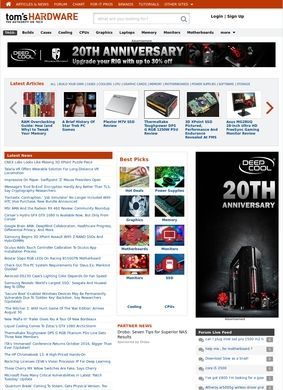
You have settled on a budget for a new GPU, but the spec sheet from the manufacturer tells you nothing about how the card behaves under a real gaming load, how loud the fan gets, or whether it throttles after twenty minutes. That gap between marketing numbers and lived performance is exactly the gap Tom's Hardware has spent its life closing. The site publishes long-form reviews of components and finished machines, and the reviews lean on measured results: frame rates, thermals, power draw, noise. For a builder trying to decide between two cards a generation apart, that data is the deciding factor.
Component reviews with measured performance data
The coverage is wide. Processors and graphics cards get the heaviest attention, which makes sense given how often those parts change, but the site also works through memory, storage drives, cooling solutions, power supplies, and motherboards. Peripherals are not an afterthought either: monitors, keyboards, mice, and headsets all get tested. If a part goes inside a desktop or sits on the desk next to it, there is a reasonable chance someone at Tom's Hardware has put it through a bench run and written up the result.
Coverage across PC hardware categories
Reviews are the public face, but the comparative data underneath is where Tom's Hardware does something most outlets do not. The Bench Database collects benchmark figures across many parts so a reader can line up two CPUs or two graphics cards directly instead of squinting at separate articles published months apart. For anyone who has tried to compare a part bought this year against one from two years ago, having those numbers in one consistent place saves real effort.
Benchmark database for part comparison
That database sits behind the paid Premium tier, which is worth being clear about. Free membership covers the reviews, the community forums, and member badges, and for a lot of readers that is plenty. Premium adds the Bench Database, hardware roadmaps that track upcoming product releases, deeper analysis reports, and a premium newsletter. The split is honest: the Tom's Hardware journalism is free, and the structured tooling that takes ongoing work to maintain costs money. Readers can decide whether the roadmap tracking and comparative data justify the fee for how they actually shop and build.
Free membership versus Premium tier features
The buying guides deserve a mention on their own. These pieces rank options within a category and a price band, which is the form most useful to someone who already knows they need, say, a mid-range cooler but has not narrowed the field. The guides get revisited as new hardware lands, so they reflect the current market instead of last year's lineup. There is also a running aggregation of coupon and discount codes for tech retailers, a practical touch for readers ready to buy once they have settled on a part.
Buying guides and discount code aggregation
Beyond the lab, Tom's Hardware runs a steady stream of news about the chip and PC industry. Product launches, supply shifts, manufacturer announcements, and the growing overlap between hardware and AI all get covered. Software developments appear alongside the silicon, which tracks with how the field has moved: the question of what a graphics card can do increasingly depends on what the software stack asks of it. A reader who wants context for why a launch matters, beyond the spec list, gets it here.
Why does hardware context matter alongside specs?
The publication has run since 1996, and that longevity shows in how often its testing is cited. Hardware makers, OEMs, and enthusiast communities treat Tom's Hardware benchmark results as a reference point, meaningful in a space crowded with pages that do little more than restate manufacturer specs. Ownership sits with Future plc, a UK specialist media group with a large stable of technology titles, so the operation has the backing of an established publisher.
It is fair to note the reading experience reflects an ad-supported, high-volume media site. The news cadence is fast and the page can feel busy, and the most genuinely useful structured material, the comparative bench data and the roadmaps, is the part you pay for. None of that undercuts the core value, but a reader expecting every tool for free should know the line before they go looking for it.
For a PC builder or upgrader weighing a specific purchase, Tom's Hardware is one of the more dependable places to check, especially when the decision hinges on measured performance rather than a spec sheet. Start with the buying guide for the category you are shopping, cross-reference the individual review of any part that makes the shortlist, and if you find yourself comparing parts across several generations often enough that the back-and-forth gets tedious, the Bench Database in the Premium tier is the feature most likely to pay for itself. The free side covers most casual research; the paid tools are built for the kind of frequent, cross-generation comparison that the free articles alone cannot support efficiently.