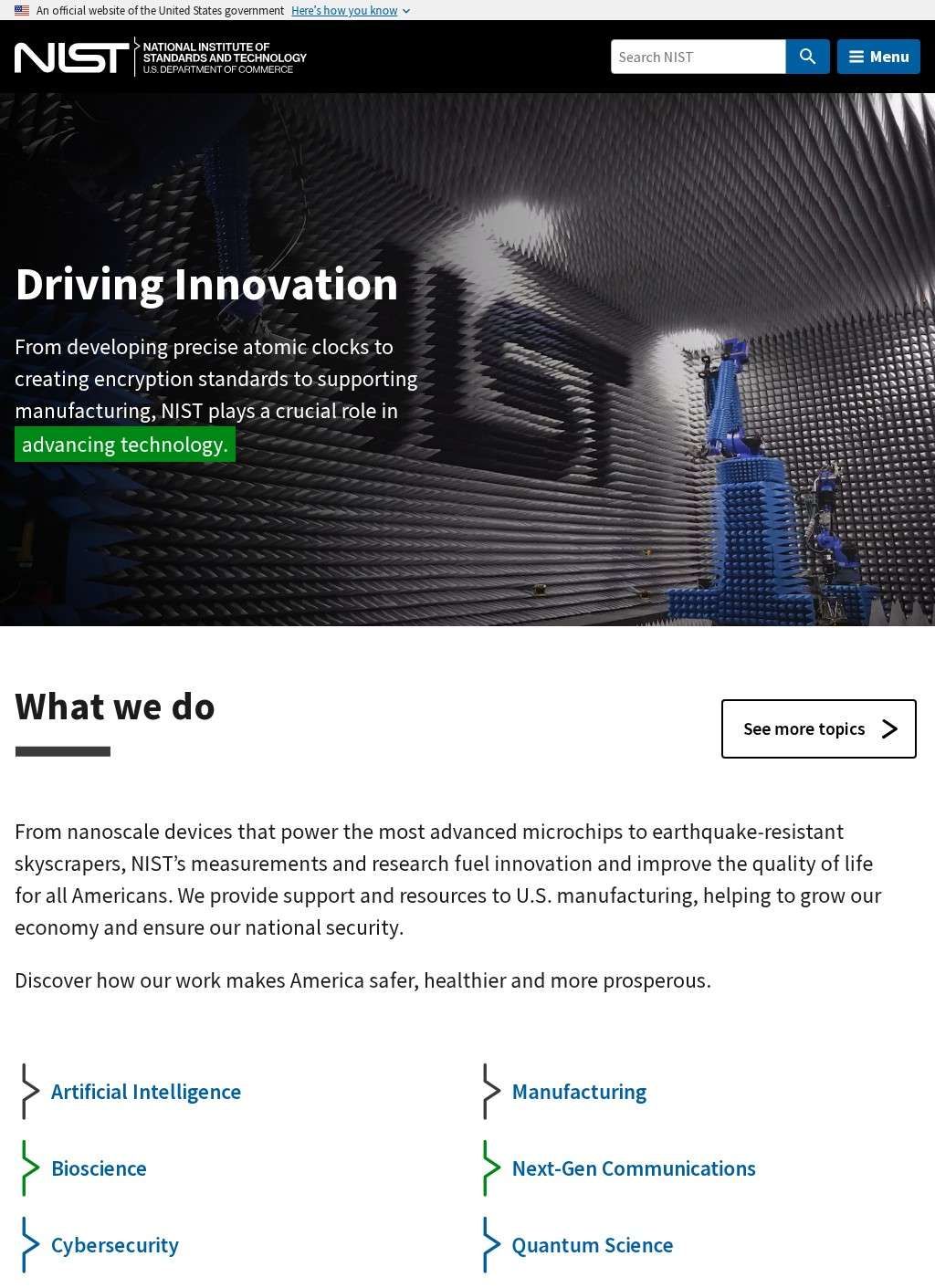
Ask where the official second comes from, and the answer is the National Institute of Standards and Technology (NIST). The kilogram, the volt, the precise frequency that keeps GPS satellites and power grids synchronized all trace back to the same authority. This is the U.S. federal agency, sitting under the Department of Commerce, that runs the country's national measurement institute, and that single role explains why so much of American science and industry quietly depends on its output. A laboratory calibrating an instrument, a manufacturer proving a part meets spec, a cryptographer choosing an algorithm: the reference point at the bottom of each of those decisions tends to go back to the National Institute of Standards and Technology (NIST).
Five laboratories and scientific domains
What the site gives a visitor is access to that reference apparatus, spread across more than twenty scientific domains. The list runs through artificial intelligence, cybersecurity, quantum science, advanced manufacturing, energy, and materials science, and each of those areas is developed in genuine depth. The technical work at the National Institute of Standards and Technology (NIST) is organized through five major laboratories, named plainly: the Communications Technology Laboratory, the Engineering Laboratory, the Information Technology Laboratory, the Material Measurement Laboratory, and the Physical Measurement Laboratory. On top of those sit user facilities, including the NIST Center for Neutron Research, which outside researchers can apply to use for experiments that demand that kind of instrument.
Standards for data storage and security
Because this listing files the National Institute of Standards and Technology (NIST) under data storage, the most relevant material is the standards and guidelines published for the technology sector. The NIST Cybersecurity Framework is the best known of these, widely adopted well beyond government, and it sits alongside the Federal Information Processing Standards, the FIPS series, and the long-running Special Publications in the SP 800 series. Those publications cover data security, cryptography, cloud computing, and the integrity of storage systems, which is to say the unglamorous rules that decide whether stored data can be trusted years from now. Anyone responsible for compliance has almost certainly read one of these documents, often without thinking about where it came from.
Behind the cryptography standards
The cryptography work at the National Institute of Standards and Technology (NIST) deserves its own note. When the agency settles on an algorithm or a key standard, that choice ripples out into commercial products, federal systems, and a fair amount of the internet's plumbing. I find it genuinely useful that the source documents are public and free to read instead of locked behind a standards-body paywall, because it means the reasoning can be checked rather than taken on faith. The publications archive and the research library extend this further, holding the back catalog for anyone tracing how a given standard evolved.
Calibration services and reference materials
Beyond the documents, the National Institute of Standards and Technology (NIST) runs services that put measurement into practice. There are calibration services and laboratory accreditation programs, Standard Reference Materials (SRMs), which are physical samples with certified properties that labs buy to check their own equipment. The site also hosts chemical fingerprint databases, software tools, and physical reference data repositories, plus time and frequency services that distribute the official time many systems synchronize against. Together these are working tools, the physical and digital infrastructure rather than commentary about it. A lab that buys an SRM is paying for a known quantity it can build its own confidence on, and that chain of traceability is the quiet thing the agency sells.
From semiconductors to quality management
The agency's mandate stretches past pure measurement into programs that touch the wider economy. CHIPS for America, the semiconductor manufacturing initiative, is administered through the National Institute of Standards and Technology (NIST), which is a substantial responsibility given how much money and policy attention sits behind domestic chip production. The Baldrige Performance Excellence Program covers organizational quality and management, a different flavor of standard than a cryptographic one but a standard nonetheless.
Support for small manufacturers
The Manufacturing Extension Partnership, or MEP, is the part worth pointing a small business toward first. It exists to help small and mid-sized manufacturers, the firms least likely to have in-house standards expertise, and the practical reach it offers is more directly relevant to a lot of working companies than the headline laboratory science. A shop owner trying to win a contract that demands certified processes lives in MEP's world, not in neutron scattering. The Baldrige and MEP programs are also the clearest sign that the mandate goes beyond physics. Some of it is about helping organizations run better, which is a softer goal than defining the meter but no less deliberate.
Who the site serves
The breadth raises a fair question about who the site is really built for. The audience the National Institute of Standards and Technology (NIST) names for itself is wide: researchers, engineers, manufacturers, federal agencies, policymakers, students, and industry professionals chasing standards compliance, precision measurement infrastructure, or technical guidance. That is a lot of distinct readers to serve from one front door, and the site does more to reward expertise than to build it.
Finding your way through the material
For a specialist who already knows the publication number or the laboratory they need, the depth is a gift. You go straight to the SP 800 document, the SRM catalog entry, or the lab page and the material is there, authoritative and complete. The agency assumes a reader who can navigate by knowing what to ask for, and for that reader the National Institute of Standards and Technology (NIST) is close to indispensable. The student or the small manufacturer arriving without that vocabulary faces a harder climb. The sheer number of programs, laboratories, databases, and document series that the National Institute of Standards and Technology (NIST) maintains can read as a wall before it reads as a map, and knowing it all exists is a different thing from knowing how to reach the one piece you need.
Weighing depth against accessibility
None of this dents the credibility of the work, which is about as solid as technical resources get. What I keep circling back to is whether the people who would benefit most from the practical programs, the MEP clients and the newcomers to compliance, can find their way to them before the depth turns into noise. The standards are sound. The measurements are exact. Whether the breadth that makes the National Institute of Standards and Technology (NIST) so authoritative also keeps part of its intended audience at arm's length is the doubt I cannot quite put down.