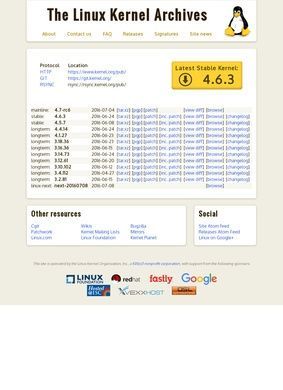
Where does the actual source code for Linux come from, the real thing that distributions build on top of? The answer is The Linux Kernel Archives, the official distribution point run by the Linux Kernel Organization, a 501(c)3 nonprofit. Every kernel tarball that downstream projects pull, patch, and ship traces back here. The site exists to serve a fairly narrow but enormous audience: kernel developers, system administrators, and the contributors scattered across the world who write, test, and maintain the code that runs underneath most of the internet.
Download channels for kernel releases
The core function is plain and unglamorous, which is the point. You come to download kernel source, and The Linux Kernel Archives hands it to you across several release channels that map to how people actually use the kernel. Mainline is where active development happens, the bleeding edge. Stable is the production-ready line. Longterm support releases, the LTS channel, is what you reach for when you need something patched for years rather than months, a real consideration for anyone running fleets of servers or shipping embedded devices. Then there is linux-next, the staging ground where upcoming features get integrated before they land in mainline. Sorting these into clear channels saves a newcomer from guessing which version is safe to deploy.
Verifying source code integrity
Every release ships with a PGP signature, so you can cryptographically verify that the source you pulled is the source the maintainers actually published and that nothing was tampered with in transit or on a mirror. For a codebase this consequential, that verification is no nicety. A compromised kernel source would be a catastrophe rippling out to millions of machines, and the signature files, along with a dedicated Signatures section explaining the process, treat that threat as real. The Linux Kernel Archives takes that verification seriously, and it shows in the documentation it wraps around the process.
Access methods and distribution
Beyond the full tarballs, the archive carries patches, diffs, and changelogs for each release, so you do not have to re-download a whole tree to move between versions or to read exactly what changed. Access is offered three ways: plain HTTP under kernel.org/pub for a quick grab, Git via git.kernel.org for anyone working against the live history, and rsync for mirroring or scripted syncs. Each method suits a different workflow, and The Linux Kernel Archives does not pretend one size fits all.
Development infrastructure and community
The reach of The Linux Kernel Archives extends past the files themselves into the working machinery of kernel development. Linked from the site are the Git Trees where the actual history lives, the kernel Documentation, and the Linux Kernel Mailing Lists (the LKML), which is still the central nervous system of how decisions get argued out and made. Patchwork tracks patches as they move through review. Bugzilla handles bug tracking. There are Wikis for the accumulated institutional knowledge that never fits neatly into formal docs. None of this is flashy, and none of it tries to be. It is the plumbing of a project that has run on email and version control for decades and sees no reason to dress that up.
Navigation matches the audience. The sections are About, Contact, FAQ, Releases, Signatures, and Site News, with Atom feeds layered on so you can subscribe to release tracking instead of refreshing a page. A developer who needs to know the moment a new stable kernel drops can wire the feed into their tooling and never visit the site by hand again. That is a sensible way to treat people whose time is spent in terminals, not browsers.
Sponsorship and global delivery
It is worth naming who keeps the lights on, because the scale of distribution here is not free. Infrastructure for The Linux Kernel Archives is sponsored by Akamai, Google, Red Hat, and The Linux Foundation. Serving kernel source to the entire planet, around the clock, with cryptographic integrity intact, is a real logistical load, and that backing is why a download never stalls regardless of where in the world the request originates.
What strikes me about The Linux Kernel Archives is how little it has changed in spirit even as everything built on top of it grew vast. There is no marketing layer, no funnel, no attempt to be anything other than the canonical place to get the code. The FAQ answers the questions people genuinely ask, the Site News records what shifted, and the release pages list versions with the dry precision of a build server. For its intended visitor, that restraint is a feature. Nobody arriving at kernel.org wants to be sold to; they want the right tarball, a signature to check it against, and a changelog that tells the truth.
The Linux Kernel Archives also draws a clean line between distribution and development. The tarballs and signatures are the archive's own job. The mailing lists, Patchwork, Bugzilla, and the Git trees are where the work happens, and The Linux Kernel Archives connects you to them without trying to absorb them. That separation keeps the download experience fast and uncluttered while still acting as a front door to the wider ecosystem. Someone who arrives needing only a stable LTS source is not forced to wade through developer tooling, and someone who needs to file a bug or follow a patch is one click from the right place.
The Linux Kernel Archives does not generate consumer reviews; it is not that kind of site. A search finds no entries on general-public review platforms, which is exactly what you would expect for infrastructure used almost exclusively by technical practitioners who discuss it in mailing lists, conference talks, and Git commit messages rather than star ratings. The authority it carries comes from the code itself and from decades of reliable uptime.
The Linux Kernel Archives is less a website to browse than a utility to rely on. The longterm channel alone makes it indispensable to anyone maintaining systems they cannot afford to break. The Linux Kernel Archives carries the full release history, the cryptographic proof, and the links into the rooms where the kernel is actually argued into existence. A stable release sits there with its signature beside it, patches and changelog one line down, ready for whoever needs to build.