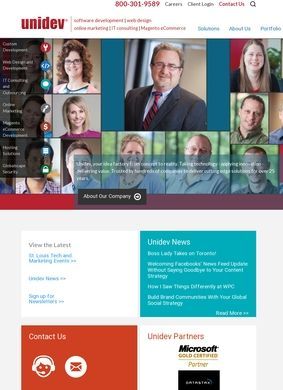
Build versus buy is how Unidev opens most conversations with prospects, and that framing alone tells you something about how the firm operates. Unified Development, Inc., trading as Unidev, is a custom software shop out of St. Louis. Its pitch is less about selling a single product and more about sitting with a client to figure out whether a piece of software should be written from scratch or bought off the shelf. That is a consulting instinct as much as a coding one, and it sets the tone for a site aimed squarely at companies that already have a technical problem and want a partner to scope it.
Services spanning custom development to managed support
The service list is broad without being scattered. Custom software development spans .NET, Java, JavaScript, and PHP, with internet-of-things work listed alongside the more conventional stacks. Mobile development covers Android, iOS, and cross-platform builds. Beyond that, Unidev offers business intelligence work, IT staff augmentation, and managed application services, the last of which is the kind of ongoing support contract that keeps a software vendor in a client's life long after the initial delivery. Taken together it reads as a firm that can build a thing and then keep it running, a combination mid-sized companies without a deep internal engineering bench tend to need.
Embedding engineers into client teams
Staff augmentation deserves its own mention because it changes the nature of the relationship. Instead of handing over a finished application, Unidev can embed engineers into a client's own team for a defined stretch. That model suits a business with an existing project that has stalled or a roadmap that is outpacing hiring. It also reflects something honest about how the firm sees demand: not every engagement is a greenfield rebuild, and some clients just need capable hands on a timeline that cannot wait for a full recruitment cycle. The willingness to offer that arrangement positions Unidev somewhere between a pure outsourced vendor and an extended internal team, which gives clients more flexibility in how they structure the engagement.
Found via this business directory, Unidev's website does more than list capabilities. There are case studies, which are the most useful thing a development firm can publish, because they let a prospective client see the shape of past work instead of taking the services menu on faith. There is a blog, there are team profiles that put names and faces to the company, and there is a careers section. That last item is a quiet signal that the firm is staffed and actively hiring rather than a front for a handful of contractors.
Tech support runs through a Jira service desk, which is a deliberate and slightly telling choice. It means existing clients log tickets through a real tracking system and get a paper trail, no chasing an email inbox hoping someone picks it up. For a managed-services provider that is the right plumbing, and it suggests the support side is run with some discipline. Strategy consultations can be booked online, so the path from curious visitor to first conversation is short. Unidev has clearly thought about how a passing reader becomes a scheduled call.
Headquartered at Two CityPlace Drive in St. Louis, Unidev leans on its Missouri base without pretending to be a coastal heavyweight. The build-vs-buy advisory, the IoT line, and the BI work point at a generalist that can flex across industries. The stated aim of helping clients increase revenue and competitive reach is the usual outcome language any consultancy uses, and that part is unremarkable. The concrete services underneath it are what carry the page.
On contact, Unidev is straightforward. A phone number and the St. Louis office address sit prominently on the site, a contact form is there for written inquiries, and the Jira portal handles existing clients. Nothing about reaching the company is buried. A reader who wants to call can call; a reader who wants to write can write. That low bar is cleared here, which is more than can be said for plenty of agencies.
Review record and employee feedback
Glassdoor shows four employee reviews with no aggregate star figure visible. Indeed also shows four employee reviews and a 2.3 out of five rating, which is a low employee score, though four is a small sample and these are workforce opinions rather than client verdicts. The Better Business Bureau lists the company under Unified Development, Inc. in Saint Louis but with no accreditation and no rating shown. DesignRush carries at least one client review, positive in tone, with no aggregate score. Serchen has Unidev listed but with nothing posted yet.
The client-side signal is faint and the employee-side number is modestly negative. A careful buyer should read both for what they are: the review record is not deep enough to lean on, and what little exists is mixed. The case studies on the Unidev site help, because they are documented work the firm chose to publish publicly, but self-published examples and a single positive third-party note do not add up to the outside corroboration you would want when handing a development partner six figures and months of timeline. The 2.3 employee rating, small sample or not, is worth raising directly in a reference call and should not be waved off.
None of this reads as a firm to avoid. Unidev presents as a real, staffed, St. Louis software company with a coherent service line, working support infrastructure, transparent contact details, and published case work. The breadth across .NET, Java, mobile, BI, and managed services is genuine substance for a mid-market buyer evaluating Unidev against other regional firms. The reservation is squarely about external validation: the review record is too limited to rely on, and the one hard employee number that exists is unflattering.
Evaluating Unidev as a development partner
Shortlisting Unidev makes sense; so does asking for direct client references and treating the public scoring as a starting point for questions, not as a final verdict. The site is transparent, the service range has genuine depth, and the path to a first conversation is uncomplicated. That is a reasonable place to start an evaluation, even if the external record does not yet close it.