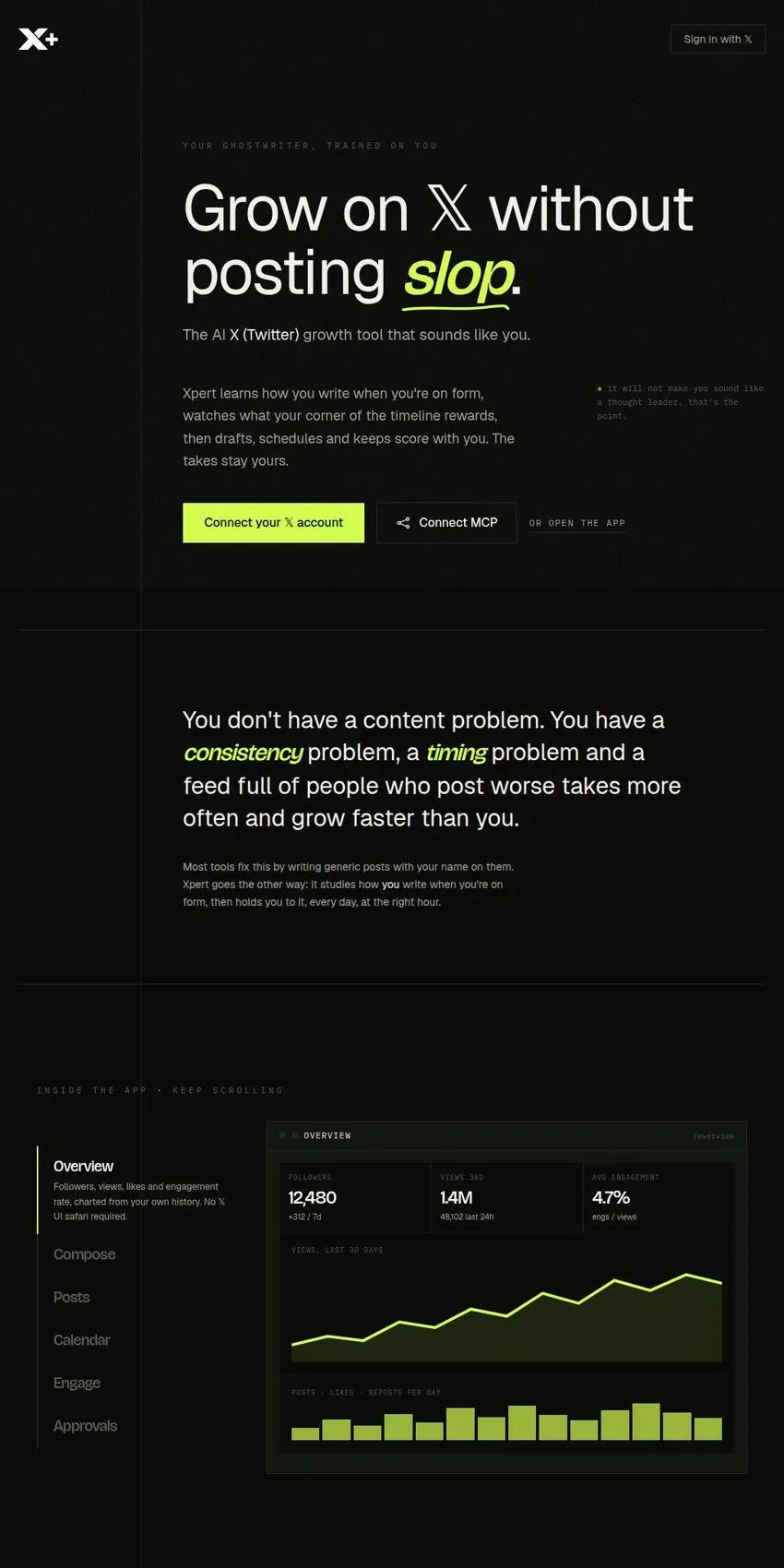
Xpert - Twitter (X) Growth Tool is an AI writing assistant built for X, the platform most people still call Twitter, and it runs entirely in the browser. The pitch is narrow and specific: it reads a user's existing posts, learns how that person actually writes, and then drafts new content in the same voice. The whole thing is aimed at people who want to post more often on X without turning into another interchangeable "thought leader" clone.
That voice-matching idea is the hook of Xpert - Twitter (X) Growth Tool, and it is a smarter starting point than the average generator, which spits out the same flat corporate cadence no matter who is doing the typing.
What the app does once an account is connected
The product splits into two halves: a marketing home page and a web app sitting behind a login. Doing anything real means connecting an X account, landing on a dashboard, and working from there. That connection is the price of entry, and it is worth sitting with for a second, because handing a third-party tool posting access to an account is a decision, not a formality. Anyone cautious about account security should weigh that before handing over access.
The feature set of Xpert - Twitter (X) Growth Tool is broad for a product this focused, which cuts both ways.
Learning a voice from past posts
The centerpiece is draft generation trained on a user's own history. Instead of a blank prompt box, Xpert - Twitter (X) Growth Tool analyzes what someone has already published and tries to reproduce their rhythm, their phrasing, the length they tend to write at.
Whether it truly captures a distinctive voice or just averages out the last hundred posts is the open question, and only a trial on a real account would settle it. The ambition is the right one, though, for anyone sick of generated text that reads like a press release. A tool that sounds like its user is worth more than one that sounds like a brand.
Scheduling and the content calendar
Drafting is half the battle; the other half is showing up consistently, and Xpert - Twitter (X) Growth Tool folds in post scheduling and a content calendar to handle it. Drafts can be lined up, slotted across a week, and managed from one screen.
This is standard territory for social tools, so it comes down to whether the drafts feeding that calendar are good enough to schedule without heavy editing. A calendar full of mediocre posts is still a chore, and no amount of scheduling fixes weak writing.
Trends, analytics, and replies
Beyond drafting and scheduling, Xpert - Twitter (X) Growth Tool reaches into niche and trend identification, engagement analytics tracking, and reply assistance.
In plain terms, it tries to tell users what is worth posting about, how their posts actually performed, and how to respond to others without staring at an empty reply box. That is a lot of surface area for one product, and breadth like this sometimes means each piece is shallower than a dedicated tool would build. The listing gives no way to gauge the depth of the analytics or how sharp the trend detection really is, so both stand as claims to test rather than proven strengths.
Step back and the shape of the product is clear. Xpert - Twitter (X) Growth Tool wants to own the whole posting workflow, from figuring out the topic to writing the draft, scheduling it, and reading the numbers afterward.
For someone who currently juggles a notes app, a scheduler, and a separate analytics tab, folding all of that into one dashboard has obvious appeal. The risk is the familiar one with all-in-one tools: a suite that does six things passably rarely beats a specialist that does one thing well, and nothing on the marketing page proves which side of that line the app lands on.
The account connection is also the evaluation problem in miniature. Because the drafting only works once a user's posting history is fed in, there is no way to judge the output from the outside, no public sample of a generated post to hold up against a human-written one. A user connects first and judges later, which puts the burden of proof on the trial itself. That is common for tools like this, but it means the marketing has to be taken on faith right up to the moment access changes hands.
A would-be buyer should slow down here. A search for reviews of Xpert - Twitter (X) Growth Tool turns up nothing that names this specific product. What surfaces instead is noise: an unrelated Twitter handle called @xpert_reviews, generic roundup articles about X growth tools that never mention this one, G2 and Capterra pages for Twitter the platform rather than the app, a separate competitor named TweetX, and a Reddit thread speculating about AI growth tools in general. No third-party rating, no business directory listing, no user testimonials, nothing independent to lean on.
That absence is not proof the product is bad, but it does mean there is no outside track record to check. A buyer would be an early adopter of Xpert - Twitter (X) Growth Tool, taking the marketing at face value, which is a very different proposition from picking a tool with a few hundred public reviews behind it.
The contact situation compounds the problem. No phone number, no email, and no contact page showed up anywhere on the reachable pages of Xpert - Twitter (X) Growth Tool. For a purely digital product a support channel might live behind the login, but from the outside there is no visible way to reach a human first, and that is fair to hold against a tool asking for account access. If a charge looks wrong or something breaks mid-draft, it is unclear where a user would even turn.
So the honest summary is a capable-looking feature list with real ideas behind it, wrapped in a near-total absence of outside validation or public contact detail. Xpert - Twitter (X) Growth Tool is asking for a level of trust it has not yet earned in the open, and the voice-matching promise, appealing as it is, stays unverified by anyone but the company selling it.
The sensible approach mirrors the caution the marketing itself invites: connect a secondary account first, ask the product directly how it handles a writer's voice and what happens to that data, and judge the drafts against a week of real posts before paying a cent. A solo founder or a freelance writer trying to sound like a person instead of another interchangeable timeline might still find the trial worthwhile, but the account access should go to a test profile long before it goes to a main handle.