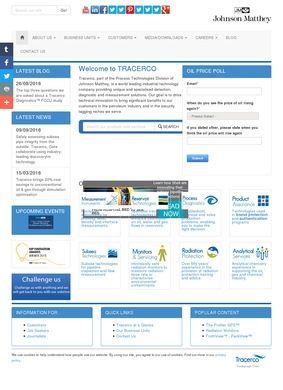
What does a company like Tracerco actually do once it arrives at an oil refinery? It looks inside the equipment without opening it. That is the plain answer, and it is why this industrial technology firm has held a job for more than 65 years: measurement, detection, and diagnostics on the pipes, columns, and vessels that no operator can afford to shut down and cut apart. Cutting into a live column just to see what is wrong is rarely an option, so the alternative has to be seeing through the wall instead.
Tracerco traces back to a radiation research division of ICI and now sits under the investment firm Sullivan Street Partners. Its own About page calls it world-leading, which is the sort of claim every firm makes about itself; the difference here is that the catalogue behind the claim is genuinely narrow and hard to copy, built up over six decades under a run of different owners rather than invented for a website.
What the company measures and detects
The work divides into services performed on-site and instruments sold to run permanently. On the services side, Tracerco brings scanning and tracer techniques to plants that need to know what is happening inside a sealed system. On the product side, it builds the gauges and monitors that stay bolted to the process long after the specialists pack up and leave. A plant might call for one visit and a fix, or it might buy the hardware and never need to call again; the company is built to sell either.
Across both, the throughline is the same. Use physics, often nuclear physics, to see through steel. That is a narrow trade with a short list of credible practitioners, and Tracerco has spent decades on it. Few outfits combine a nuclear physics background with the plant-floor experience needed to make the readings mean something to an operator standing next to a column.
Scanning and tracer technology
Tracerco's gamma scanning and neutron backscatter let the team map what sits inside a distillation column or a pipe, spotting blockages, liquid levels, and flaws without a shutdown. Chemical and radioisotope tracer technology tracks how fluids actually move through a system, the kind of question guesswork answers badly and a tracer answers precisely.
Asset integrity monitoring extends that thinking to subsea pipelines, where nobody can send a person down to look. Radiochemical analysis, fuel marking programs, and carbon capture and storage solutions round out a services list that stretches well past the refinery floor, out to the seabed and into emissions work. Each of these most likely started as one specific plant problem that got solved once and then turned into a repeatable service.
The Instruments, Profiler, and DrumVision lines
The hardware is where Tracerco gets specific. Nucleonic instrumentation handles level and density measurement, the steady day-to-day readings a plant lives on. The Tracerco Profiler measures phase, sorting out where oil, water, and gas each sit inside a separator.
DrumVision watches coke drums, a genuinely hostile piece of equipment to keep eyes on, and gives operators a live read on a process that would otherwise be a black box. These are not generic sensors. Each one answers a problem a general-purpose gauge cannot touch, and naming them individually, rather than folding them into one broad product line, suggests a company that expects a buyer to already know which problem they have.
Radiation monitoring and dosimeters
Because so much of the work involves radioactive sources, Tracerco also makes the safety instruments that go with them. Dose rate monitors, contamination monitors, and X-ray monitors cover the plant side, and Personal Electronic Dosimeters ride on the individual worker. A firm that sells radiation-based diagnostics and the monitors to keep people safe around them is covering its own ground in a way that reads as coherent, and the internal logic is one of the more reassuring things about the outfit.
It would be an odd look for a company built on radiation physics to outsource the business of measuring radiation exposure to someone else.
Who relies on it
The customers are heavy industry. Tracerco serves oil and gas across refineries, petrochemical plants, drilling, and upstream FPSO vessels, along with subsea and pipeline operators and the mining sector, and it does so worldwide. This is a business-to-business supplier whose name a consumer will never spot on a shelf; it turns up instead in a trade catalogue or a business directory built for procurement teams and plant engineers, not in a search a shopper would run.
That explains the quiet on the reputation front. There are no Google, Trustpilot, or Yelp customer ratings to weigh, which is normal for an industrial supplier of this kind. The only third-party scores that surface are workplace ones: Glassdoor shows an employee rating around 3.7 out of 5 from roughly fifty reviews, with a mixed set on Indeed. Those speak to life as an employee, not to the quality of a gamma scan, so they tell a buyer very little about whether the engineering delivers.
Contact is easy to find, which for a firm this specialized counts for something. Tracerco lists a general email, a physical address at its measurement technology centre in Billingham, a general contact page, and a separate inquiry page for putting a specific problem in front of the team. The site also carries Case Studies and a Downloads library, so an engineer can vet the approach before making contact, and ISO 9001 and 14001 certification sits behind the quality and environmental claims.
Set Tracerco beside a broad-line instrumentation vendor such as Emerson, and the trade becomes clear. Emerson will sell a plant almost every gauge it owns; Tracerco sells the handful of nuclear and tracer techniques a generalist simply does not have, backed by the analysis service to run them. For a sealed column, a subsea line, or a coke drum that no ordinary sensor can read, that narrower catalogue is the one worth calling.