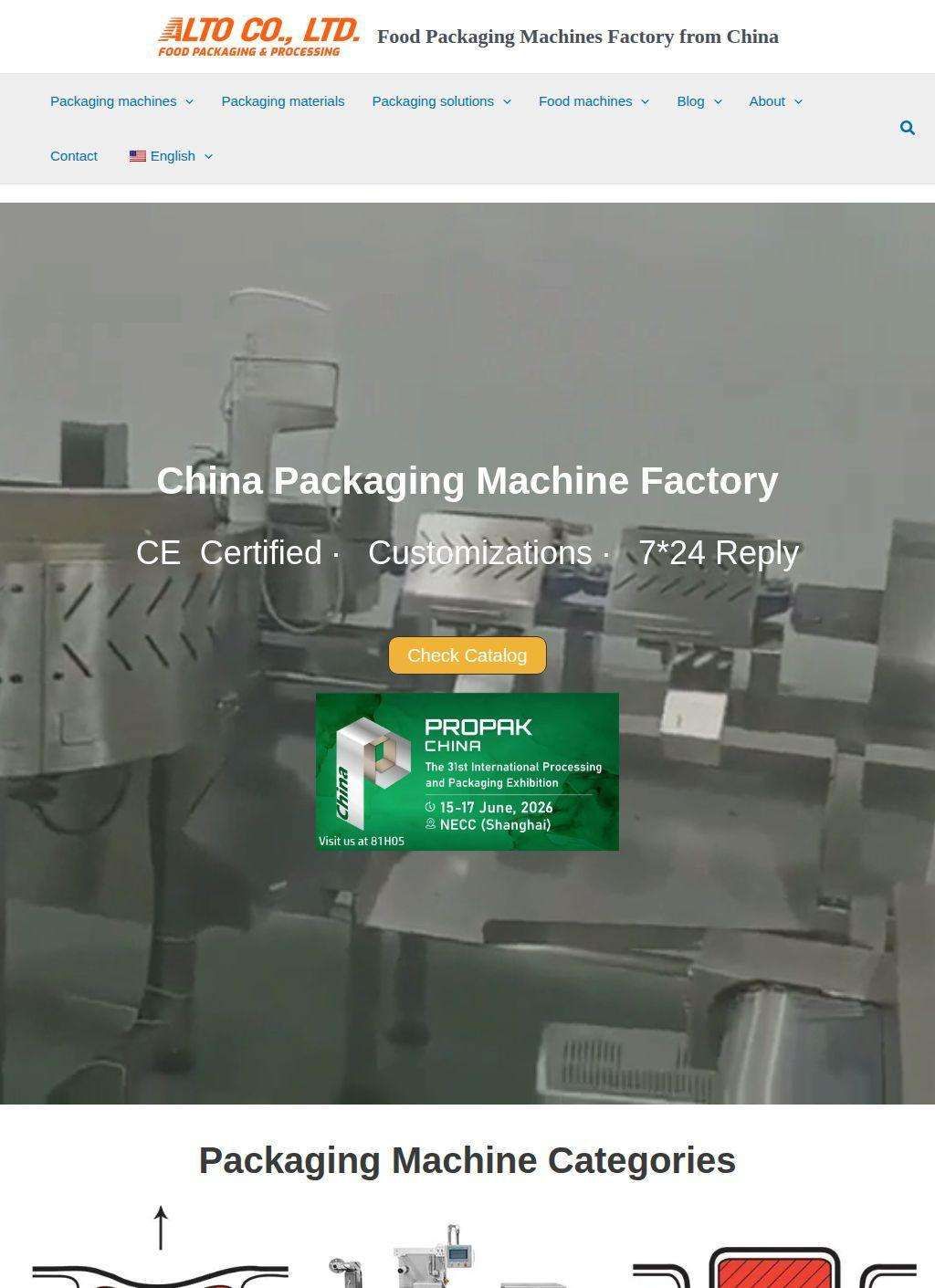
Food producers shopping for a packaging line usually arrive with a narrow, stubborn problem: a specific product that has to come off the line sealed, shelf-stable, and presentable, at a throughput the plant can sustain. Cheese needs one approach, fresh fish another, dry snacks something different again. The site at landarcn.com, run by Zhucheng Alto Co., Ltd. (which trades as Alto Machinery), is built around that exact way of thinking. The catalog is organized by what you are trying to pack, which is the order of operations a buyer with one product in mind tends to follow.
Vacuum, thermoforming and shrink equipment lineup
Start with the machine roster, because it is wide. On the vacuum side there are belt-type continuous units, double and single chamber models, inline systems, thermoforming lines, rotary machines, and hot-water shrink equipment. The thermoforming category covers both compact thermoformers and full-size ones, plus blister pack machines.
Modified atmosphere and skin pack systems
Modified atmosphere packaging, the gas-flush method that extends shelf life for chilled foods, shows up as tray and cup filling and sealing machines in tabletop, vertical, rotary, inline, continuous, and linear builds. Vacuum skin packaging gets its own multi-format range. Then there are cling film wrapping machines in tabletop, vertical, and linear forms, horizontal and vertical form-fill-seal machines, and pouch pick-fill-seal units. That is a lot of distinct hardware families under one roof, and the spread points to a manufacturer trying to be a single source for an entire packaging hall rather than a vendor of one or two flagship products.
Processing equipment upstream of packaging
The equipment list does not stop at sealing the product. Zhucheng Alto Co., Ltd. also lists food processing machinery that sits upstream of the packaging stage: meat processing, vegetable and fruit handling, washing, drying, cooking, frying, sterilization, and mixing, blending, and coating equipment. For a plant builder, the scope is consequential. Sourcing the wash line, the cook step, and the final seal from one supplier can simplify integration and after-sales support, and it shows the company sees itself in the business of whole production lines, the last machine before the pallet and nothing else.
Packaging paths organized by industry segment
This is where the structure of the site does real work. Instead of forcing a buyer to guess which of the dozens of machines applies, Zhucheng Alto Co., Ltd. presents packaging solutions by industry segment. There are dedicated paths for red meat, poultry, fish and seafood, cheese and dairy, farm produce, bakery and ready meals, snacks, seasonings and jam and juice, medical devices, and pet food. A seafood processor can follow the fish route and see the relevant vacuum and skin-pack options without wading through equipment built for biscuits. It is a sensible way to organize a deep catalog, and it cuts down the back-and-forth that usually precedes a quote.
Materials, videos and language support
Supporting that, Zhucheng Alto Co., Ltd. sources compatible packaging materials through partner suppliers, so the films and trays a given machine needs can come from the same conversation. There is also a blog with articles on vacuum and MAP packaging, a set of FAQs, product videos, a news section, and an online shop. The videos in particular are worth more than the spec sheets for this kind of buyer, since watching a machine cycle tells you things a parameter table cannot. The whole site runs in ten languages, which fits a manufacturer aiming at export markets and dealing with buyers who do not work in Chinese or English.
A decade in business, CE certified
Some context on the company itself. Zhucheng Alto Co., Ltd. is based in Zhucheng, China, and presents itself as both manufacturer and supplier with more than ten years of operating history. The machines are described as CE-certified, which is the marking European buyers will look for before a unit can be imported and installed, so its presence is a practical detail for that market. Zhucheng Alto Co., Ltd. was also scheduled to exhibit at ProPak China 2026 in Shanghai, a mainstream trade show for the packaging and processing industry. In-person presence at an industry show is something equipment buyers tend to factor in when they are about to commit serious capital, because it offers a chance to see the machines run and to meet the technical staff directly.
What do independent reviews show?
Listing a company in a business directory is one thing; independent third-party coverage is another. A search for external feedback on Zhucheng Alto Co., Ltd. did not surface notable buyer reviews or industry assessments. The results that appear are press-release syndication on outlets such as Barchart, Markets Insider, StreetInsider, and TechBullion, all of them carrying the same company-issued announcement about the ProPak China 2026 appearance. That is distribution, not assessment. A single release echoed across financial-news feeds confirms the company is doing outreach, but it tells a prospective buyer nothing about how the machines perform in a working plant or what the service experience is like after the sale. No platform count emerged from the search.
For industrial equipment of this scale, the absence of public reviews is less damning than it would be for a consumer brand. Packaging-line purchases rarely turn on star ratings. They turn on factory audits, sample runs, reference customers the seller provides directly, and the terms of the warranty and commissioning support. A buyer using this listing as a starting point should treat the catalog as the opening of a conversation and plan to verify the rest in person or through references, because the open web will not do that vetting for them.
How to contact Zhucheng Alto
On contact, Zhucheng Alto Co., Ltd. keeps a navigation tab for inquiries, so reaching the company is at least clearly signposted. The homepage carries a "7*24 Reply" claim, promising round-the-clock responsiveness, which is a common pledge among export manufacturers handling buyers across many time zones. Specific phone numbers and street addresses are not surfaced on the homepage, and presumably sit on the contact page itself. For a first inquiry the navigation gets you there.
Put the two halves together and the shape of Zhucheng Alto Co., Ltd. is fairly clear. The product side is genuinely deep and well-organized, covering vacuum, thermoforming, MAP, skin-pack, wrapping, and form-fill-seal machines, backed by upstream processing equipment and by-industry navigation that respects how buyers search. The supporting content, the videos, blog, FAQs, and ten-language reach, points to a company set up to sell internationally and to educate as it sells.
The weaker spot is the external evidence. Zhucheng Alto Co., Ltd. has put a coherent, detailed catalog online and is visible at a major industry show, but independent buyer feedback is not yet findable through a general search. The catalog is worth a specifier's time if the project involves chilled or dry food packaging; the diligence beyond that, references, a sample run, an audit, is the part this listing cannot supply. Zhucheng Alto Co., Ltd. gives enough to open a serious inquiry; whether that inquiry goes anywhere depends on what the company can demonstrate once a conversation starts.
Important pages
Business address
Zhucheng Alto Co., Ltd.
No. 248 Shunyi Road,
Zhucheng,
Shandong
262200
China
Contact details
Phone: +8618654721858