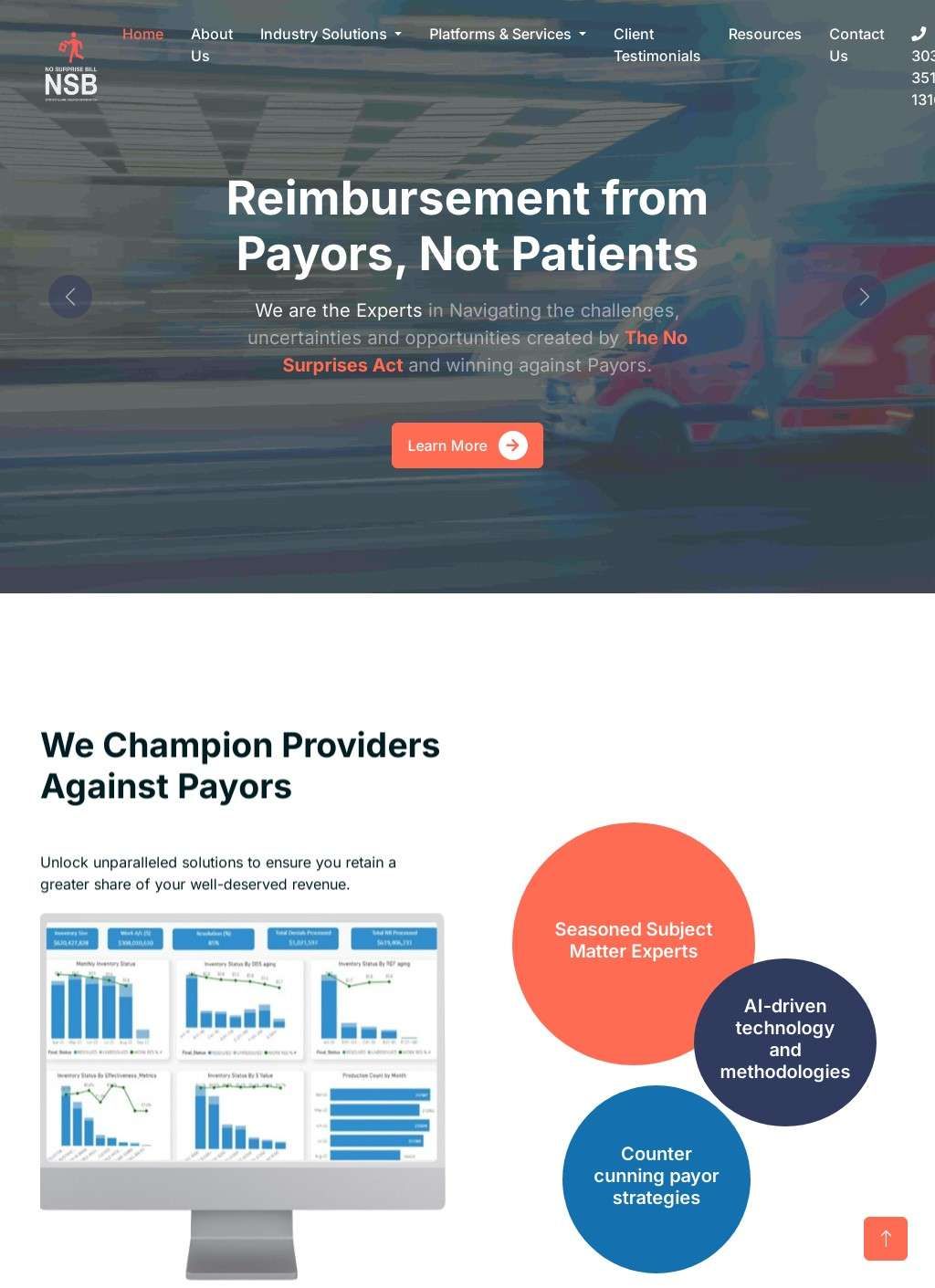
Built around one specific federal mechanism, No Surprise Bill is a Denver firm whose entire operation runs on the Independent Dispute Resolution process written into the No Surprises Act, the law that stopped patients from receiving out-of-network bills they never agreed to. Its flagship product, the NSA Revenue Accelerator, files IDR claims on behalf of healthcare providers who believe an insurer has underpaid them and pushes those disputes through to a resolution. That is a narrow specialty to anchor a company to, and the narrowness is deliberate.
How the independent dispute resolution process works
The customer base is named fairly precisely on the site: hospitals, emergency departments, anesthesiology groups, radiology practices, and behavioral health providers. Those are the specialties the law was written to cover, because they are the ones a patient rarely chooses in advance. A patient does not pick the radiologist reading their scan or the anesthesiologist in the operating room, so those bills used to land out of network without warning and now fall under the law's protections. Organizing the solution pages around those four or five specialties rather than offering a generic services menu shows that No Surprise Bill has read the situation correctly. A provider in emergency or anesthesiology will find the site speaking directly to their billing problems, not to some averaged-out healthcare operator.
Services beyond IDR claims
Beyond the IDR work, the service list widens into the broader business of getting providers paid. There is out-of-network claims processing the company describes as AI-driven, payor negotiation aimed at improving contracted rates, balance billing prevention and compliance, and a more hands-on offering where No Surprise Bill helps build or run a provider's revenue cycle management team outright. That last engagement is a different kind of commitment. Filing an arbitration claim is a transaction; standing up someone's RCM operation is a relationship. A firm willing to do both is after the deeper account, beyond the one-off dispute fee, and any provider weighing this should be clear on which version they are buying before any contracts go out.
The headline number is a 90 percent plus success rate across thousands of IDR claims submitted. That deserves a careful read. As a self-reported figure with no third-party audit attached, it gets the same weight any vendor's own scorecard gets, which is to say: treat it as a claim, not a certified result. The volume is the more telling half.
From volume comes arbitration expertise
Thousands of submitted claims means No Surprise Bill is not a firm that filed a handful of disputes and extrapolated a percentage. There is a real caseload behind the statement, and in arbitration work, repetition is where competence accumulates. A firm learns which claims survive the qualifying batch process, how certified IDR entities tend to rule, and how to assemble offer numbers that hold up in a hearing. Volume is more persuasive than a clean percentage when evaluating an arbitration specialist, and here the volume is doing most of the persuading.
Educational resources on surprise billing
The Resources section is built out with educational articles on surprise billing and the mechanics of the IDR process. That is a natural fit for No Surprise Bill, a company whose value rests on a law most provider billing staff do not fully understand. Explaining the dispute process in plain articles does two things at once: it helps the reader and it demonstrates that No Surprise Bill actually knows the terrain it sells against. The material points back toward the service, predictably, but the underlying subject is genuinely technical. Walking a provider through how a qualifying IDR dispute gets initiated teaches something useful regardless of who wrote it, and the articles function as explanations a billing manager could act on rather than as sales pitches.
A search turns up the company's own pages, a LinkedIn presence, and a Crunchbase profile. The Crunchbase entry shows no funding data and no review ratings, and there is no body of third-party feedback beyond that: no cluster of client reviews, no independent ratings, nothing from outside the firm vouching for the outcomes it describes. Most of what surfaces beyond the company's own pages is government and regulatory material about the No Surprises Act itself, which is the law talking, not anyone talking about No Surprise Bill specifically.
That absence does not mean the work is poor. RCM and IDR consulting is a quiet B2B category where clients sign engagement contracts and almost never leave public reviews, so a low-profile review footprint is normal for the space. But a prospective provider cannot lean on outside validation here. The evidence available is the firm's own track record claims and the quality of what it explains, and any real diligence has to happen through direct conversation and references the company supplies on request. No Surprise Bill has clearly built its offering around a law that did not have a specialist arbitration industry behind it until recently; what it has not done is surface the client-facing proof that would let a new prospect skip the reference-checking step.
That gap sits in tension with how dialed-in the rest of the offering looks. A firm this focused on the IDR process, with this much claimed volume and this clear a target market, would ordinarily have collected at least a few public client references by now, and none have surfaced. For a provider, that shifts the buying decision back onto basics: ask for case examples in your own specialty, ask how the success rate is measured and over what claim set, and ask what the engagement actually looks like on a month-to-month basis. Those answers will be more useful than any star rating.
Taken together, No Surprise Bill reads as a genuine specialist firm working a real and growing problem. The No Surprises Act created a federal arbitration lane that did not exist before 2022, providers are still figuring out how to use it effectively, and No Surprise Bill was built specifically to run that lane on their behalf. The specialty pages, the IDR focus, the payor-negotiation and RCM services, and the published contact details, including a phone number, an email, and a street address on South Colorado Boulevard in Denver, describe an operation that is actually running and reachable. The right posture toward No Surprise Bill is interested but verifying: the firm has built its case; the provider's job is to confirm through references and conversation that the outcomes described actually hold in their own specialty.