Women Agents runs on a premise that most professional directories skip entirely: before a name goes live, the platform says it checks judiciary records in that agent's state of licensure for grievances, formal disciplinary actions, and civil malpractice suits, then publishes whatever it finds on the agent's profile. That is an unusual promise for a free listing site. Most platforms that gather professionals lean on user reviews or self-reported credentials. Women Agents claims to do the slow, dull legwork of pulling public legal records first, which is the part that most people looking for an agent would never think to check on their own.
Real estate professionals listed by specialty
The directory is run by Heritage Web LLC and can also be reached through femalebrokers.com, so the same operation sits behind two front doors. Its premise is narrow in one sense and wide in another: every professional listed is a woman, but the professions stretch well past the real estate category this entry sits under. On the property side the coverage is genuinely broad. Women Agents lists residential agents, commercial agents, brokers, appraisers, agents who handle farms and land, and full real estate agencies. Someone buying a first condo and someone trying to value a hundred acres of pasture would both find a relevant heading here, which is more range than a lot of single-focus property sites bother to carry.
Expanding into insurance and other professions
Step outside real estate and the scope keeps going. Women Agents also indexes insurance of nearly every flavor, from health and life through car, home, and travel cover. Mortgage brokers sit alongside hard money lenders. Then it pushes into territory that has nothing to do with property at all: business brokers, literary agents, sales agents, sports agents, talent agencies, and recruiting firms. The common thread is the word agent and the fact that every listed professional is a woman. Whether that is one coherent directory or several stitched together under a single banner is a fair thing to wonder about, because a person hunting a real estate appraiser and a person hunting a literary agent have almost nothing in common except the platform they landed on.
Browsing agents by location and specialty
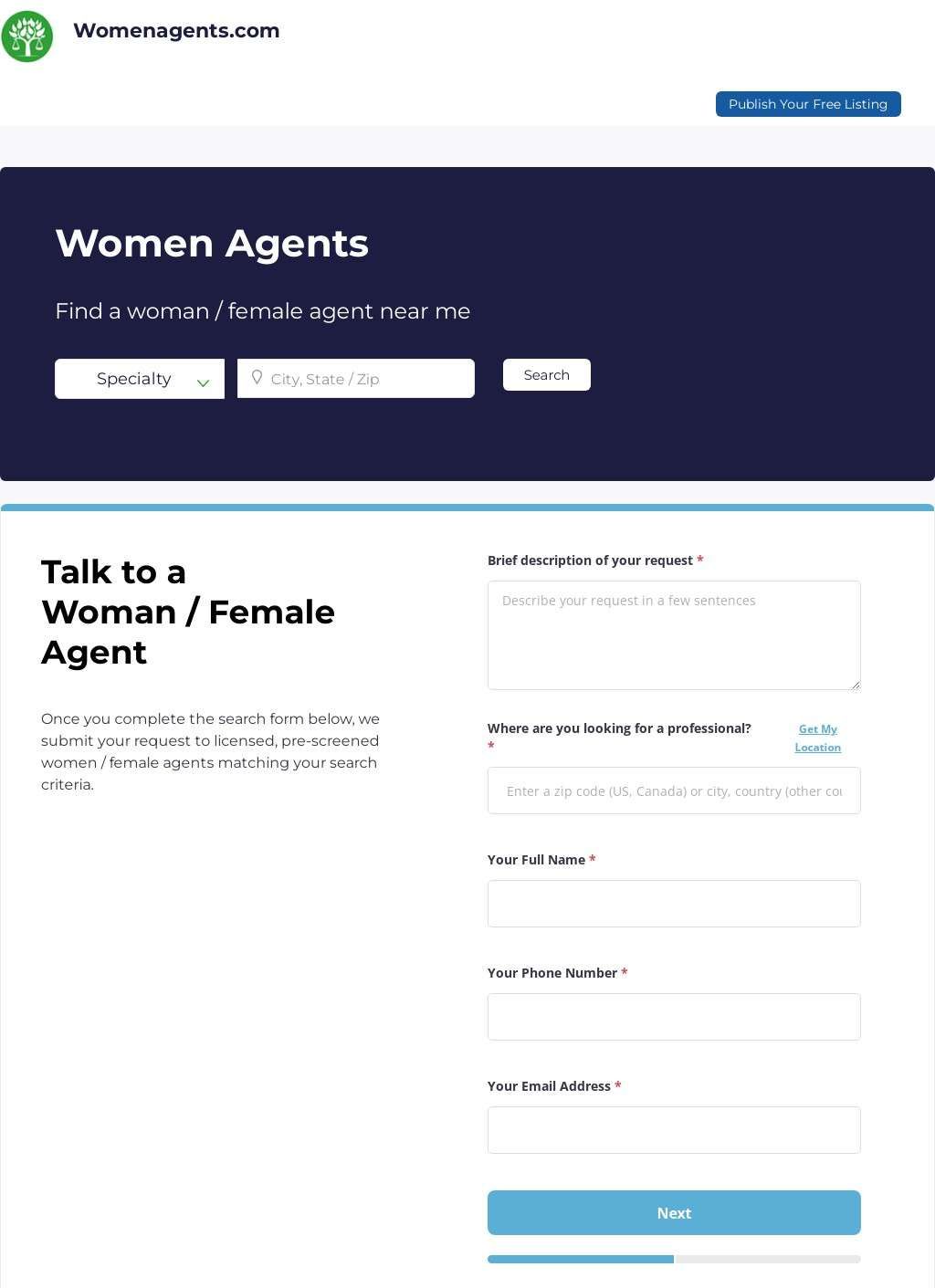
How the matching works in practice is straightforward enough. A user can fill out a request form to be paired with a professional, message agents directly inside the platform, and browse by specialty and by US state or city. That browse-by-location structure is the right call for real estate in particular, where the whole transaction is tied to a place and a license that only works inside one state. Drilling from a category down to a city saves a buyer or seller from scrolling past hundreds of irrelevant names.
Checking judiciary records before listing agents
The pre-screening pitch is the single most interesting thing Women Agents puts forward, so it deserves more than a nod. Checking state judiciary records for disciplinary actions and malpractice suits, then publishing that on the profile, is the sort of thing a careful consumer would otherwise have to do alone, often without knowing which court website to even open. If Women Agents does this consistently and keeps records current, that is real value, especially in fields like real estate and insurance where a license can be suspended quietly and the public rarely hears about it.
Verifying screening claims independently
The honest caveat is that a visitor cannot verify the depth or freshness of that screening from the outside. The claim is stated; the methodology behind it is not laid out in detail anywhere on the surface of the site. A reasonable reader should treat the published record as a useful starting point and still do their own confirmation with the state licensing board before any agreement is signed. That is not a knock specific to Women Agents so much as plain sense for any agent-matching service, but the screening promise raises the stakes because it invites a level of trust that the visitor has no easy way to audit independently.
One detail in the fine print is worth flagging plainly: the legal disclaimer notes that Women Agents may receive compensation for reviews. Keeping that disclosure on-site is the responsible move, and it is better that they say it than bury it. It also means a sharp reader should weigh any editorial content with that arrangement in mind.
Articles keep visitors informed
Beyond the matching tools, Women Agents publishes articles across the categories it covers and runs a monthly newsletter. For someone weighing whether to use a buyer's agent, or trying to understand the difference between a mortgage broker and a hard money lender, that supporting content adds a reason to stay on the site past a single search. An actively maintained article section is worth noting in a space where directories frequently go stale the moment they launch, and Women Agents appears to keep it current.
Contact options without a phone line
On the contact side, there is a contact page on the site, and a separate help center is linked through Heritage Web's own domain, so a user with a question is not left stranded. The footer carries social links for Facebook, X, LinkedIn, and Instagram. What is missing from the front of the house is a phone number or a physical address. For a platform whose entire value rests on vetting and trust, the absence of a visible phone line or office location is a fair point to raise. It does not sink the proposition, since a contact route and a help center do exist, but a person who wants to speak to a human before relying on the screening claims would have to dig for it.
A search turned up no notable third-party ratings on the usual platforms, no Google reviews, no Trustpilot or Yelp presence, nothing from the BBB that surfaced for the domain. That absence is not the same as a bad reputation. It means there is no crowd of past users whose collective experience a prospective visitor can check, so any judgment has to rest on what Women Agents publishes about itself. The screening disclosure and the compensation disclaimer are at least two things Women Agents puts in writing, which is more than many comparable sites bother to do.
Weighed up, Women Agents is a well-built and clearly maintained platform. The category coverage on the property side is thorough, the browse-by-state structure fits how real estate licensing actually works, and the screening promise is more ambitious than comparable services attempt. Against that, no independent review record exists to confirm the pitch, and someone who wants to verify the screening would need to take it to the state licensing board directly. The compensation disclosure in the fine print is an honest detail that a careful user should factor in. Women Agents is a sensible starting point for a buyer or seller who specifically wants to work with a woman in real estate; the published evidence is enough to treat it as a legitimate option, with the understanding that independent verification of any individual agent remains the prudent step.