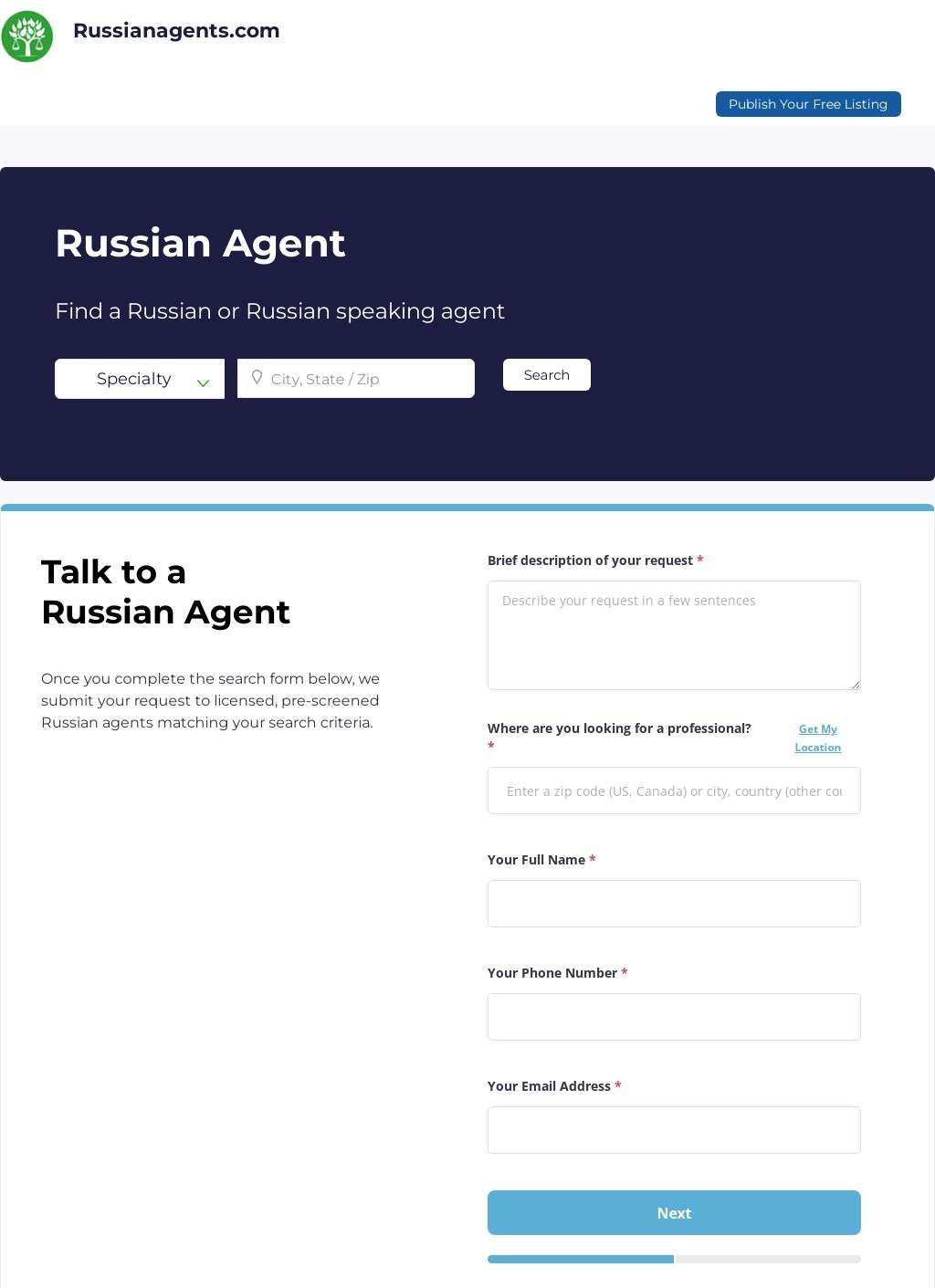
Russian Agents charges the professional, not the client. Anyone browsing for a Russian-speaking real estate agent, mortgage broker, or insurance consultant pays nothing to search, filter, or submit a request. That fee structure is the most transparent thing about the platform, and it is worth stating upfront because the rest of the picture is murkier than the homepage implies.
How the platform charges users
Russian Agents operates as a directory and matching service for licensed, Russian-speaking professionals across the United States, Canada, and Russia. Real estate is the center of gravity. Surrounding it: insurance, business consulting, mortgage, recruiting, and travel. The combination is deliberate, mirroring the sequence of needs a family relocating from Russia to the U.S. or Canada faces in practice. A single platform grouping professionals across those categories compresses what would otherwise be five separate searches, each starting cold.
Russian Agents also goes by Russian Brokers Directory on its own about page. The site does not explain whether this is a rebrand in progress, a legacy name, or a parallel property running under two identities. It is a small inconsistency, but one worth noting if you search one name and land somewhere that presents itself slightly differently.
Geographic coverage spans major U.S. cities, Canada, and Russia. Russian Agents does not claim to cover every market, which is the correct call for a niche service whose roster depends on professionals actively paying to be listed. The stated footprint maps plausibly onto the cross-border investment and migration corridors the platform is built around, and the honesty about scope is more reassuring than an inflated claim would be.
Screening and verification process
Russian Agents states that listed professionals are pre-screened and licensed, and that profile pages carry verified details as part of a listing review process. No independent confirmation of that process is publicly available. The platform does not publish its screening criteria, name a third-party auditor, or show sample verification records. A declared gate exists between submission and publication, which distinguishes this from an open free-for-all, but the mechanism behind that gate is entirely opaque.
Opacity as structural problem
For a platform whose value proposition rests on trust between a client and a professional found through a search result, opaque vetting is a structural problem, not a formatting detail. Clients are being asked to extend meaningful trust, sometimes for a property purchase or an insurance decision, on the strength of a process they cannot examine. A state licensing board lookup would independently confirm a license number in minutes. Russian Agents offers no equivalent shortcut, and no link out to one.
Listing costs and placement economics
The platform does not publish any pricing information for professionals who want to be listed. What a listing costs, whether tiers exist, and whether paid placement correlates in any way with profile prominence are all questions the public pages leave unanswered. A client trying to assess whether a listed agent earned their position or simply purchased it has no basis for that judgment, because the economics of placement are entirely hidden.
Absence from external rating platforms
Search results for russianagents.com surface a visa-services company with a similar name. That is a separate business with no connection to this platform. Setting it aside, no independent review record exists for Russian Agents on major rating platforms. No Yelp page, no Google reviews, no Better Business Bureau profile. The platform has operated long enough that its absence from every external rating channel is notable rather than unremarkable. Niche professional directories can escape mainstream review aggregators, but the complete absence across all of them leaves prospective clients with nothing external to consult.
That is not a technicality. It means the only evidence a new client can evaluate is what Russian Agents says about itself. No crowd signal, no volume of positive or negative outcomes, no independent corroboration of the vetting claims, no complaints trail, nothing. The platform's self-description is doing all of the work, and self-description is the weakest form of evidence for this kind of service.
Search filters and contact methods
Filtering works by practice area, agent name, and region. A separate request-and-match path lets visitors describe what they need and wait for the platform to surface candidates, which is useful for someone who does not yet know exactly which type of professional they are looking for. Help documentation lives at a Heritage Web domain, placing Russian Agents inside a larger publishing operation. A niche directory backed by an established publisher is less likely to go unmaintained than one with a single owner and no infrastructure behind it. That is one structural positive worth noting.
Contact options include a web form, Facebook, X, LinkedIn, and Instagram. No phone number is listed. No physical address appears on the main pages. For a service positioning itself around personal connection and language-based trust, the absence of a direct line creates friction for first-time visitors who want to speak to someone before handing over a request form.
Russian Agents fills a narrow niche: Russian-speaking professionals across several service categories, a free-entry model for clients, and a stated vetting step. The concept is coherent. The geographic scope is plausible. But a coherent concept is not a track record, and Russian Agents does not have a publicly visible one. No external ratings anywhere. No independent confirmation of its screening process. No pricing transparency for listings. No phone number. The site's own vetting claims are the primary basis on which a prospective client would decide to contact any listed professional, and those claims rest entirely on the platform's own word.
State licensing board lookups will independently confirm a professional's credentials in minutes, and professional associations in real estate, insurance, and mortgage each maintain searchable member directories with public accountability trails. Russian Agents, as it stands, offers a directory structure and a claimed vetting process, and no external evidence that the process produces what it promises.