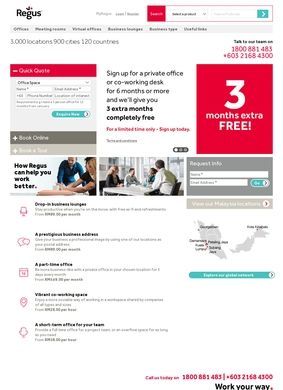
Regus runs flexible workspace in more than 180 countries, with thousands of locations clustered around major cities and transport hubs, which places it among the largest names in the serviced-office trade anywhere on the map. Type the Malaysian web address and it forwards straight to the global Regus site, so a search that starts local lands on the same worldwide network everyone else reaches.
The proposition is simple to state. Regus rents work environments by the hour, the day, the month, or the year, with short-term terms and no lead time, so a business can walk in and start working without the multi-year commitment a conventional lease demands. Pricing comes either pay-for-use or all-inclusive, and a mobile app handles the booking and the day-to-day management of it.
What Regus rents
The catalogue is broad, and it repays walking through, because the name gets reduced to just private offices when the range is considerably wider than that.
Regus is built to serve a freelancer needing a desk for an afternoon and a global enterprise leasing a whole building, and most points in between. The trick it is selling is that both can buy from the same provider on terms that flex, and that a company can move from one tier to the next as it grows without changing supplier or city.
Private offices and coworking
The office tier runs from an individual room through small and large team spaces to full-floor and day offices, so a company can size the room to its headcount and take a single day when that is all it needs. Coworking sits below it: dedicated desks for a permanent spot, plus hourly and day passes and broader access plans for people who move between locations.
Regus is selling flexibility here more than square footage, and the pricing structure follows from that. A team that doubles in a quarter is the classic case this tier exists for, since scaling a normal lease at that speed is a nightmare of subletting and penalties. The day pass, at the far end, exists for the person who needs a professional desk for a single meeting-heavy afternoon and nothing more.
Meeting rooms and event space
For businesses that work remotely but occasionally have to gather, Regus rents conference rooms, boardrooms, training rooms, and larger event and collaboration spaces by the booking.
A distributed team that never shares an office still needs a proper room with a screen and a door a few times a year, and this is the part of the offer that answers that need without a standing cost the rest of the time. Booking a boardroom for a morning is a very different commitment from renting one every month, and the appeal is that the option sits there ready.
Virtual offices and company registration
The virtual-office tier is the piece I find genuinely clever, because it sells the address without the room. A business gets a real street address, mail handling, call answering, and even company registration services, so a one-person operation can present a credible city presence without paying for physical space it would rarely set foot in.
For a startup counting every dollar, that is a real lever, and it costs a fraction of a desk. A registered address in a recognised business district does a quiet amount of reputational work for a young company that a home address cannot.
Specialized spaces and enterprise deals
Past the standard fare, Regus fits out specialized rooms: medical offices, beauty and wellness suites, and interview rooms built for one specific use. At the top end, enterprise solutions cover whole-building leases, workplace recovery programs for companies knocked offline by disruption, and technology services. Workplace recovery in particular is a serious-business offering, a place for staff to keep operating when their own premises go down, and it points at a client base well beyond the freelancer with a laptop.
Regus is trying to be the answer at both ends of the market, the single desk and the corporate estate, and the sheer location count is what makes that ambition plausible instead of empty.
One more thing shapes how Regus works in practice: standardisation. A meeting room in one city looks and behaves much like a meeting room in another, the booking runs through the same app, and the billing follows the same logic whether the space is a single hot desk or a whole floor. For a company that operates across borders, that sameness is a large part of the appeal, since a team can land in an unfamiliar city and drop into a workspace that behaves exactly the way the one back home does.
It also means a manager can approve spending against a predictable line item instead of negotiating fresh terms in every market.
The trade-off underneath all of it is the familiar one for flexible space. Convenience and speed are bought at a per-desk price that, month over month, runs higher than a lease signed and furnished independently. Regus strips out the deposit, the fit-out, the long tie-in, and the wait, and charges a premium for doing so. Whether that premium pays for itself comes down to how often a business actually needs to expand, shrink, or walk away on short notice, rather than sign a long lease it never touches again.