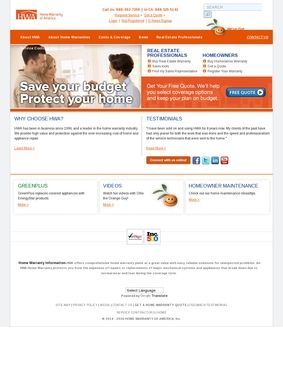
Home Warranty of America leads with two plan tiers: Premier at $46.08 a month and Premier Plus at $59.92, both carrying a 30-day money-back window. The pitch is familiar to anyone who has bought or sold a house: pay a flat monthly fee, file a claim when the dishwasher dies or the AC quits, pay a trade call fee when a technician shows up, and let the company sort out repair or replacement. HWA covers the usual roster of major appliances, including refrigerator, washer, dryer, and dishwasher, alongside the core systems that get expensive fast: HVAC, heating, plumbing, electrical, and garage door openers.
Plan tiers with competitive reimbursement limits
What separates the two tiers is mostly breadth of coverage, and the headline figure worth holding onto is the aggregate reimbursement ceiling of up to $15,000 per coverage period. That is a genuinely competitive cap, and it is the number editorial reviewers at Forbes Home Improvement and This Old House have pointed to in HWA's favour. Claims run 24/7 through the website or by phone, and the company says it dispatches licensed local technicians. Customers track claims and manage their contract through an account portal at my.hwahomewarranty.com.
Coverage for appliances and home systems
One thing the site does well is acknowledge that a home warranty gets sold to three different audiences at once. Homeowners are the obvious buyer, but HWA also builds out a full track for real estate agents, with seller-side and buyer-side warranty options plus tools meant to help close a sale, and a third track for contractors looking to join the service-provider network. That structure puts HWA squarely at the intersection of consumer protection and real estate transactions, which is exactly where these products tend to get bundled into closings.
Three customer tracks in one platform
The outside picture on HWA is genuinely split, and pretending otherwise would not serve a buyer well. On Trustpilot the company holds around four stars across roughly 3,000 reviews, a respectable showing for a sector where unhappy customers are usually the loudest. Then there is Yelp, where the brand-level page sits at 1.1 out of five across more than 1,500 reviews, with a separate Houston location carrying its own batch. That is not a small gap. It is the kind of contradiction that should make a buyer slow down and read the actual complaints carefully.
Trustpilot ratings versus Yelp reviews
That spread looks like the signature of claims-based businesses: people who get a fast approval rarely post, and people who get a denial or a long wait post twice. Editorial commentary backs this reading, noting mixed experiences around how claims play out in practice, even while crediting the reimbursement limits. Worth flagging plainly: HWA is not accredited or rated by the Better Business Bureau, so one of the trust markers buyers often reach for simply is not there. None of this makes the product a scam. It does mean the experience appears to hinge heavily on the specific claim, the specific contractor, and the fine print about what counts as covered.
Claims processing patterns shape customer feedback
Employee-side reviews on Glassdoor and Indeed matter less for a buyer but round out the picture of an established operation with a real workforce. The volume of reviews across every platform, even the critical ones, confirms HWA does business at real scale rather than operating as a reselling shell.
Contact methods and contract details
HWA maintains a presence in more than one business directory, though the most useful information is on its own site. On contact, the site is direct without being generous. Two phone numbers sit prominently on the page, (888) 616-9901 and (888) 328-9540, and the portal handles account questions. There is no physical address on the homepage and no published email, with the company steering people toward phone or the online account instead. For a national service contract sold remotely, that is fairly standard. A buyer who likes a paper trail will want to lean on the portal and keep their own records of every call.
Pricing transparency balanced against reputation gaps
The warranty itself lives in the contract language, and that is where the real assessment happens. So where does that leave HWA? Somewhere in the middle. The pricing is transparent, the $15,000 cap is competitive, the coverage list hits the systems that tend to break, and the three-audience structure shows a company that knows its market. Against that sits a reputation that swings from solid on one platform to near the floor on another, no BBB rating, and a body of editorial commentary that keeps circling back to claims friction.
When to request a quote from HWA
My read is that HWA is worth a quote and a careful contract review for a homeowner weighing a warranty or an agent looking to attach one to a sale, but the four-star and one-star verdicts are two halves of the same story, and the coverage exclusions and trade call fee deserve a close look before anything is signed.