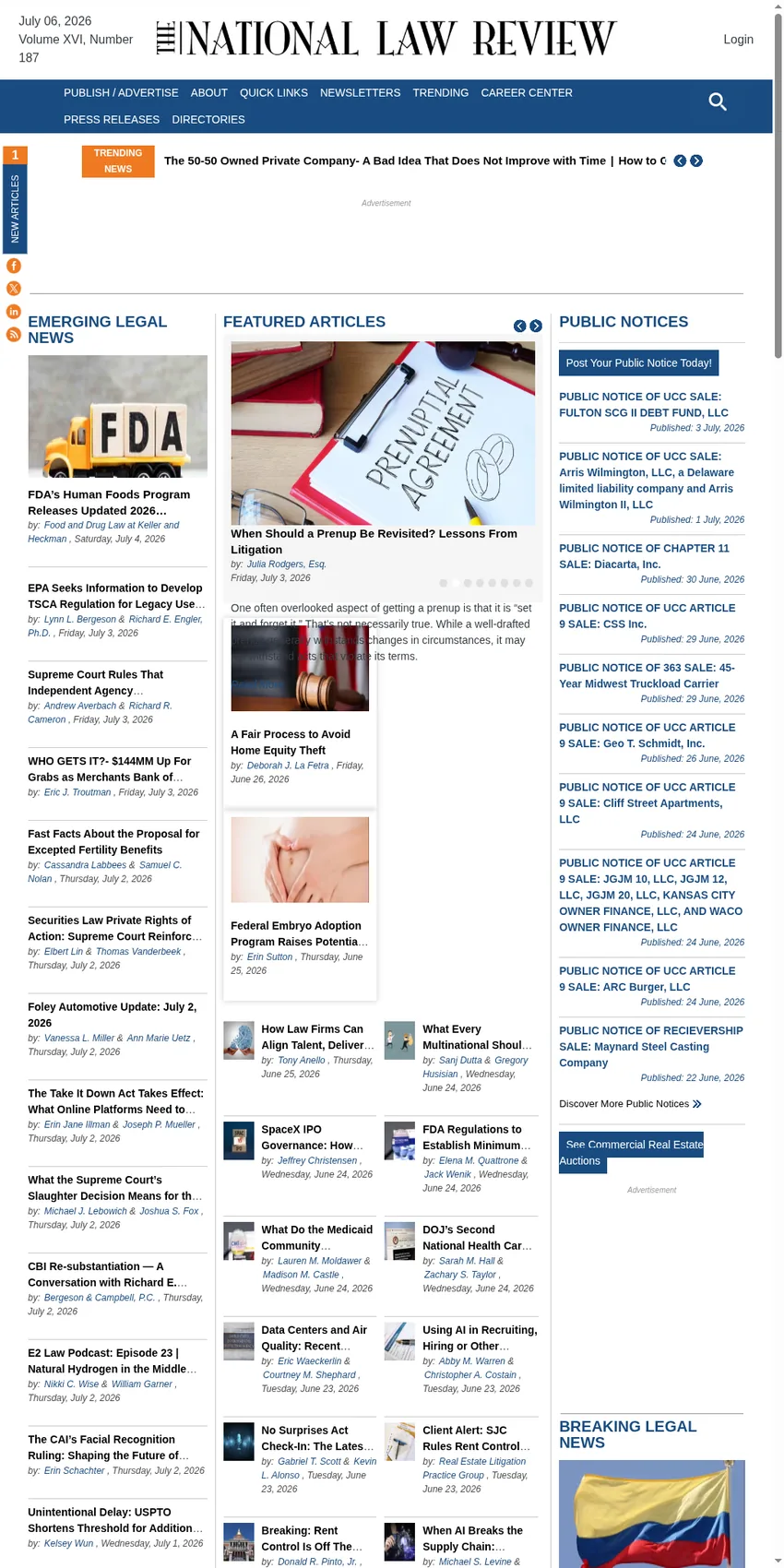
Law firms pay to publish their own articles on The National Law Review, and 95 percent of the firms that pay renew the arrangement each year, a figure the site reports about itself. That single statistic explains most of what a reader finds here: a legal news operation whose writers are also its customers, publishing at a volume no conventional newsroom could hope to staff.
The numbers involved are large. The National Law Review claims a monthly reach of 3.4 million readers and a contributor pool of roughly 14,000 attorneys and other specialists it calls "thought leaders," and everything published is free to read, with no login and no paywall anywhere on the site. Both figures are the site's own.
The name is far older than the website. The National Law Review traces its origin to a business law publication first printed in Philadelphia by the legal publisher Kay & Brother in the late nineteenth century. Today National Law Forum LLC runs it from Highland Park, Illinois, and describes the current site as a merger of that historic journal with a legal research database.
The print inheritance still shows. The publication carries an ISSN, and issues are cited by volume and number the way a bound journal would be, the same format a footnote needs when it points to something formal.
A legal magazine paired with a database
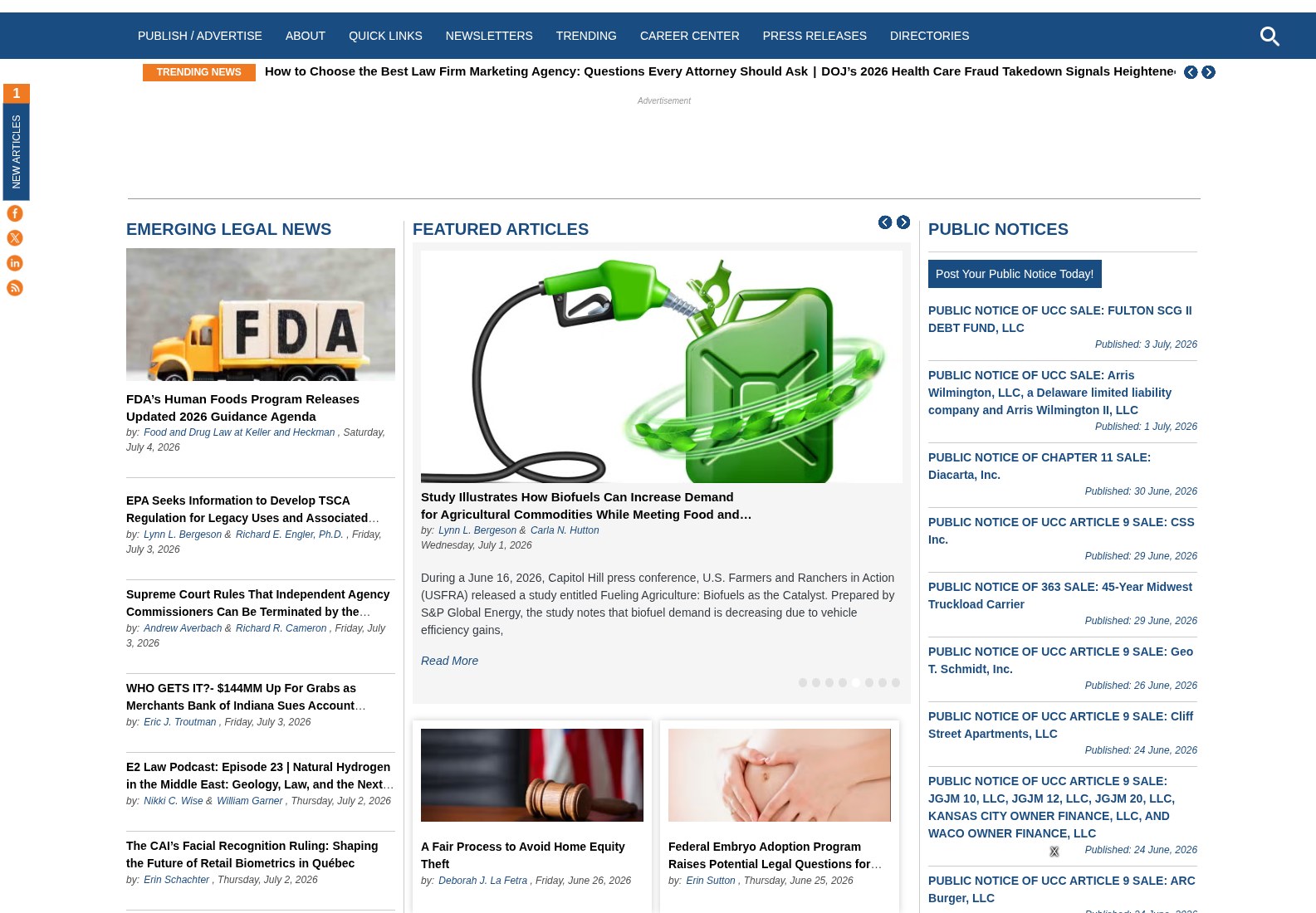
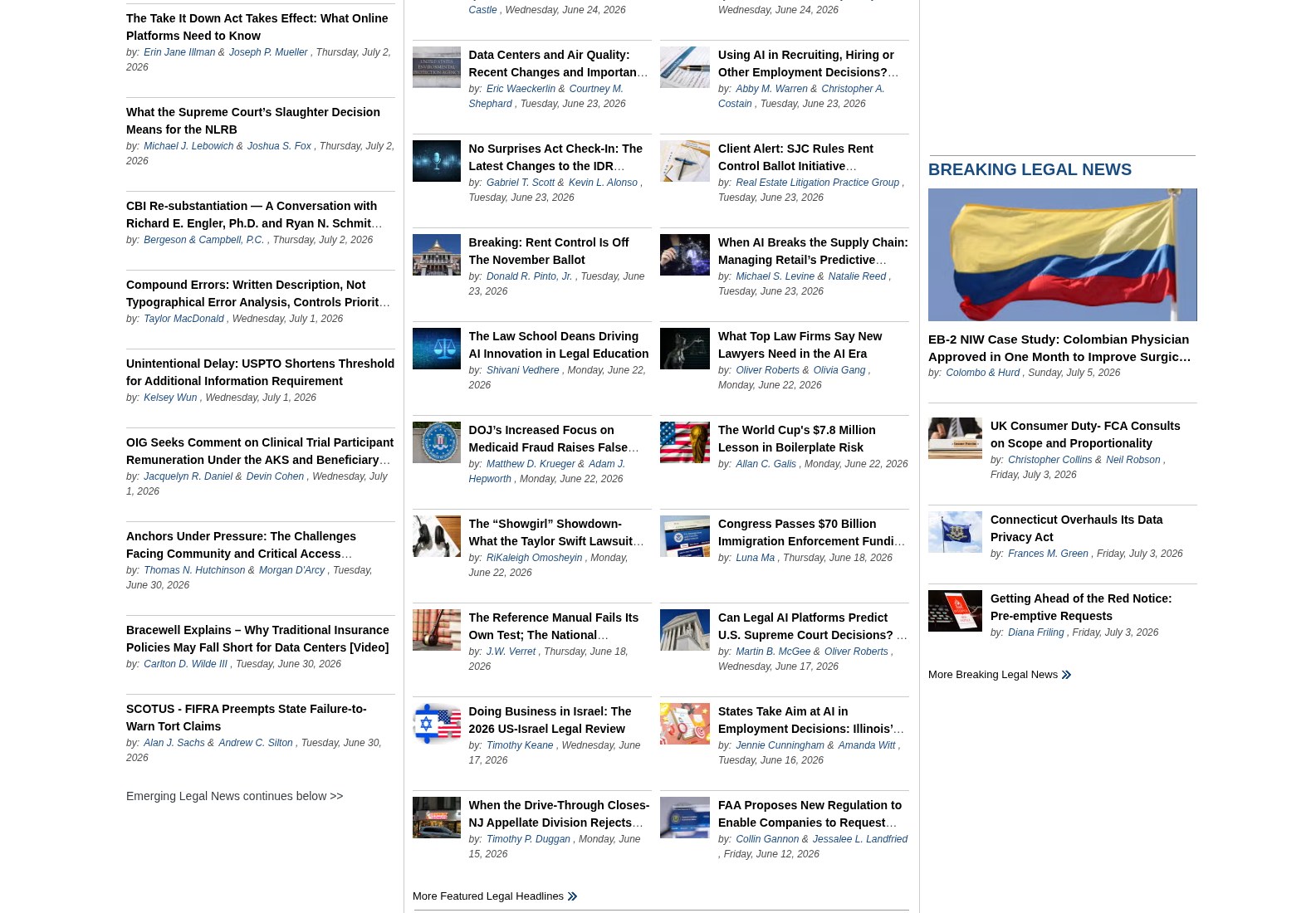
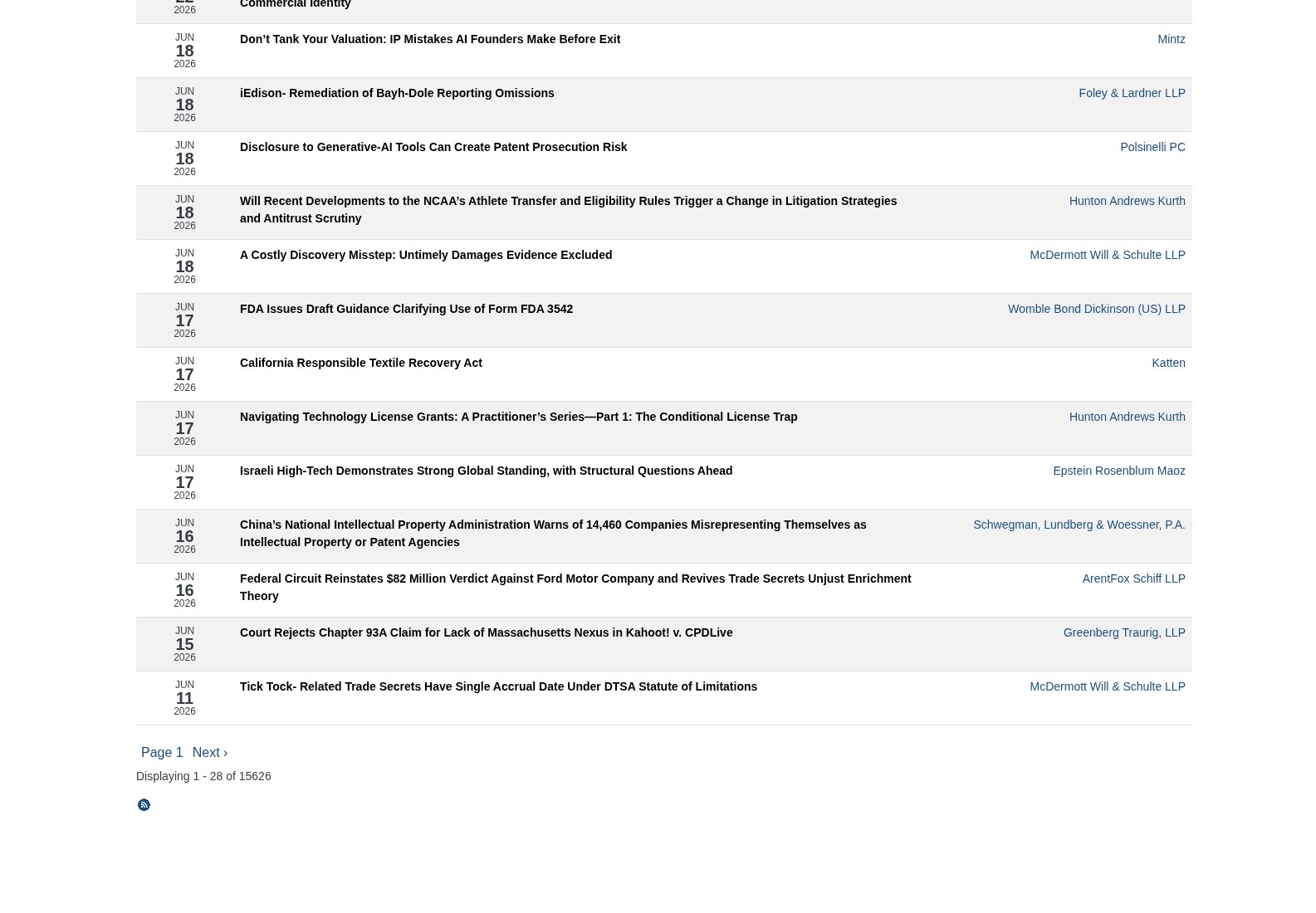
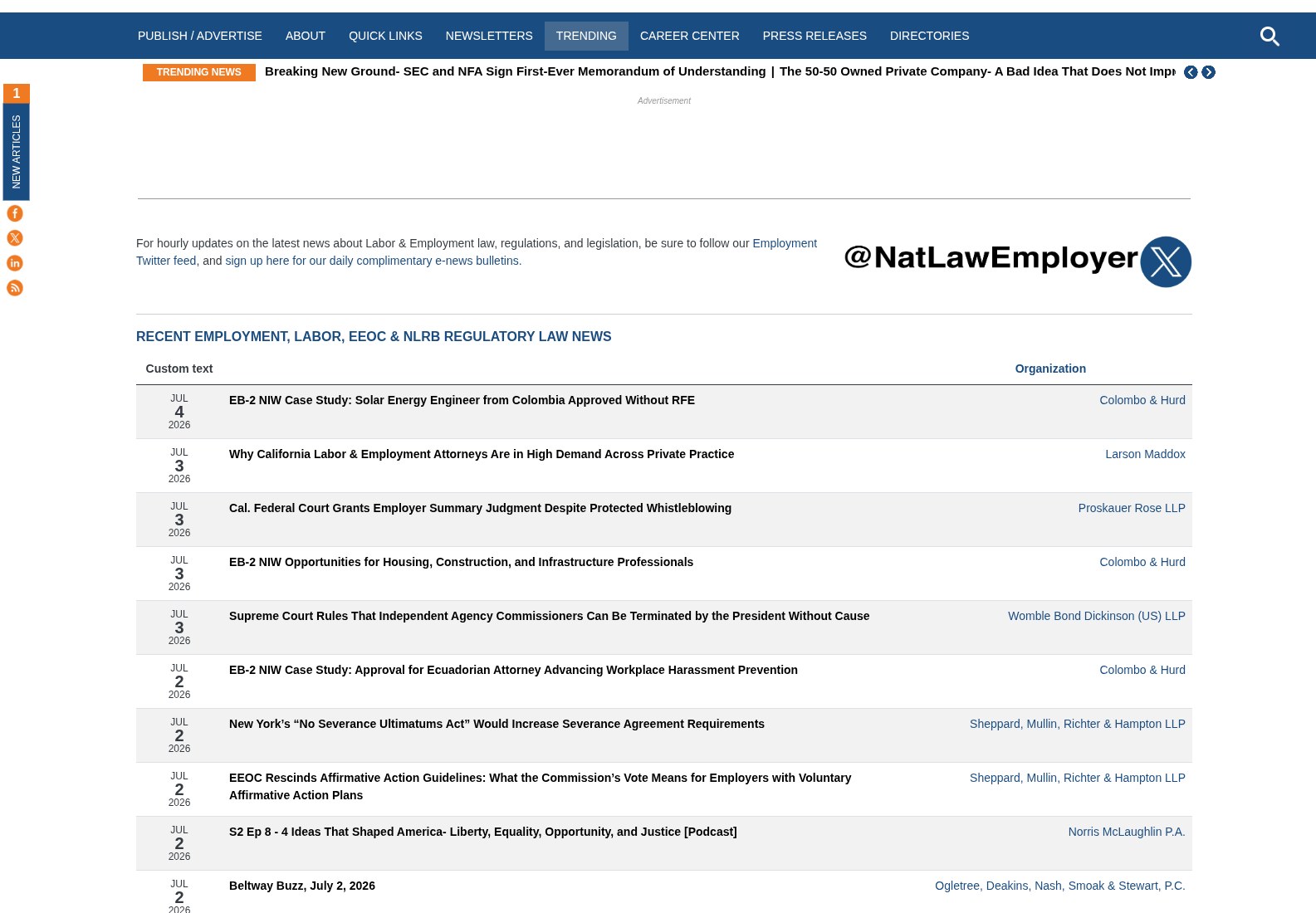
That heading is The National Law Review's own self-description, lightly trimmed, and it holds up. The magazine half is a homepage built around a featured article grid, a Breaking Legal News page that tracks trending stories, a Featured Legal Headlines section, and a carousel of contributing firm logos running beneath it all. The database half sits under the surface: every article is filed by practice area, by firm, and by author, searchable without an account, and a working RSS feed serves anyone who prefers the raw stream.
The audience follows from the content. In-house counsel, compliance and HR staff, attorneys watching fields adjacent to their own, and anyone who must track US legal developments without a research budget can treat The National Law Review as a free stand-in for the alert memos big firms send their paying clients, gathered in one place and sorted.
Practice area sections and the daily stream
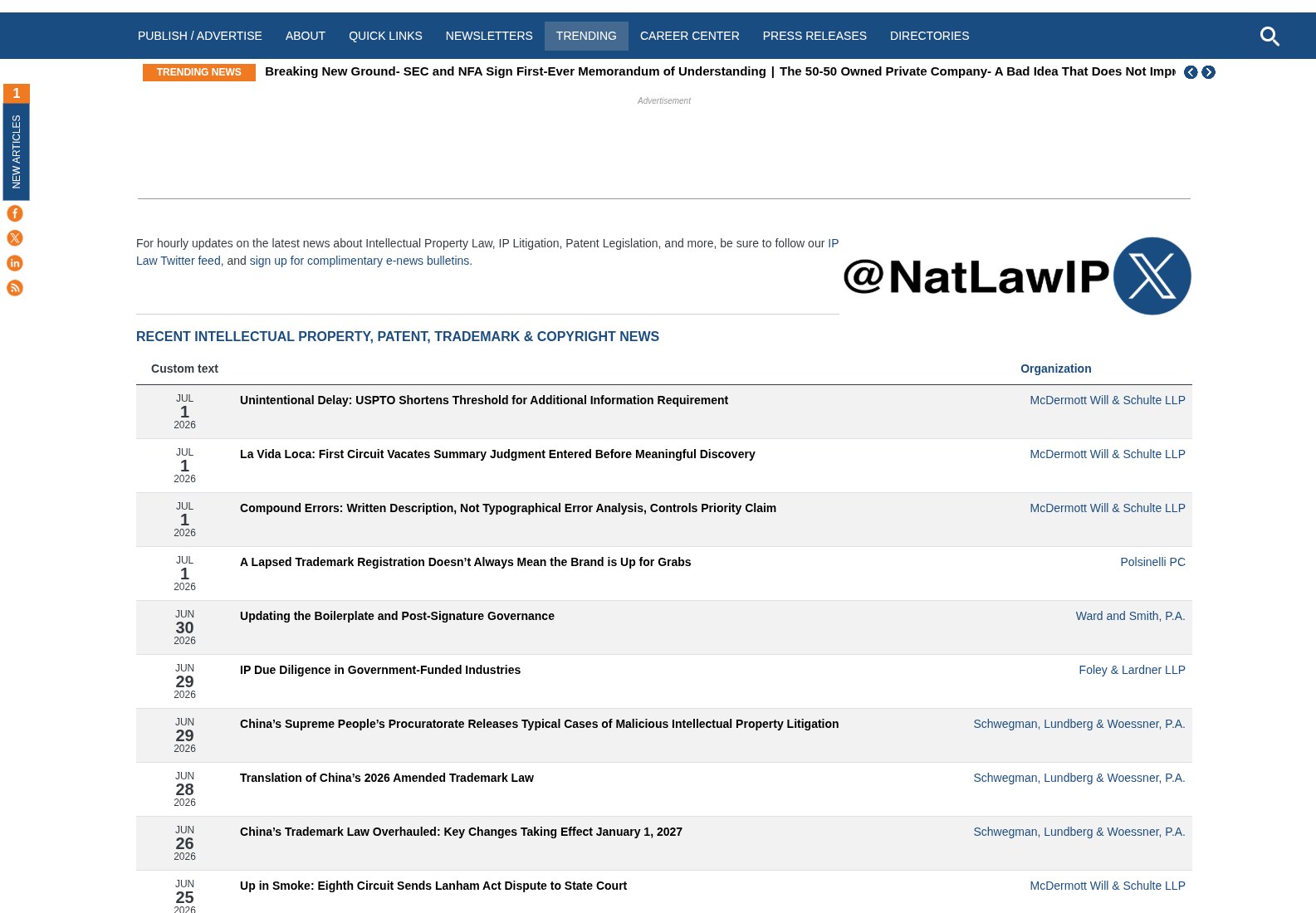
Coverage on The National Law Review is organized into 22 practice area sections, among them Antitrust, Litigation, Intellectual Property, Labor & Employment, Health Care, Tax, Immigration, Environmental & Energy, and White Collar Crime. Each section has its own front, and each front reads like a small trade publication for its specialty, newest firm-written analysis on top, older material filed behind it. An employment lawyer can live inside one section and never touch the other 21. A general counsel can skim five of them over coffee.
Even the section addresses name the regulators each beat watches: Tax pairs with Treasury and the IRS, Labor & Employment with the NLRB and the EEOC, Health Care with the OIG. Whoever built the taxonomy was thinking about how lawyers search.
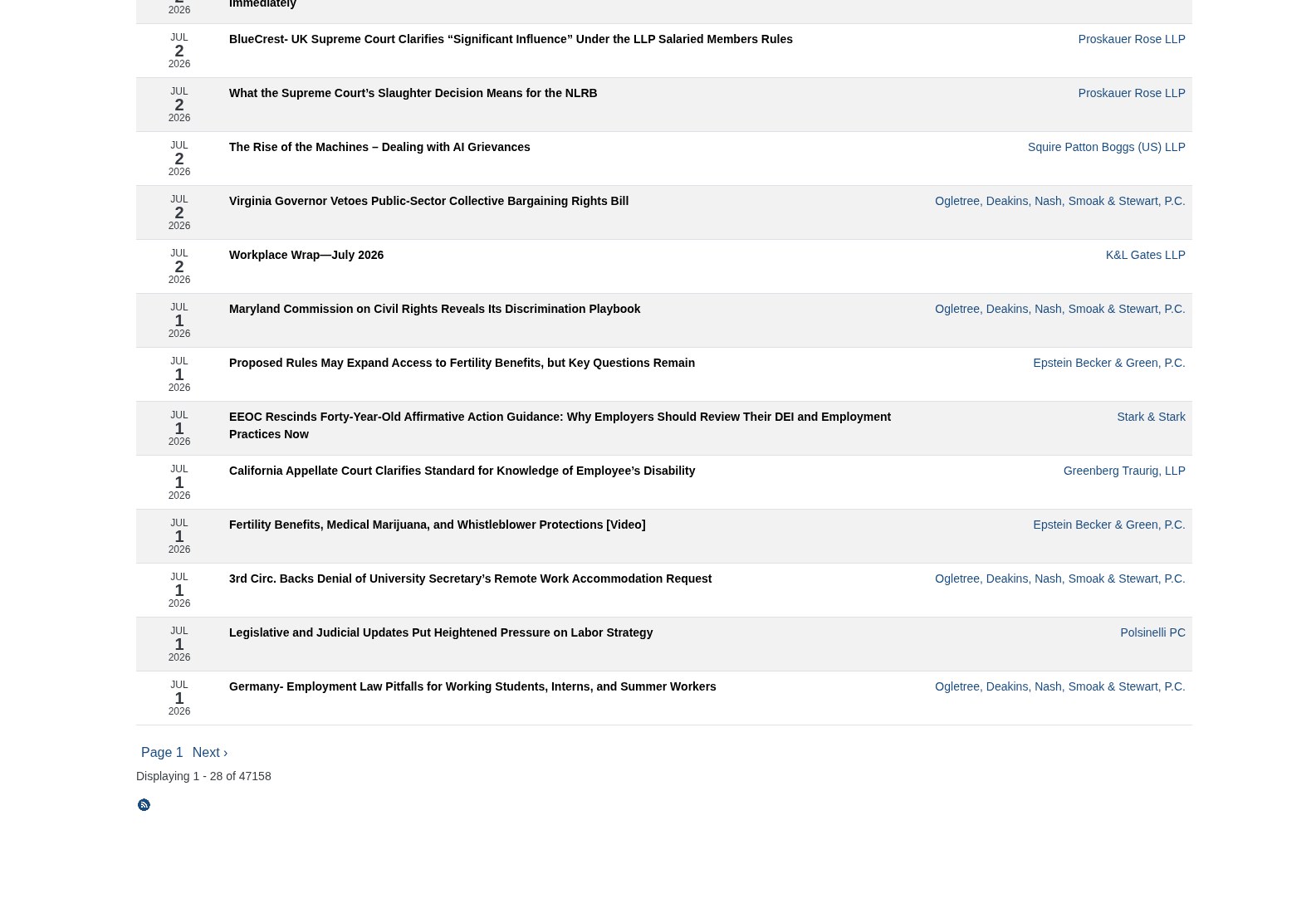
For readers who want everything in publication order there is a chronological Most Recent stream, and the Breaking Legal News page gathers whatever is drawing attention across sections at a given moment. Volume is the defining trait of the whole site; the section structure is what keeps that volume navigable. The sane approach is to treat it as a monitoring tool: pick two sections, add a newsletter, and let the rest of the stream go by.
Twenty-five newsletters and counting
The newsletter catalog runs past 25 topic-specific email digests, including one devoted entirely to AI & the Law, and The National Law Review puts its combined subscriber count above 800,000. Signing up costs nothing.
For most people the newsletters are the sensible way in. A weekly digest scoped to health care regulation or tax is a habit a working professional can hold onto, while a homepage fed by thousands of contributors is something to visit when a specific question comes up.
Subscriber numbers that size, if accurate, mean the email lists are the real product, and the renewal rate among paying firms gets easier to understand: the distribution those firms are buying exists.
Directories and a separate career center
Alongside the news, The National Law Review maintains a searchable Law Firm Directory and a Lawyer Directory, plus a Publishing Firms roster that lists the contributing firms alphabetically, hundreds of them. The roster doubles as a disclosure device, since a reader can check in seconds whether a given firm publishes on the platform before deciding how much weight its analysis deserves.
There is also a separate Career Center on its own subdomain, with distinct job alert newsletters for employers and for job seekers.
The publishing firms and the credibility check
None of the bylines on The National Law Review belong to staff reporters. The contributors are practicing lawyers whose firms pay the publisher for content distribution, and the roster includes heavyweight names: Greenberg Traurig, Morgan Lewis & Bockius, McDermott Will & Emery, Sheppard Mullin, Barnes & Thornburg, Foley & Lardner, Wilson Elser, and Epstein Becker Green.
That 95 percent renewal rate measures the paying side of the exchange: firms evidently consider the visibility worth the fee, and the number is silent about readers. The site's vocabulary is at least candid about the deal. Contributors are "thought leaders," the paying firms appear under "publishing firms," and the marketing language sits in plain view beside the analysis it funds.
What the money buys is exposure. What the reader gets is the client alert genre: prompt, competent explanations of new rules, rulings, and enforcement actions, written by specialists who would be glad to be hired on the subject they are explaining. Read with that understood, the material is genuinely useful, because these are people covering their own field at the exact moment something in it moves. The AI & the Law newsletter is the pattern in miniature: firms want to be seen as fluent in the newest compliance territory, and readers collect current coverage out of that ambition.
The National Law Review does set a floor under all this. Its editorial guidelines exclude publicity items, court pleadings, and legal forms, which keeps plain press releases off the site. At the selective end, the annual Go-To Thought Leadership Awards name about 75 honorees a year, under one percent of the contributor pool, a rate tight enough that the award tracks something real, whatever marketing value it also carries for the winners.
Outside ratings and the bottom line
Media Bias/Fact Check rates The National Law Review as high credibility and least biased, with high factual reporting. For an outlet whose content comes entirely from interested parties, an independent assessment at that level is the most useful outside signal available, and it is a strong one. The rating covers the outlet as a news source and does not grade individual firm articles, which still vary with their authors. Trustpilot, for what little it adds, shows a 3.7 score resting on a single review, a sample that says nothing in either direction.
The company behind The National Law Review is easy to identify and reach. A standard contact page lists a full street address and a phone line with a toll-free alternative, and the organization pages name the chief executive, Gary Chodes. The footer links Facebook, X, and LinkedIn accounts, plus a Mastodon account, an unusual touch. That is the transparency a publisher claiming millions of monthly readers should offer, and this one provides it.
As a whole, The National Law Review is a marketing channel that has to stay readable to keep working, and for the most part it does. Breadth across 22 specialties comes free, and the print lineage and editorial exclusions give the operation more spine than its funding model would predict; the outside credibility rating backs that up. The permanent limits are just as clear: no original reporting, and a stream shaped by what contributing firms want to be known for.
The natural alternative to weigh is Law360, which covers similar territory with staff journalists and original litigation reporting behind a paid subscription. Docket-level detail and newsroom scoops cost money there. The National Law Review does not compete on that front, but for tracking what changed week by week in employment law, tax, or health care compliance, its free contributor coverage, written by people with a direct stake in getting the rules right, covers most of the same ground.
Verified social profiles
Business address
National Law Forum LLC
2070 Green Bay Rd., Suite 178,
Highland Park,
IL
60035
United States
Contact details
Phone: (708) 357-3317
On September 23, 2026, the Court again postponed the previously scheduled Early Neutral Evaluation (ENE) conference and related…
From the June 6, 2022 signing of Phil Michelson to a $200 million multi-year contract with promise for recruitingadditional…
Every Indian passport carries, on the very first page, a message from the Indian President requesting the foreign authorities to…
It has been reported that during his remarks at the 20th Annual Global Antitrust Enforcement Symposium on September 15, 2026, at…