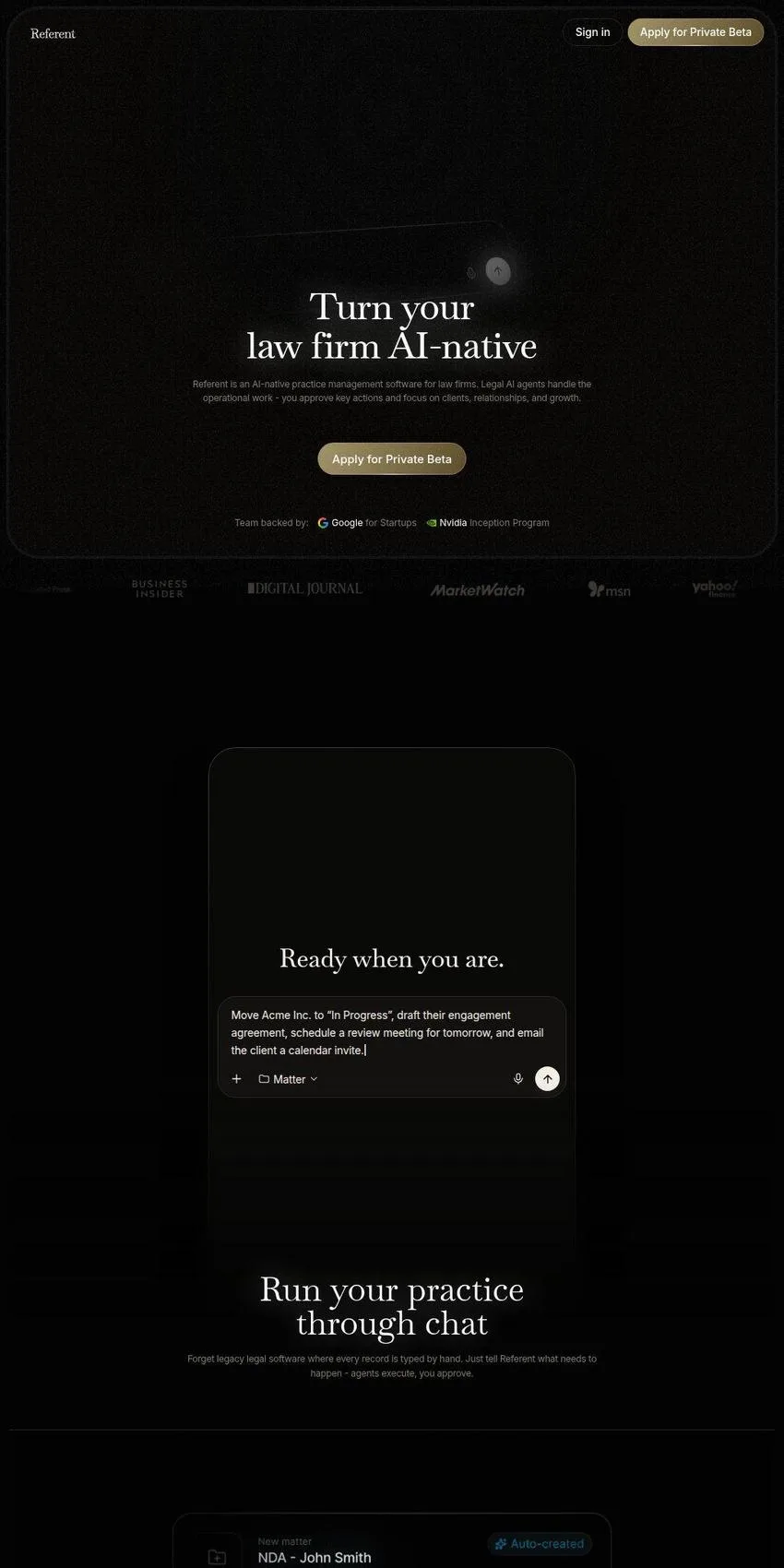
Referent operates in legal tech, and more precisely in the practice management corner of it, the software that keeps a law firm's clients, matters, deadlines, and bills organized. The pitch is unusual for the category, though. Rather than another database where lawyers type things in, Referent describes itself as AI-native software where AI agents do the operational work and the lawyer signs off on the results.
The company draws a distinction that's worth explaining, because it shapes everything else on the site. Traditional legal software is called a "system of record": it stores what you enter and waits. Referent positions itself as a "system of action": the software moves the work forward on its own, then pauses for approval before anything reaches a client. It's the difference between a filing cabinet and an assistant who actually opens the mail.
What does that look like day to day? The workflow starts at intake. A firm sends prospective clients a link, the client talks to the AI, and Referent screens the fit, opens the matter, and preps the engagement paperwork for the lawyer's review. No phone tag, no intake forms retyped into a database by hand.
Email handling is the second pillar, and honestly it's the one most lawyers will care about. Connect an inbox and Referent files incoming messages and attachments to the correct matter automatically, flagging whatever needs attention. Anyone who has spent a Friday afternoon dragging emails into client folders will understand the appeal here.
Then there's drafting. Replies, letters, and documents arrive pre-written, built from the full context of the matter rather than from a blank page. The lawyer edits, approves, and sends. The same pattern repeats for deadlines, where court dates, filings, and limitation periods are tracked with reminders before things turn urgent, which in a profession where a missed deadline can mean malpractice is no small thing.
Billing rounds out the operational suite. Time logs itself as work happens, and invoices assemble in the background, whether the firm bills hourly or flat fee. Follow-ups get the same treatment: payment nudges, client check-ins, and review requests are drafted by the system, though nothing goes out without the lawyer's OK. That approval gate is the constant refrain across the whole product. AI prepares, the lawyer approves, and every action lands in an audit trail.
The platform serves three audiences, with different framing for each. Solo lawyers get pitched the ability to run a full firm alone, with agents covering the back-office work a support staff would normally handle. Boutique and small firms are told they can grow caseloads without growing headcount. A Big Law tier is listed as coming soon, described as an AI operations layer rolled out across practice groups.
Migration is addressed head-on, which suggests the team knows switching costs are the graveyard of practice management software. Referent imports clients, matters, tasks, and files from a firm's existing tools during setup. Current integrations cover Gmail, Google Calendar, and Google Drive, with Outlook and Microsoft 365 marked as on the way. Mobile apps for iPhone and Android let lawyers review agent work and approve actions between hearings.
Because this is legal software, confidentiality gets its own detailed treatment, and the specifics are stated plainly rather than buried in a policy page. Each firm's data lives in an encrypted, isolated workspace with AES-256 at rest and TLS 1.2+ in transit. The company commits to never training AI models on firm data, never selling client information, and genuinely deleting data when a firm deletes it. SOC 2 and ISO 27001 certifications are listed as in preparation, and role-based access controls what each team member can see.
The FAQ section reads more like an education campaign than a sales page, which as a reviewer I found refreshing. It defines what an "AI-native law firm" means, walks through the three-step path to get there, and explains candidly how Referent differs from pasting text into a general-purpose chatbot. The short version: a chatbot knows nothing about your firm, while Referent works from live matter context and then does the task rather than describing it.
Some context on the company itself. The founder, George Zaletski, describes fifteen years building technology, time working inside a law office, and four years in legal tech before starting Referent. The team is backed by Google for Startups and the Nvidia Inception Program, and the site notes press coverage across outlets like the Associated Press, Business Insider, and Yahoo Finance. A blog publishes research-style posts, including statistics on US lawyers by firm size.
Access is currently gated. Referent runs a private beta, with an application process, personal invites, and white-glove onboarding, meaning the company handles the setup and data connection work itself. The site claims a firm can reach a working AI-native baseline in days rather than months, though prospective users will need to apply and be selected first.
In my opinion, the most credible thing about the product design is its restraint. The agents are deliberately constrained: each one owns a narrow routine, every client-facing action requires explicit sign-off, and everything is logged. For a profession bound by ethics rules and built on client trust, that architecture answers the obvious objection before it's raised.
Who's the fit? Solo practitioners drowning in admin, small firms that want more matters without more staff, and any lawyer curious about what running a practice through chat and voice commands actually feels like. Firms wedded to Microsoft tooling may want to wait for the Outlook integration to land, but for Google-based practices, the pieces are already in place.


Important pages
Business address
Referent