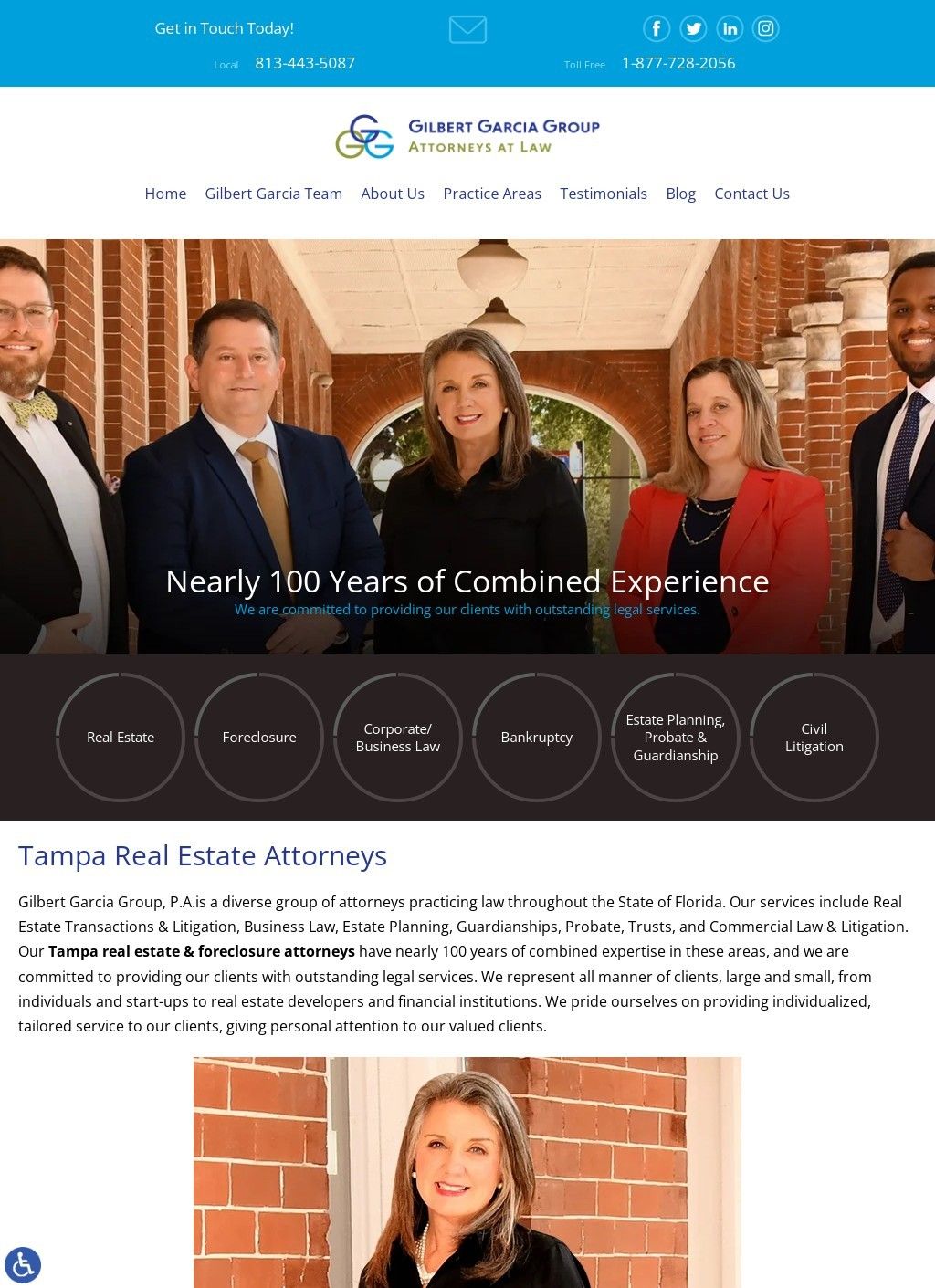
Tampa Real Estate Attorney is the listing name for Gilbert Garcia Group, P.A., a law firm working out of Tampa, Florida, at gilbertgrouplaw.com. The label sounds like a single-lane specialty. The practice behind it runs wider than that, and how much wider is the first thing a visitor should sort out before deciding whether this office fits the problem in front of them.
Three attorneys are named on the site, which counts for something in a field where plenty of firms hide behind a switchboard. Michelle Garcia Gilbert runs the practice as Managing Partner. Ydelmis Cutino works as an Associate Attorney and also handles title processing, a pairing that makes plain sense for a shop doing property closings. Mary E. Castillo covers litigation. It is a small bench, but an accountable one, and the operation behind Tampa Real Estate Attorney does not pretend to be larger than it is.
The reach beyond property is broad. Business law shows up as business litigation, commercial collections, and commercial leases. Estate planning covers trust administration and asset protection. Add probate and guardianships, general civil litigation, criminal defense, and lender default servicing with foreclosure representation, and the picture is a general-practice firm built around a property core. The client list is just as wide: individuals, start-ups, real estate developers, and financial institutions, which is an unusual spread for three lawyers to serve under one roof.
That mix raises a fair caution before any of the details. A firm that represents financial institutions on foreclosure work and also represents individuals in landlord and property disputes is playing on both sides of the same field, in different matters. Nothing about that is improper, but a prospective client should understand it going in.
Where the real estate promise holds up
Property work is the center of gravity for Tampa Real Estate Attorney, and here the depth is genuine. Gilbert Garcia Group handles real estate litigation, deed preparation, REO closings, title defects, partition actions, landlord disputes, representation of homeowner and condominium associations, and evictions. That single list spans the calm end of the business and the ugly end at once: the quiet paperwork of a clean transfer, and the courtroom fights that erupt when co-owners cannot agree or a title comes back clouded.
What makes the spread believable is that the transactional and the contentious sit in the same office. A firm that only drafts deeds tends to hand you off the moment a dispute starts, and this one keeps both, which is part of what a Tampa Real Estate Attorney should offer when a routine matter turns sour and suddenly needs a litigator who already knows the file.
Estate planning and probate sit close to the property work too, since a death or a trust can put a house into play, and one office that handles both the deed and the probate saves a client from stitching two firms together at a bad moment.
Closings, deeds, and title defects
For a buyer, seller, or lender, the transactional side is the everyday reason to call a Tampa Real Estate Attorney. Deed preparation and REO closings are standard fare, and pairing them with title-defect resolution means the office that draws up the paperwork can also chase down the problem that surfaces mid-search. Cutino's title-processing role lands squarely in this lane.
That overlap keeps a file from bouncing between offices when a closing hits a snag, and for anyone who has watched a sale stall over a bad legal description or an old lien that never got released, it is a practical convenience worth the phone call. REO closings in particular reward a firm that knows the bank side of a transaction, since a lender-owned property carries its own paperwork and its own timeline, and the firm's foreclosure and default-servicing background sits right next to that work.
Partition actions, evictions, and association disputes
The litigation side is where a Tampa Real Estate Attorney earns the harder half of the fee. Partition actions, the legal route for forcing the sale or division of jointly owned property, are messy and personal, and they sit on the menu alongside landlord disputes and evictions. These are the cases that come with raised voices and family history attached, and they demand a lawyer who can stay on the law when the clients cannot.
Representation of HOAs and COAs rounds things out, and it carries a wrinkle worth naming. The firm works for associations in some matters and for individuals in others. A homeowner tangling with a condo board should confirm up front which side of that line Tampa Real Estate Attorney would take for them. It is a fair question, and a reasonable firm will answer it directly rather than dance around it.
Contact is easy, outside validation is scarce
Getting in touch is easy, and Tampa Real Estate Attorney makes no secret of how. Local and toll-free phone numbers sit on the site next to a physical address and a contact form, with links out to Facebook, Twitter, LinkedIn, and Instagram.
Consultations can be booked online. There is an email newsletter for anyone who wants ongoing updates, and Spanish-speaking clients are served, the site noting Se habla espanol. A blog runs pieces on real estate disputes, probate litigation, business formation, and estate planning, which shows the firm is willing to explain its own territory in public instead of leaving the practice-area list to do all the talking.
Outside validation is the quiet part. A Yelp page exists for Gilbert Garcia Group at a Tampa address and carries 28 photos, yet no star rating or review count turned up. A FindLaw profile offers a Leave a review link with nothing behind it so far. Facebook activity is light, with one recent post drawing two reactions. The testimonials on the Tampa Real Estate Attorney site are the firm's own selection, which is normal but self-reported, and a reader should weigh them as marketing rather than independent proof. I went hunting for a solid third-party rating and came up empty.
That absence is not proof of a bad reputation. It means the credibility case rests on what the firm shows about itself: named attorneys with defined roles, a findable address, a direct way to call, and blog content that matches the services on offer. For a Tampa Real Estate Attorney handling closings and property fights, that transparency counts for something, though it stops well short of the reassurance a stack of verified reviews would deliver.
A cautious client might treat the first consultation as the real audition, and there is nothing wrong with walking in prepared to test the fit. The online scheduling makes that first step painless, a genuine point in the firm's favor even if a modest one.
So the decision loops back to the person doing the searching. A clean closing, a deed, or a title snag points naturally toward a small named firm that also keeps the litigation in-house. A courtroom fight against an association the firm might otherwise represent, or a matter where an outside track record would settle the nerves, leaves more room for hesitation given how little independent feedback is on the record. Either way, the reason for calling determines how much comfort Tampa Real Estate Attorney can offer going in.