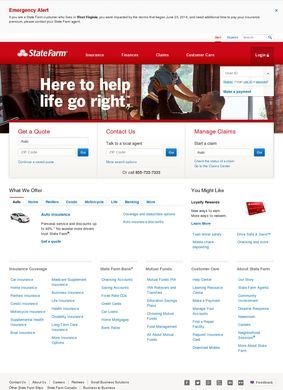
State Farm covers more financial ground than most people expect from a company they first encountered through a car policy. The site lays out its insurance lines clearly: auto, homeowners, renters, condo, life in term, whole and universal forms, plus health, disability, liability and pet cover. That spread handles the situations a typical family runs into over a few decades, and the structure makes it easy to read one line against another without getting lost in the catalogue.
Insurance lines and financial services
The life insurance section is where the choices get more interesting, because term, whole and universal policies serve genuinely different goals and the site keeps them distinct instead of blurring them into a single pitch. Someone shopping for cheap coverage during the mortgage years lands in a different place than someone thinking about a permanent policy with a cash value component. Pet insurance sitting alongside disability cover is a small sign of how wide the catalogue has grown.
Life insurance options
Insurance is only part of the picture. State Farm also runs banking products, checking and savings accounts, credit cards, home loans and mortgages, and personal loans. That places it closer to a full financial services operation than a pure carrier, and the practical upshot is that a customer can hold deposits, borrow, and insure without leaving one relationship. Whether bundling everything in one place is the right call depends on your own preference for keeping eggs in separate baskets, but the option is there and laid out plainly.
Banking products
For owners and operators, the business lines deserve their own mention. Commercial auto, business owners policies, workers' compensation and professional liability cover the core exposures a small or mid-sized firm carries, and these are the policies that tend to send people hunting for a knowledgeable contact instead of a checkout button. State Farm leans on that human side hard. Roughly 19,000 independent contractor agents work across every U.S. state, backed by something like 54,000 employees, and the agent locator connects a visitor to a specific person nearby. For commercial buyers especially, that local representation is more useful than a slick quote engine.
Commercial coverage for businesses
The investment and retirement planning piece rounds out the financial offering. State Farm puts its financial advisors forward for that work, which points to an ambition to be considered for long-horizon questions, not the annual premium alone. Pairing retirement planning with the same advisor who handles a life policy is a reasonable fit, since both depend on the same picture of a person's age, dependents and goals. The site does not oversell this corner; it states the service and points toward an advisor, and that restraint reads as honest.
Investment and retirement planning
Day to day, the website and the State Farm mobile app carry the routine tasks. Customers can manage policies, file claims, pay bills and pull quotes through either one, which is the baseline most people now expect and the part that gets used far more often than the marketing pages. Claims handling in particular is the moment a policyholder finds out what they paid for, so putting that flow on the phone rather than burying it behind a phone tree is the sort of practical decision that earns repeat business. The quote tools let a prospective customer get numbers during the early shopping stage, which keeps things low pressure.
Digital tools and claims handling
Scale is part of what this company is, and it is fair to name it. State Farm is the largest property and casualty insurer in the United States measured by premium volume, and that standing shapes how it can operate: a claims network that reaches into small towns, an agent within driving distance of most addresses, and the financial depth to pay out after a regional disaster when smaller carriers strain. Size is not automatically a virtue, and a giant insurer can feel impersonal, but the agent model is the deliberate counterweight, putting a named local face on a national balance sheet.
Which local agent should you choose?
Customer reviews on Google and Trustpilot number in the thousands across various State Farm agent pages, though ratings vary noticeably by location. That variation is worth factoring in: a national brand with 19,000 local agents means the service experience depends heavily on which office you end up with. Looking up the specific local agent before settling on one is a reasonable step.
If there is a caution worth voicing, it is the familiar one for any carrier this broad: the right policy sits inside a lot of options, and the cheapest line is rarely the one that pays cleanly when you need it. The website is good at presenting the menu and weaker, by nature, at telling any single visitor which combination fits. That gap is exactly what the agent network exists to close, so treating the site as the research step and the agent as the decision step is the sensible way to use both.
A family consolidating several policies will get the most out of the breadth here, since auto, home and life under one agent simplifies renewals and claims. A small business owner weighing commercial auto or a business owners policy should head to the agent locator and book a conversation, because those policies reward a real discussion of risk. The product range and the depth behind it make State Farm a reasonable first call for most American insurance and personal finance needs.