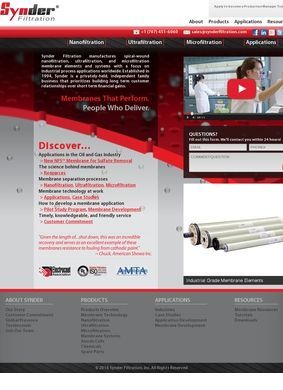
A dairy processor watching good product slip into the drain, or an electrocoat line bleeding expensive paint solids into its rinse water, usually shows up with one narrow question: which membrane, at what cut-off, will survive my process and still perform after the thousandth clean-in-place cycle. Synder Filtration works squarely on that ground. The site is built around the physical products and the engineering that surrounds them, and there is refreshingly little marketing haze to wade through before you reach specifics.
Synder Filtration is a privately held U.S. manufacturer of membrane separation technology, based in California. The pages are organized the way a technical buyer thinks: by format, by filtration technology, and by the industries each product is meant to serve. You are not handed grand statements. You are handed geometries, pore ranges, and applications, which is exactly what a plant engineer needs when the decision has real money and real downtime riding on it.
Membranes that perform across five formats
Few single-format suppliers offer this much range, and that breadth counts for anyone who has been handed one membrane type and told to make it fit a process it was never designed for. Synder Filtration builds spiral-wound, hollow fiber, tubular, plate and frame, and capillary membranes.
Carrying five geometries under one roof means the format can follow the application, instead of forcing the application to bend around whatever a supplier happens to stock. Spiral-wound elements pack a lot of area into a small footprint; tubular and plate and frame configurations tolerate dirtier, more viscous feeds that would blind a spiral element in days.
Having all of them available from Synder Filtration lets an engineer match geometry to the fouling reality of the stream. For a difficult feed, that flexibility is the whole game.
Breadth like that is the site's strongest signal.
The catalogue does not stop at the elements. Synder Filtration also sells complete membrane systems, anode cells, spare parts, and process chemicals. A plant can source the module, the housing, the consumables, and the cleaning agents from one supplier, which trims the coordination headache when something fails mid-run and a line is sitting idle waiting on a part.
Consolidating the whole consumable chain with the same manufacturer that made the membrane is a practical convenience that adds up over years of operation. It also means Synder Filtration can specify chemicals it knows are safe for its own membranes, which spares a customer the trial-and-error of matching a third-party cleaner to a foreign element and hoping the two are compatible.
Nanofiltration through microfiltration
The separation technologies span nanofiltration, ultrafiltration, and microfiltration, which together cover a wide slice of what industrial liquid separation actually demands, from tightening out small dissolved molecules at the nanofiltration end to clarifying larger suspended solids at the microfiltration end. Pair that range of pore sizes with five membrane formats and the design space becomes genuinely large. A biopharmaceutical customer concentrating a protein and a wastewater operator polishing an effluent stream are chasing very different targets, and Synder Filtration has a plausible answer for each.
The named markets bear this out: dairy, electrocoat manufacturing, biopharmaceuticals, food and beverage processing, industrial wastewater treatment, oil and gas, and textiles and dyes.
That is a spread of industries with wildly different fouling behavior, temperature limits, and cleaning regimes. A membrane that thrives in a dairy plant will not necessarily last a week in an oil and gas stream. The fact that Synder Filtration addresses these sectors by name, matching the chemistry and format each one tends to require, reads as accumulated application knowledge instead of a copy-pasted list of buzzwords.
It is the sort of specificity that only comes from having solved the problem before. Textiles and dyes, for instance, ask a membrane to recover color and reclaim water from a hot, chemically aggressive stream, while food and beverage work brings sanitary standards and gentle handling into play. Synder Filtration presenting both, side by side, without pretending one product covers everything, is a sign of an outfit that knows where the lines are.
People who deliver behind the hardware
Hardware alone rarely closes a separation problem. The hard part is picking the right membrane and proving it works on a real feed before capital gets committed. Synder Filtration handles this with in-house pilot testing, engineering support, custom application development, and membrane development programs. A customer with an unusual or stubborn stream can, in principle, send in a sample and get data back, rather than gamble a system purchase on a spec sheet and hope. That testing capacity is where a manufacturer stops being a parts vendor and starts being a partner.
The membrane development side deserves its own mention. A company that develops its own membranes, and does not simply resell someone else's, can tune chemistry and pore structure to a specific problem. Synder Filtration operating its own development programs means a novel or awkward separation is not automatically a dead end. That is a meaningful advantage for a customer whose process falls outside the standard options everyone else is selling.
Pilot testing and engineering support
The pilot testing offer is the part that should catch a process engineer's eye. Running an actual feed through candidate membranes at small scale, before ordering a full system, is how you dodge an expensive surprise at commissioning. Synder Filtration pairing that testing with hands-on engineering support means the numbers arrive with people who can interpret them and translate them into a workable full-scale design. For anyone scaling a new process, that combination cuts the risk down to something a plant can actually justify to a finance department.
The claimed track record is substantial. The company points to more than thirty years of operation and customers in over sixty countries, under the tagline "Membranes That Perform. People Who Deliver." Those figures come from the company itself and are not independently confirmed here, but they sit comfortably with a catalogue this deep and a testing operation this involved. A supplier that had lasted only a few years would struggle to support this range.
Contact is easy, which for an industrial supplier where every project starts with a conversation is exactly as it should be. The landing page carries a street address in Vacaville, California, a phone number, and a sales email, plus links to Facebook, LinkedIn, and Twitter. A prospective customer does not have to dig to reach a human being. That visibility fits the way Synder Filtration positions itself, since a membrane project is rarely a click-and-buy transaction and almost always begins with a technical discussion about the feed.
The public review trail runs much shorter than the catalogue, and it is worth saying so plainly. No customer-facing ratings surfaced on Google, Trustpilot, Yelp, or the BBB. What does exist sits on the employee side: Glassdoor carries roughly nineteen or twenty reviews averaging somewhere around 3.3 to 3.5 out of five, and they split hard.
Some staff describe a low-stress environment with reasonable benefits and generous time off; others cite office politics and limited room to grow, and a couple go so far as to title their reviews a flat warning to steer clear. LinkedIn shows Synder Filtration with close to thirteen hundred followers but no star rating attached.
None of that speaks directly to product quality or to how customers are treated, since employee sentiment and customer satisfaction are genuinely separate things. Still, a buyer weighing a long-term supplier relationship would be wise to ask a few pointed questions about staffing stability and service continuity, since the people who answer the phone in five years matter as much as the membrane shipped today. The gap between a strong product story and a quiet customer-review record is the one real caveat here, and it is worth carrying into any conversation with Synder Filtration rather than glossing over.
What the published material shows is a manufacturer with five membrane geometries, three separation technologies, seven named industries, and its own pilot-testing and development programs, backed by a claimed thirty-plus years in business and customers in over sixty countries. Nothing in that record is independently verified, and the outside review trail barely exists to check it against. What is checkable, though, is the depth and coherence of the catalogue itself, and on that measure Synder Filtration reads as a manufacturer that has actually built the range it claims, not assembled a list of buzzwords to sound like one.