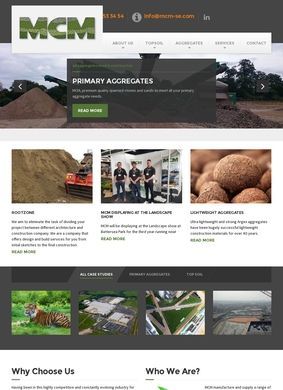
MCM has spent thirty years in soils, aggregates and waste, and the branding puts that figure right at the top of the page, reading "30 Years in Soils | Aggregates | Waste." Three decades is a long stretch in a trade where plenty of yards open and fold inside ten years, so the number is doing real work as a signal of staying power.
The company runs out of Surbiton in Surrey and supplies the construction, utility, civil engineering and landscape trades, mostly across the South East of England but nationwide when a job calls for it. What MCM sets out is a working supplier's catalogue, organised around four material lines and one waste operation, and the pages line up with that: Home, About Us, Soils, Aggregates, Concrete, Construction Waste, News and Contact.
Soils come first and come with real detail. The range covers British Standard topsoils and subsoils along with higher-performance blends, and the split between landscape use and construction use is a meaningful one. A decorative planting scheme and a structural fill are not asking for the same material, and MCM sorts its soils accordingly. That British Standard point is worth stressing, because topsoil made to a recognised standard is a different proposition from unscreened dirt sold by the ton, and a landscape architect writing a specification will care about the distinction.
Aggregates split into primary and recycled stock, sorted by what a job needs, whether that is general building, drainage or highways work. The recycled line matters for anyone under pressure to cut the carbon and the cost of virgin quarried stone, and having it sit on the same order sheet as primary aggregate is genuinely convenient. Drainage stone and highways aggregate are graded jobs where the wrong material fails inspection, so a supplier that keeps the grades straight earns repeat orders on that alone.
Ready-mixed concrete rounds out the supply side. MCM pairs the concrete with pump hire that can run day or night, which counts for a great deal on a pour that has to happen after dark or reach a spot no truck chute can get to.
Construction waste, handled end to end
The construction waste service is where MCM moves past straight supply. It covers inspection, testing, removal and disposal of both hazardous and non-hazardous material, which for a contractor closes a loop that would otherwise mean bringing in a separate waste carrier and hoping the paperwork lines up. Keeping supply and disposal under one roof spares a site manager a stack of phone calls and a second set of invoices.
Hazardous and non-hazardous streams are treated as distinct, which legally they are, and handling both means MCM can take material off a site that a general skip firm would turn away. Contaminated spoil in particular brings duty-of-care paperwork most contractors would rather hand to someone who does it daily. On a demolition or remediation job, that breadth is the difference between one supplier relationship and several stitched together, and it is the sort of service the utility and civil engineering clients named on the site would lean on hardest.
Rapid testing for contaminated soils
On a dig that turns up questionable ground, the wait for lab results can stall a whole programme while plant sits idle, so quick classification of what is safe and what is not matters a great deal on a live site. MCM folds that testing into the same waste operation, which means the firm arranging disposal is also the one identifying what the material is.
That removes a handoff, and handoffs are where site programmes usually bleed time. For anyone managing muck away on a tight schedule, it is a sensible piece of vertical integration and probably the most persuasive single thing on the site.
Bulk bags and the online shop
Smaller jobs are covered too. The bagging service supplies multi-trip bulk bags for flexible delivery around the UK, which suits a landscaper or a self-builder who has no use for a full tipper load and nowhere to put it. There is an online shop as well, so part of the range can be ordered without picking up the phone at all, which is a small mercy for anyone who has spent a morning on hold to a builders' merchant.
It is a practical spread. The same supplier can handle a highways contractor pulling in hundreds of tonnes and a homeowner reworking a back garden, and MCM keeps that small order in the same catalogue as the big one instead of pushing it to the side.
Finding the company, and reading its name
Contact is straightforward. MCM lists a phone number, an email address, a full postal address and a contact page of its own, so reaching a real person takes no digging around. A physical yard in Surbiton and a landline both add weight, marking this as a firm with a genuine place of work behind the website, which is what a trade buyer checks before opening an account.
Beyond the material pages, About Us, News and customer testimonials fill in the surrounding picture, and project updates give some sense of live work instead of a static shopfront. A third-party business record on ZoomInfo backs up the topsoil, aggregate and waste-management description, and notes an aim of simplifying the supply chain, which squares with the one-supplier-for-everything logic that runs through how MCM is set up.
Customer testimonials sitting on the site are the company's own selection, so they carry the usual caveat that comes with self-published praise, but their presence at least points to named jobs behind the sales pages.
Outside reputation is where the record runs short. A search for independent reviews of this particular supplier turns up very little, and the culprit is the name. MCM is generic to the point of collision: the results fill with a luxury goods label of the same initials, an electronics distributor, a hotel, a structural engineering firm at an unrelated domain, even a bicycle model, none of them this Surbiton soils and aggregates business.
No review platform listing specific to the company came up at all. That absence is not a mark against the work itself, though it does mean a prospective client cannot lean on a wall of star ratings and has to weigh MCM on the strength of the site and a direct conversation instead.
For a site manager or a civil engineering buyer who wants soil, stone, concrete and licensed muck away from a single number instead of four, MCM is worth a direct call, and the rapid contaminated-soil testing is the thing to raise first, since few competitors fold it into the same contract. A landscaper after a couple of graded bulk bags is served just as well through the online shop. The thirty years make the headline, but the breadth stacked behind that number is the better reason to get MCM on the phone.