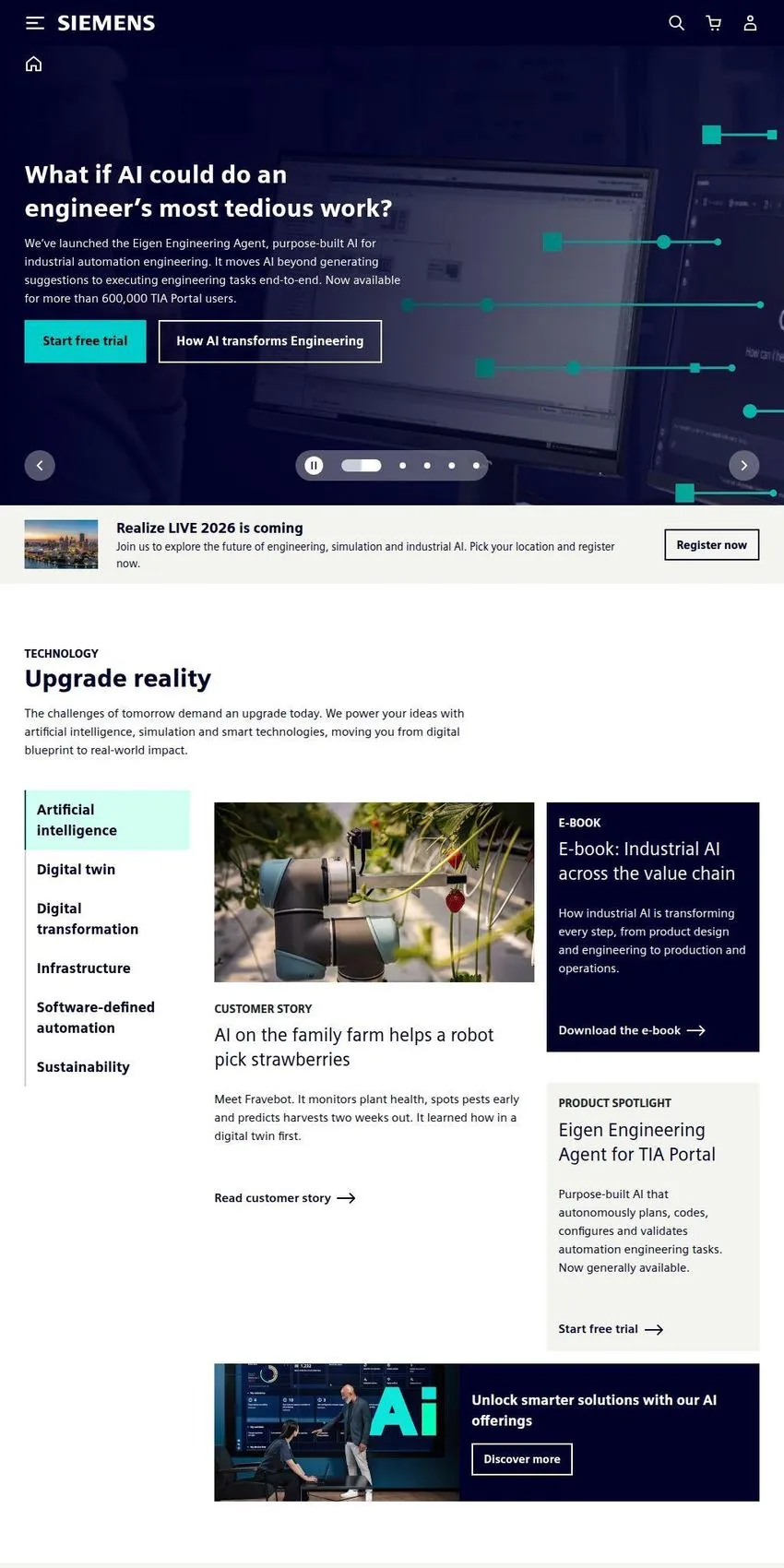
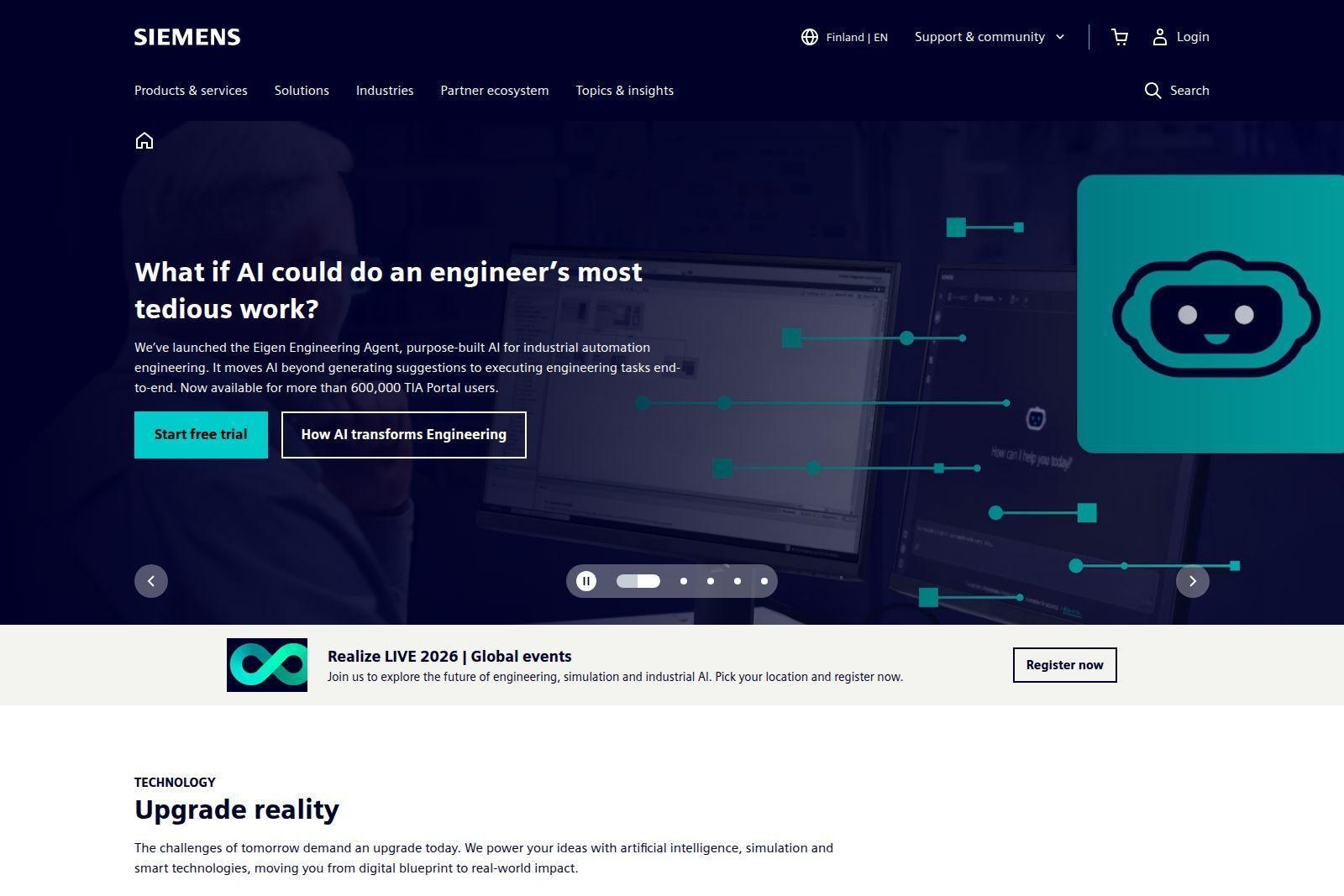
Siemens now points its attention at the Eigen Engineering Agent, an artificial-intelligence assistant built to take on the repetitive engineering work inside industrial automation. It sits on the same digital shelf as NX X, the computer-aided design and manufacturing suite, Gridscale X for power networks, Building X for the guts of a building, and Vectron X, which is a locomotive. The naming looks like a marketing tic until you notice what it is doing, which is stapling a sprawling and otherwise unrelated set of products to one recognizable line.
A chip-design tool sitting one click away from a train is a fair summary of the company behind the page.
Siemens AG has been at this since 1847, when, by its own telling, it started as a workshop in a back courtyard in Berlin. The gap between that courtyard and a present-day catalogue of industrial AI is the thread the site keeps pulling, and the History section under the Company menu walks the timeline in genuine detail for anyone who wants to follow it. Very few businesses can point that far back and still be selling to the frontier of their field.
Siemens splits itself into three sectors, and the site is built to mirror that split. Industry covers smart factories and the automation software that keeps them running, while Infrastructure reaches into buildings, electrical grids, and the tangle of systems that keeps a city's power and utilities alive. Transportation is narrower: rail and the broader mobility business, which is where the locomotives belong. Line the three up and you get a company that manufactures the machines, wires the buildings those machines live in, and builds the trains that tie the whole thing together.
Because of that spread, the site has to answer several kinds of visitors at once: a manufacturing engineer weighing automation software, a city planner comparing grid or building platforms, a rail operator sizing up rolling stock, an investor reading the quarterly numbers. All of them land on the same domain, and the navigation has to keep them from colliding. It mostly manages it, since the three sectors give each visitor a clear first door to walk through.
It operates in more than two hundred countries, and that reach is less a bragging point than a design constraint. A catalogue meant to serve buyers on every continent, across dozens of regulatory regimes and languages, cannot be a plain list. The site handles this by pushing regional and language variants, so the same product can be reached through the lens of a local market. Scale of that kind is also why the company leans so hard on standardized software. A platform ships and updates in a way a physical product never can.
The product shelf and the sections around it
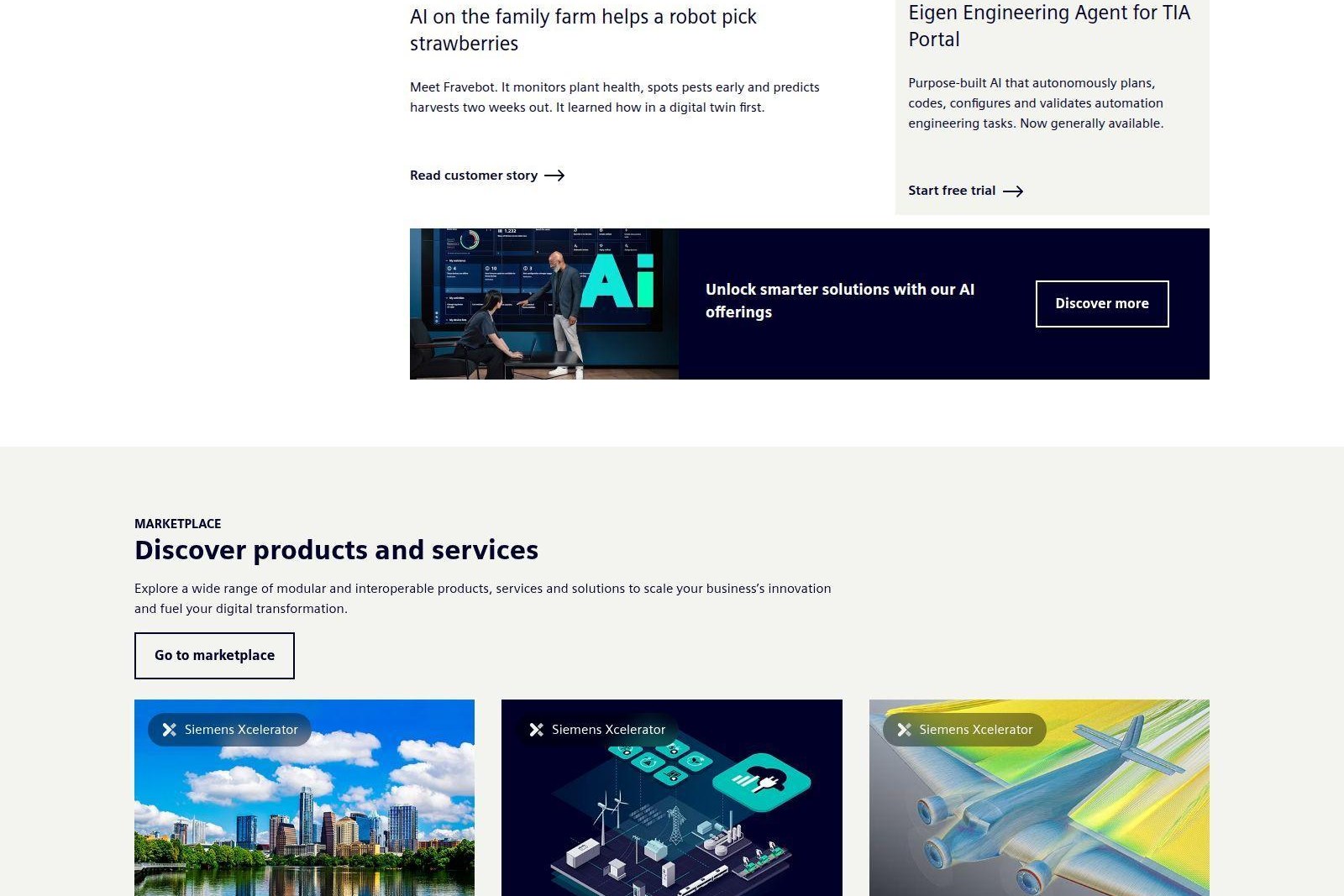
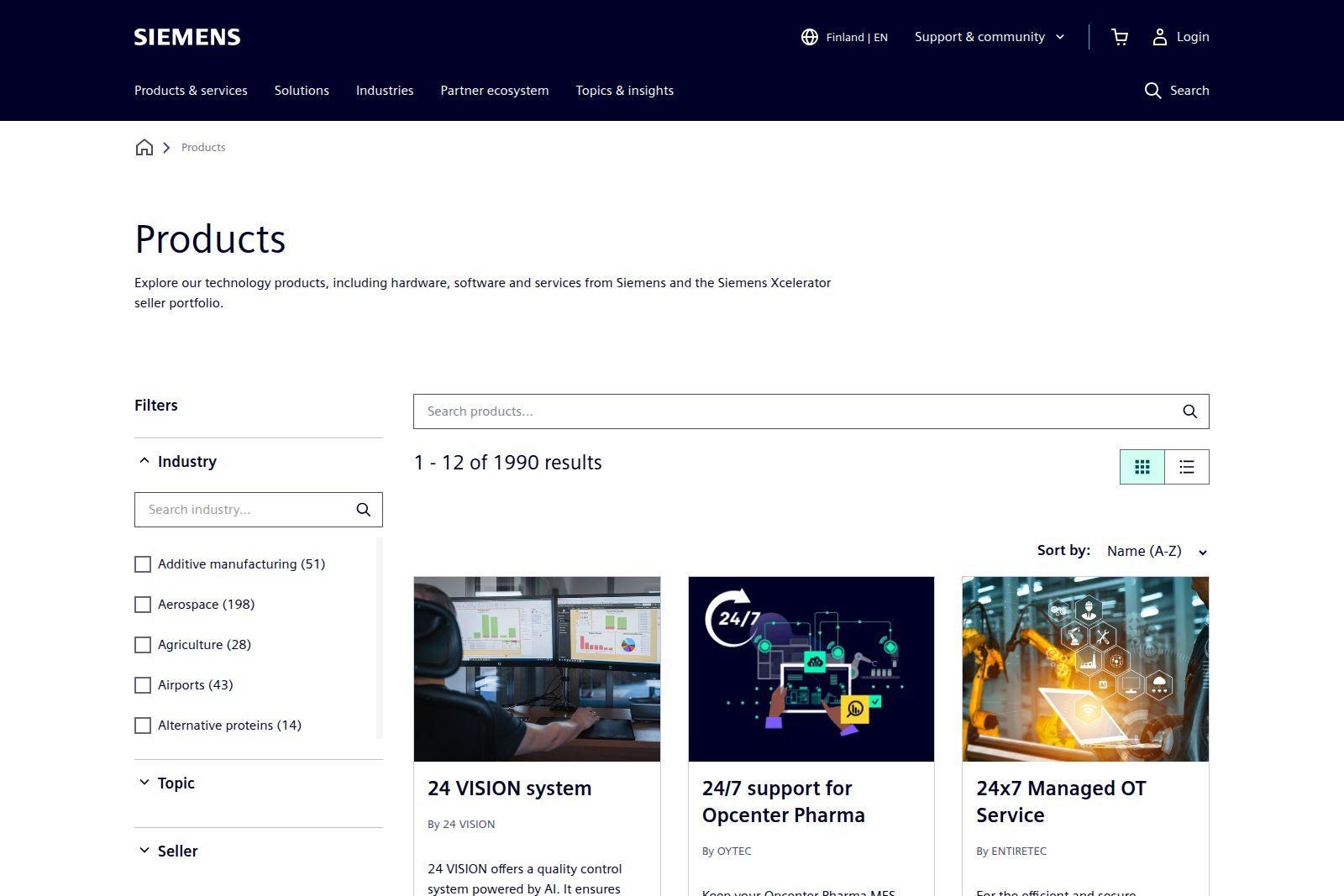
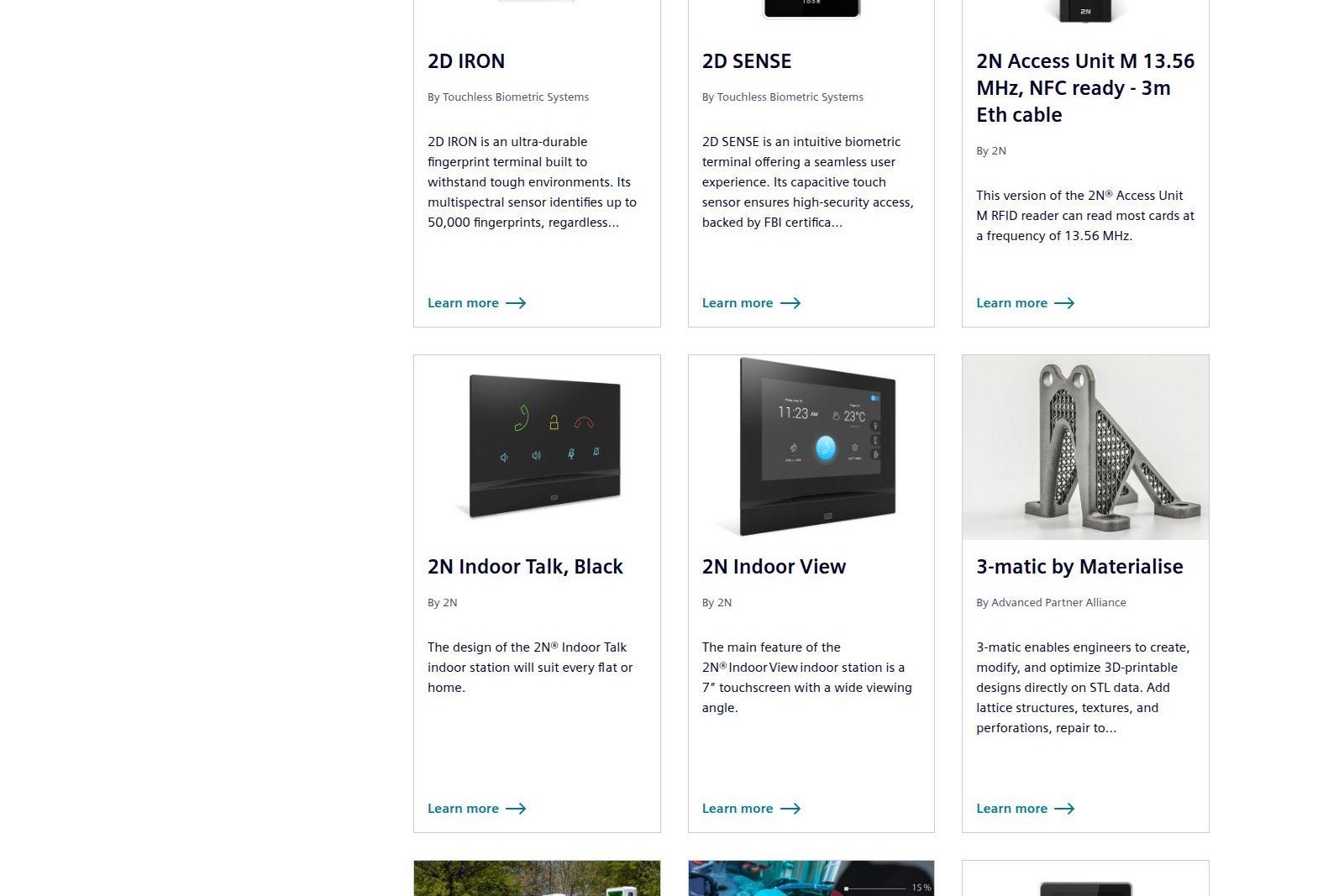
The Marketplace tab is the commercial heart of the site, closer to a technical catalogue than a storefront or a business directory listing, and everything in it wears that house naming style with the X pinned to the end. The convention does real work. It tells an engineer at a glance that a page belongs to the current generation of the Siemens portfolio, and it papers over the fact that these products come from businesses with very different histories and buyers. A grid-management platform and a CAD package have almost nothing in common at the level of daily use, yet the shelf presents them as siblings.
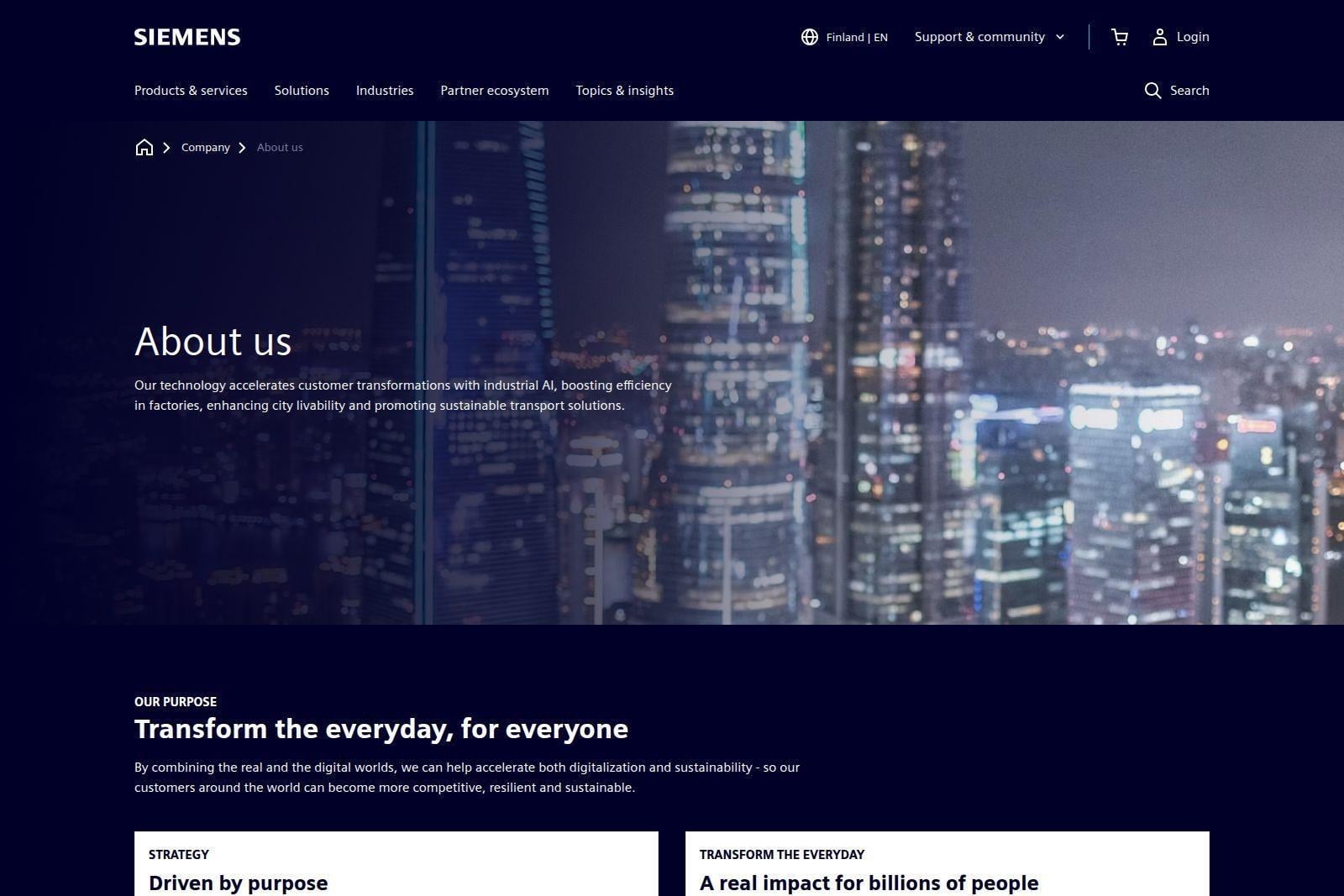
Four more sections sit around the Marketplace. Technology gathers the research and forward-looking material, including the topic pages on artificial intelligence and digitalization where Siemens sets out what it thinks the next decade of factories and grids looks like, and Ecosystem covers the partner network, the third parties who build on top of the platforms. News runs off the press center Siemens operates at its own media hub, while Company is the reference section, holding About, Insights, Careers, and the History timeline. The divisions line up cleanly with how the business runs, which makes an organization of this scale easier to reason about than it has any right to be.
One idea runs underneath most of the catalogue, and it is the digital twin: a working software model of a physical thing, a machine, a building, a rail line, kept in step with the real object so it can be tested, tuned, and predicted against before anything happens in the world. The engineering agent, NX X, and the grid and building platforms all lean on some version of it. Once you see that, the portfolio stops looking like a random pile of X-suffixed products and starts looking like one method pointed at a dozen industries.
Industry and industrial AI
The Industry sector is where Siemens has planted its clearest flag, and industrial AI is the banner over it. The Eigen Engineering Agent is the headline, an assistant aimed at the automation engineers who would otherwise wire up control logic by hand, line by line. Behind that headline sits the slower, less photogenic work the company has been compounding on for decades: the factory-automation software, the digital-twin models that let a plant be simulated and stress-tested before a single beam is bolted into place, the controllers that keep a production line in motion once it is live. This is where I stopped skimming and started reading, because the depth here is earned rather than merely claimed. An engineering agent is only useful sitting on top of that unglamorous layer beneath it, and Siemens has more of that layer than almost anyone selling into a factory today.
Grids, buildings, and the mobility side
The other two sectors carry most of the X-named catalogue. Building X runs the operations of a building, its energy use and its internal systems handled together as one picture. Electrification X and Gridscale X both deal with power, one at the level of distribution inside a facility and the other at the scale of the grid that feeds whole regions, and then there is Vectron X, a real locomotive with a product page, whose place in the same family as a semiconductor design tool is the plainest measure of how wide Siemens has spread. What ties Building X, Gridscale X, and Vectron X together is durability. Each one is built to run for twenty or thirty years without a hard stop, and the software is sold on exactly that promise of continuity.
The software and PLM division
Set a little apart from the rest is a dedicated software and product-lifecycle-management division, run as its own operation with its own identity. This is the engineering-software business in the fullest sense: NX X for design and manufacturing, plus a deeper set of tools that reach all the way into chip design and semiconductor work. It is a reminder that Siemens sells more than hardware and the code that runs it; it also sells the design environments inside which other companies invent their own products, down to the silicon. For an engineer or a procurement lead, keeping that division distinct is the sensible arrangement: the lifecycle and chip-design tools answer to a completely different buyer than a factory-floor controller does, and a plant manager and a semiconductor designer are not shopping in the same aisle.
The history section and the sustainability numbers
Company is also where the long view lives. The History section traces the line from that Berlin courtyard in 1847 to the Siemens of the present, and it is unusually thorough for a corporate timeline, the sort of resource a student or a watchful competitor could spend a full hour inside without running dry. Careers and Investor Relations sit alongside it, the second making plain that this is a publicly traded stock corporation under German law, an Aktiengesellschaft that answers to its shareholders. That legal status shapes how the whole enterprise behaves, since a listed company reports its numbers on a schedule and cannot quietly bury a bad year.
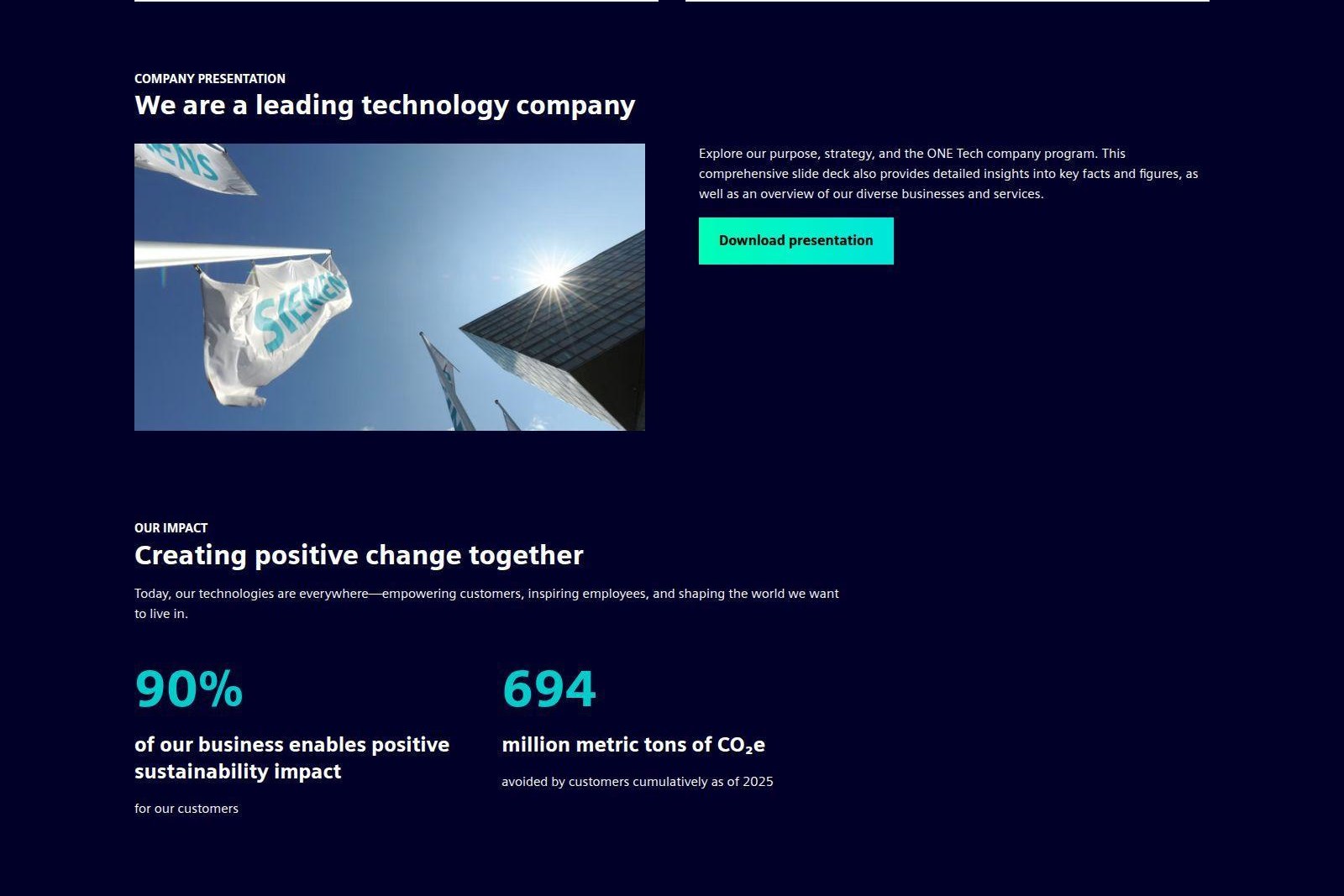
The sustainability pages carry the hard figures, and they are specific enough to be worth repeating. Siemens reports putting EUR 438 million into employee education and training, logging 58,000 hours of employee volunteering, and directing EUR 47.9 million into community investment. It states that 90 percent of its business enables a positive sustainability impact for its customers, and points to 694 million metric tons of CO2e that those customers have cumulatively avoided. Numbers like these are easy to print and hard for an outsider to independently check, so a reader is right to hold them at arm's length. Even so, specific claims are more accountable than vague ones, and these come attached to real units.
So the site works best as a map of a company that is genuinely everywhere, honest about which parts are the growth engine and which are the deep foundation the rest stands on. The catalogue is the summary; there is no shorter one. Bring it a concrete problem, a factory to automate, a grid to modernize, a product to design down at the chip level, and it routes to the exact division that owns the answer. What the site cannot settle on its own is scale: the same Siemens portfolio that overshoots a single production line matches the size of a national grid or a rail fleet, and the fit depends entirely on which end of that range the problem sits.
Business address
Siemens Aktiengesellschaft
Werner-von-Siemens-Strasse 1,
Munich,
80333
Germany
Contact details
Phone: +49 89 38035491
404 Anonymous (not verified) Mon, 08/12/2019 - 10:41 Please use another Browser It looks like you are using a browser that is not…
403 Anonymous (not verified) Mon, 08/12/2019 - 10:41 Please use another Browser It looks like you are using a browser that is not…