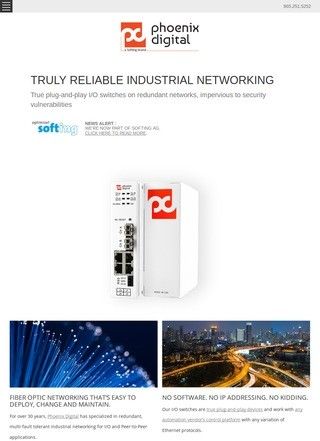
One number frames everything else on the site: 300,000 nodes running in the field. Phoenix Digital puts that figure up front, covering oil and gas plants, water and wastewater systems, mines, bridges and tunnels, and power generation sites. These are not forgiving environments for electronics. Heat, vibration, electrical noise and the simple fact that a network outage can halt a process line all push requirements toward equipment that just keeps working. That is the corner of the market Phoenix Digital has chosen, and the whole site is built around it.
Fiber optic modules for industrial plants
Phoenix Digital makes fiber optic communication equipment for industrial automation, and has been doing so since 1992. The product range is narrow on purpose. Fiber optic communication modules sit at the centre of it, joined by Ethernet-based smart switches, fiber optic media converters, and multiport network switches. The named product lines tell you more than a generic catalogue would. The OCR module is DIN-rail mounted, multi-fault tolerant, and built for redundant Ethernet, with a plug-and-play setup and, notably, no software updates required. That last detail is unusual to advertise and it speaks to the kind of customer being courted: a plant engineer who does not want firmware patch cycles on a switch buried in a substation.
Platform compatibility and integration
The OCP module is the more specific of the two, engineered for Rockwell Automation's 1769 CompactLogix platform. Instead of describing fiber networking in the abstract, Phoenix Digital names the control platforms it integrates with: Rockwell ControlLogix, CompactLogix and the older PLC-5, plus Honeywell Experion and ControlEdge on the DCS side. A control engineer can land on a platform page, see their own equipment listed, and work out compatibility without a sales call. That is a sensible way to organise a technical site, and it is the sort of structure that gets harder to replicate the deeper you go into the product tree.
Redundancy and fault tolerance in networks
Redundancy and fault tolerance run through the technical claims. The Phoenix Digital networks are described as high-availability and fault-tolerant, with support for DLR, the Device Level Ring topology used in industrial Ethernet to keep a network running when a single link fails. In a ring, traffic simply reverses direction around the break, so a severed cable or a dead node does not take down the whole segment. For the sectors Phoenix Digital lists, that property is the point. A water treatment plant or a power station cannot pause while someone traces a fault, and the marketing language here, for once, lines up with a real engineering requirement rather than floating free of it.
Ownership by Softing AG
There is a corporate wrinkle worth noting. Phoenix Digital is now a division of Softing AG, a German measurement and connectivity group, which acquired the Phoenix Digital assets at a date the visible pages do not pin down. The acquisition matters for anyone weighing long-term support and parts availability, since it puts a larger parent behind the brand. The site keeps its own identity and product focus, so a returning customer would not feel the change in day-to-day use, but the ownership detail is the kind of thing a procurement team will want to confirm directly when planning a multi-year deployment.
The "global leader in fiber optic communication networks for industrial automation" line is the company's own description of itself, and it should be read as such. Self-applied leadership claims are cheap, and this one cannot be checked from the site alone. What can be checked is the substance underneath it: a coherent product set, named platform support, a stated install base, and a clear sense of which industries the equipment is aimed at. The claim does the work of a headline; the engineering pages do the work of proof. Phoenix Digital's catalogue holds that line.
Beyond the core products, the site carries a platform-specific section, an integrators contact page, and a blog. The integrators page is a telling inclusion, because in this market the buyer is often a systems integrator specifying parts on behalf of an end client, not the plant owner directly. Addressing that audience by name shows Phoenix Digital understands its own sales channel. The blog rounds out a site that is otherwise heavily product-led, though its depth and update frequency are not clear from the outside.
On contact, there is a page at the /contact-us/ address, framed around integrators. A phone number and email do not surface in search results and only appear once you navigate there directly. For a product category like this, that is a minor point. The people buying multi-fault-tolerant fiber switches for a power plant are perfectly willing to click through, and many will reach out through an integrator anyway. A phone number placed higher up would help search snippets, though a serious buyer will find the details in a click regardless.
Where can you find customer reviews?
Where the picture gets sparse is public feedback. A search turns up zero third-party customer reviews for Phoenix Digital specifically. Yellow Pages carries a listing with no reviews submitted against it, and a SoftwareWorld profile under a similar name turns out to be a different company, a digital marketing agency unrelated to the fiber optic manufacturer. None of that counts against the engineering, and it is normal for industrial component suppliers, whose customers are plant engineers and integrators rather than the kind of consumers who leave star ratings. It does mean a prospective buyer cannot lean on a crowd of public opinions and will have to judge Phoenix Digital on its technical claims, its install base, and references obtained directly from existing users.
Speaking directly to control engineers
What Phoenix Digital does well is talk to its actual audience. The product names, the platform compatibility lists, the redundancy topology, and the focus on harsh-environment sectors all point at someone who already works in industrial control and knows what they are specifying. There is little here for a casual visitor, and Phoenix Digital does not seem to want one. A reader outside the field would find the pages dense and the value hard to gauge, which is the right trade-off for hardware that lives in substations and pump houses.
Weigh Phoenix Digital as a long-running specialist with a focused catalogue, a named place in the Rockwell and Honeywell ecosystems, a six-figure node count it puts on the table, and a German parent company standing behind it, set against a near-total absence of public reviews and contact details that take one extra click to reach. The 1992 founding date and the 300,000-node figure are the two numbers a buyer will keep returning to.
Business address
Phoenix Digital
7209 Chapman Highway,
Knoxville,
TN
37920
United States
Contact details
Phone: +1-865-251-5252