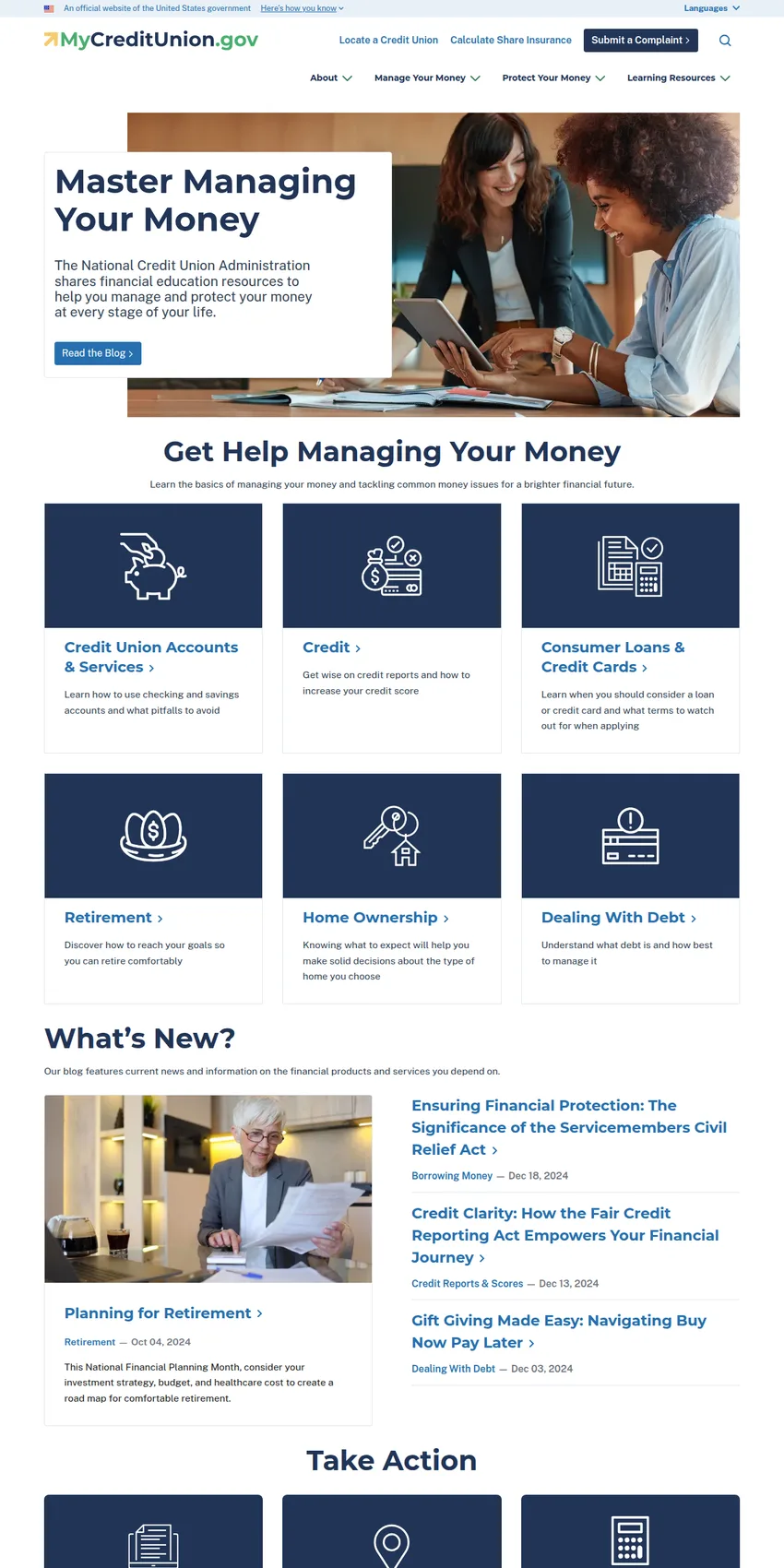
MyCreditUnion.gov is the consumer education website of the National Credit Union Administration, the independent federal agency that charters and supervises the country's federal credit unions. The site gathers plain-language guidance on everyday money decisions, among them the choice between leasing and buying a vehicle, and it connects members of credit unions to a federal complaint channel. Because the same agency writes the rules under which a federal credit union may lease a car or other property to a member, this resource sits alongside the other federal reference points a consumer uses when a lease is held by a credit union.
The agency behind the site
Congress created the National Credit Union Administration in 1970 and made it an independent agency of the executive branch. It charters new federal credit unions, examines them for safety and soundness and for compliance with consumer law, and administers the National Credit Union Share Insurance Fund. That fund, backed by the full faith and credit of the United States, insures the share accounts of members at federal credit unions and most state-chartered credit unions up to the standard limit of 250,000 dollars per account category.
The agency works from Alexandria, Virginia, and is run by a three-member board whose members are nominated by the President and confirmed by the Senate. Like other federal banking supervisors, it is funded by the institutions it oversees rather than by congressional appropriation, so operating fees and insurance-fund payments from credit unions cover its budget. Its consumer-facing work, including this website and a telephone assistance center, is handled by the agency's office for consumer financial protection.
The site carries no advertising and promotes no individual credit union.
Why a credit union regulator addresses leasing
A federal credit union is allowed to lease personal property to its members, and the conditions for that activity are set out in Part 714 of Title 12 of the Code of Federal Regulations. The regulation covers both direct leases, where the credit union deals with the member itself, and indirect leases arranged through a third party such as an automobile dealer. Vehicles are the property members lease most often, though the rule reaches other personal property as well.
The standards are exact. A federal credit union may enter only net, full-payout leases, meaning the payments plus any guaranteed residual value are expected to return the credit union's full investment and costs. The unguaranteed portion of the estimated residual value cannot exceed twenty-five percent of the property's original cost; where the estimate runs higher, a financially capable party such as the manufacturer or a well-rated insurer must guarantee the excess. The credit union has to keep salvage powers over the property so it can act if conditions change. Every consumer lease must follow the Consumer Leasing Act and its implementing rule, Regulation M.
Leasing compared with borrowing
Much of the site's vehicle content sets a lease against an auto loan so a reader can weigh the two. A lease covers the use of a car for a fixed term and mileage allowance, with the member returning the vehicle or paying to buy it at the end, while a loan builds toward ownership. The material explains how monthly cost, mileage limits, wear charges, and end-of-term options differ between the two, and it lists the questions a member should ask before signing.
Consumer protections and disclosures
Regulation M requires a lessor to hand the consumer a standard set of disclosures before a lease is signed, covering the amount due at signing, the number and size of payments, and the charges that can arise at the end of the term. The rule limits early-termination and excess-wear charges to reasonable amounts and constrains the balloon payment a lessee can face. The website restates these rights in ordinary terms so that a member reading about a lease understands what a credit union or other lessor must tell them and what it may charge.
Using the site
The website is organized around consumer topics rather than agency structure. Sections cover credit union basics, share insurance, loans and credit, fraud prevention, and financial life events, with calculators and articles aimed at people without a finance background. Content appears in English and Spanish. A share-insurance estimator lets a member check whether their accounts are fully covered.
The other role of the site is access to the NCUA Consumer Assistance Center. A member who cannot settle a problem with a federal credit union directly can file a complaint with the center, which reviews disputes and answers questions about federal consumer financial law. The center operates by telephone on weekdays and accepts complaints through an online portal, and it helps a consumer reach the correct regulator when the institution involved is supervised by a different agency. For someone weighing a credit union vehicle lease or already holding one, the pairing of neutral explanation with a working complaint route is what places this government resource within the leasing services field.






Business address
National Credit Union Administration
1775 Duke Street,
Alexandria,
Virginia
22314
United States
Contact details
Phone: (800) 755-1030