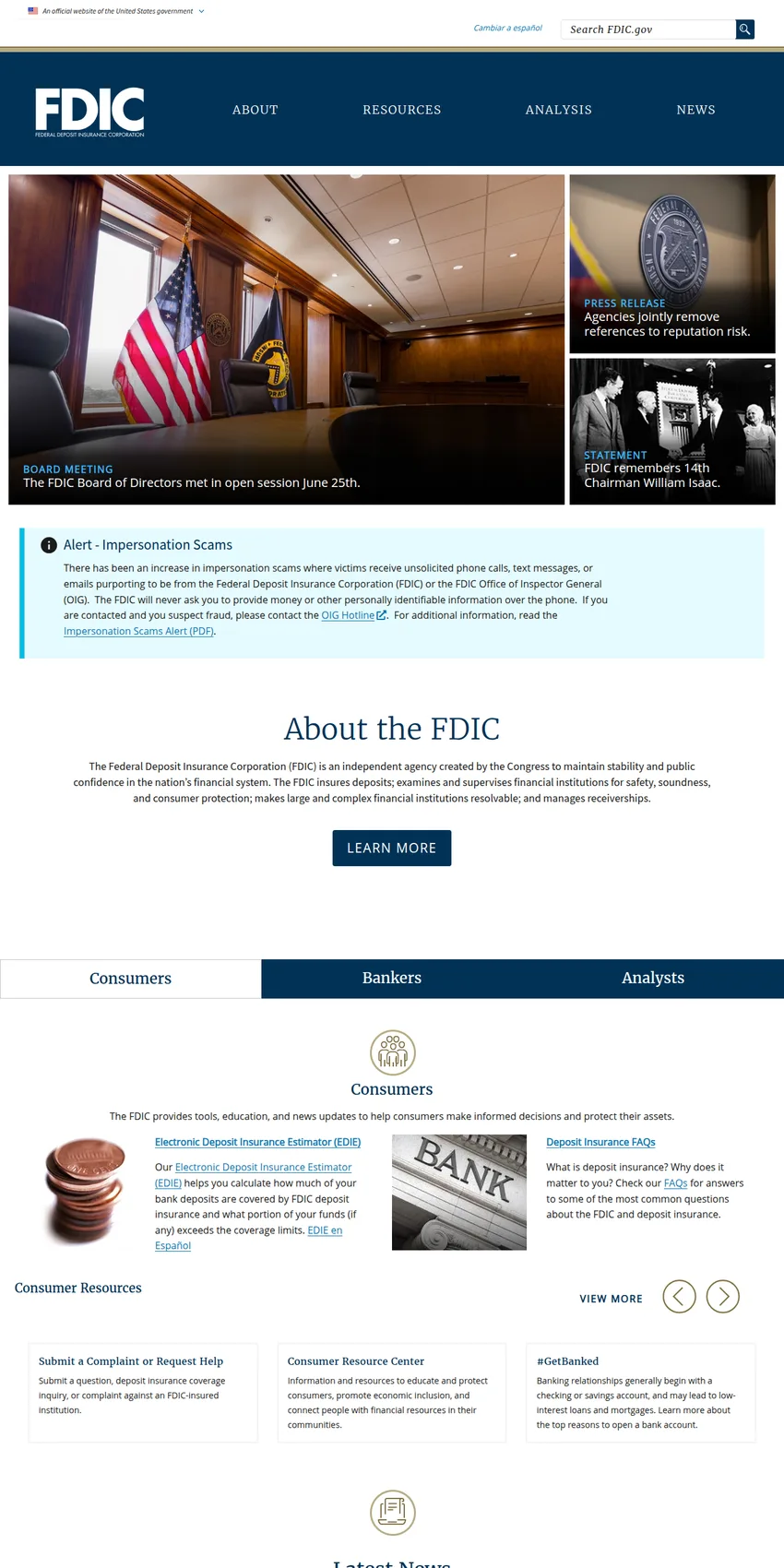
The Federal Deposit Insurance Corporation is the independent federal agency that insures deposits at American banks and supervises much of the state banking system. It publishes consumer guidance on borrowing and leasing, examines the banks it oversees for compliance with federal leasing-disclosure rules, and runs a national assistance center where a bank customer can raise a complaint about a loan or lease. Because a state-chartered bank the agency supervises may itself write vehicle and equipment leases, the FDIC is one of the federal authorities a consumer encounters when a lease is held by such an institution.
Origins and mandate
Congress established the FDIC in the Banking Act of 1933, during the banking collapse that followed the 1929 crash, and deposit insurance took effect on the first day of 1934. The insurance protects each depositor at an insured bank up to the standard limit, currently 250,000 dollars per depositor, per bank, for each ownership category. That figure was raised from 100,000 dollars during the 2008 financial crisis and made permanent by the Dodd-Frank Act in 2010. The agency reports that no depositor has lost a penny of insured funds since insurance began, a record that anchors public confidence in the banking system.
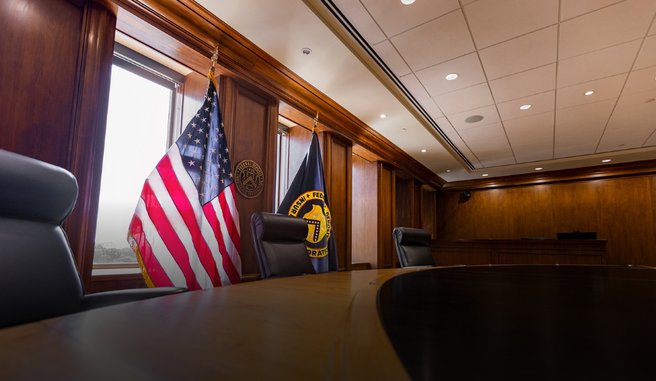
Beyond insurance, the FDIC is the primary federal supervisor of state-chartered banks that do not belong to the Federal Reserve System, together with many state savings institutions. Its examiners review these banks for safety and soundness and for compliance with consumer financial law, and the agency acts as receiver when an insured bank fails, paying insured depositors and selling the failed bank's assets. The corporation is funded by premiums paid by insured banks and by interest on its investments, not by taxpayer money. A five-member Board of Directors governs the agency from its headquarters in Washington.
Why a deposit insurer addresses leasing
The banks the FDIC supervises are permitted, within limits set by state and federal law, to lease personal property such as vehicles and equipment to their customers. When a state nonmember bank does so, the FDIC is the federal agency that checks whether the bank follows the consumer-protection rules that govern the transaction. The central rule is the Consumer Leasing Act, which Congress added to the Truth in Lending Act in 1976 and which is carried out through Regulation M. The rule applies to consumer leases of personal property that run longer than four months. Authority to write Regulation M passed to the Consumer Financial Protection Bureau in 2011, while the FDIC keeps the job of examining and enforcing the rule at the banks it supervises.
The agency's expectations are written down for its examiners. The Consumer Compliance Examination Manual devotes a chapter to consumer leasing, setting out how staff test a bank's lease disclosures and charges. Regulation M requires a lessor to give the consumer a standard disclosure of the cost of a lease before signing, including the amount due at the start, the payment schedule, and the charges that may arise at the end of the term. It also limits balloon payments and requires that early-termination and excess-wear charges be reasonable. FDIC examinations check that supervised banks meet these standards.
Consumer education on loans and leases
The FDIC produces consumer material that treats leasing alongside other credit choices. Its financial education program, Money Smart, has been offered since 2001 in versions for adults, young people, older adults, and small business owners, and it teaches budgeting, borrowing, and the trade-offs between leasing and buying. The agency's consumer pages explain the disclosures a shopper should expect and the terms a lease contract contains. The register is neutral and instructional rather than promotional, and the guidance names no particular lender.
The assistance center
Consumer complaints and questions reach the FDIC through its National Center for Consumer and Depositor Assistance. A customer who cannot resolve a dispute with a supervised bank, including a dispute over a lease, can contact the center by telephone on weekdays and Saturday mornings or through an online form. Staff review complaints against the applicable law, and where a bank is supervised by another federal agency they direct the consumer to the right office. A companion directory lets a user confirm which agency oversees a given bank and whether the bank is insured.
Reach and public tools
The agency maintains public databases that a consumer or researcher can query, among them a directory of insured institutions and quarterly financial data on every insured bank. These tools sit next to the consumer guidance and the complaint channel on the agency's website. For a person considering a lease from a state-chartered bank, or holding one already, the pairing of clear disclosure rules, examinations that enforce them, and an open complaint route is what places this federal resource within the leasing services field.
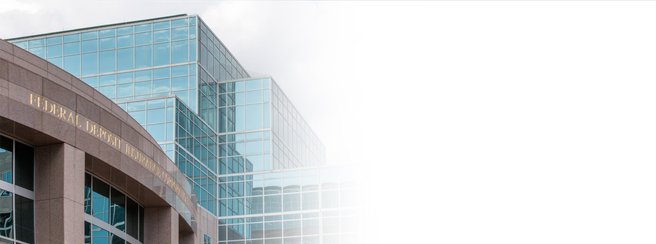



Business address
Federal Deposit Insurance Corporation
550 17th Street NW,
Washington,
DC
20429
United States
Contact details
Phone: (877) 275-3342