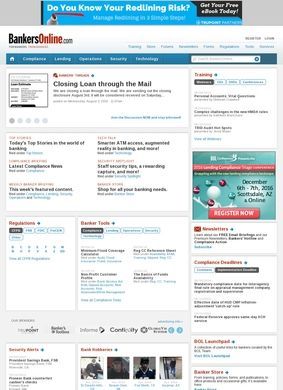
Bankers Online is a U.S. compliance and information resource for people who work inside banks and financial services firms, online since 2000. The audience is narrow and the content matches it: compliance officers, risk managers, and operations staff who spend their days inside federal banking rules and need a place to check their reading against someone else's. The site pulls more than 130,000 unique visitors a month, which for a subject this specialized is a real number, not a vanity figure.
Searchable library of regulations
The core of the site is a searchable library of articles and regulatory guidance. It covers the regulations that consume a compliance department's week: TILA and Reg Z, BSA and AML obligations, flood insurance under Reg H, the Fair Credit Reporting Act, FinCEN rules, and others in that family. What sets it apart from a plain blog is that Bankers Online also publishes full-text reproductions of the federal regulations themselves, with annotations attached. That matters in practice, because a banker dealing with a tricky disclosure question often needs the actual regulatory text and a working explanation of it side by side, and chasing both across separate government sites wastes time.
Annotations that explain regulatory text
The annotation layer deserves a closer look, because it is where Bankers Online does work that a reader cannot easily replicate. Pulling a regulation off a federal site is free; understanding which clause applies to a specific deposit product, and where the common interpretation has shifted, is the harder part. By sitting commentary next to the statutory language, the site collapses two steps into one. For a small institution without an in-house legal team, that arrangement is the difference between a usable reference and a pile of raw text.
From subject-matter experts and peer forums
Then there is the human layer, which is the part of Bankers Online that is harder to copy. A section called Guru Central is staffed by subject-matter experts who answer compliance questions submitted by working bankers, under the "Ask a Guru" banner. This is the kind of thing that gives the site its reputation: a flood compliance question or a CIP edge case gets a considered answer from someone who has handled it before, instead of a forum guess.
Alongside the Gurus run peer-to-peer discussion forums, carried under the tagline "For Bankers. From Bankers," spanning HR, operations, compliance, and management. The forums and the Guru answers together turn the regulatory text into something closer to a working community of practice, and they are a large part of why people come back to Bankers Online instead of treating it as a one-time lookup.
Compliance tools and template documents
The library and the Q and A would already be useful on their own, but Bankers Online layers practical materials on top. There are downloadable compliance tools and template documents, the example given being privacy opt-out notices and model forms, the sort of artifact a small bank's compliance team would otherwise have to draft from scratch or pay a vendor for. Briefings and newsletters keep readers current on regulatory movement, which is the whole game in a field where a single FinCEN advisory can change a procedure overnight. Taken together, these materials make Bankers Online less a static archive and more a place a compliance team can return to as the rules shift.
Content comes from two directions: editorial staff and the banking professionals themselves. That mix is a strength and a thing to watch at the same time. Practitioner-contributed material carries the credibility of people who run these processes daily, but it also means quality and currency can vary across the library, and a reader checking an older article should confirm the underlying rule has not since moved. The site itself claims to be "the internet's leading authority for banking and financial services professionals," and while that is its own marketing line, the depth on offer at least makes the boast defensible.
The commercial side is visible but not hidden behind the content. Bankers Online sells advertising and sponsorship to banking vendors, and it maintains a directory of sponsors and service providers. Anyone using the site should keep that in mind when a sponsored vendor turns up next to editorial guidance. It is a common model for a free industry resource, and the more important point is that the substantive regulatory material on Bankers Online does not appear gated behind it.
Who is this genuinely for? A compliance officer at a community bank or credit union is the obvious fit, someone who needs a fast read on a regulation and a second opinion from a peer who has been through the same examiner conversation. Operations staff handling day-to-day disclosures, model forms, and BSA workflows are well served too. A consumer looking for a bank to use is in the wrong place entirely; this is a professional reference, built for the people behind the counter and the back office, not the people in front of it.
It is also worth being clear about what Bankers Online does not try to be. It is not a law firm, and the guidance, however expert, is not legal advice tailored to one institution's facts. The Gurus answer questions for a general audience of bankers, and the forums trade in shared experience. A reader treating Bankers Online as a substitute for counsel on a high-stakes matter is asking more of it than the format can deliver. Used as a research starting point and a sanity check against how other practitioners read a rule, it fits its lane well. The distinction sounds obvious, but in a field where examiners hold institutions, not websites, accountable, it is the boundary that keeps the resource useful rather than dangerous.
The breadth is the selling point and also the question. A site that tries to cover TILA, BSA, AML, flood, FCRA, and FinCEN, plus forums, plus templates, plus newsletters, is carrying a lot, and the value of any single answer depends on how fresh and well-maintained that specific corner is. The Gurus and the editorial team can vouch for what they personally touch, but the practitioner-driven forum threads and the older library entries are only as reliable as their last update. For a field where the consequence of relying on a stale interpretation can be a regulatory finding, that is not a small caveat.
Independent reviews of Bankers Online on professional forums are scarce; a general search turns up little in the way of star ratings or structured feedback. What does exist comes from compliance discussion threads where practitioners cite the Guru answers as reliable, which is probably the more meaningful signal for this audience than a star count.
The honest limit of Bankers Online is not the depth of material but whether a given reader can tell, on a given page, how current that material is before acting on it. A compliance professional who treats it as a first stop and then confirms the live rule will get real value. One who treats any single article as the final word, without checking the underlying regulation, is the reader most likely to be caught out, and the site's own breadth makes that mistake easy to slide into.