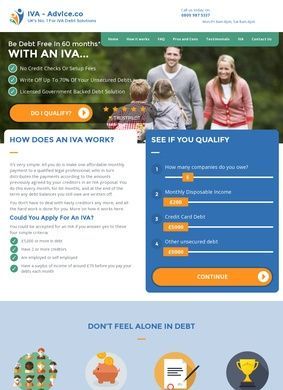
The letters have started arriving in red ink, a collector has called twice this week, and the sums involved have crept past what any normal month could clear. That is the position most people are in when they land on Consumer Advice for IVAs, a UK site aimed at residents carrying unsecured debts of roughly 5,000 pounds or more. Its answer to that panic is information: free, plain-English guidance on what an Individual Voluntary Arrangement is, whether you qualify, and what it would cost, before anyone signs anything.
That framing matters. An IVA is a binding, years-long commitment, and Consumer Advice for IVAs treats the decision as one to understand first and act on second.
The audience is specific: UK residents whose unsecured debts have reached the level where an IVA becomes a realistic option. That focus keeps the guidance relevant. Someone with a few hundred pounds on one card is pointed toward lighter tools, and someone drowning in tens of thousands finds the heavier machinery explained in the same place.
What the guidance covers
The core of the site is education. Consumer Advice for IVAs runs explainers on how IVAs work, who is eligible, what they cost, and the honest pros and cons of entering one. It also offers free confidential debt assessments and eligibility checks, the practical first step for anyone unsure whether an IVA even fits their situation.
What the explainers on Consumer Advice for IVAs do well is take a term that sounds bureaucratic, an Individual Voluntary Arrangement, and translate it into consequences a person can picture: how long it runs, what it does to a credit file, and which debts it can and cannot touch. For someone who has only ever heard the acronym in a worried phone call, that plain walk-through is the gap between an informed choice and a blind one.
The site does not treat the IVA as the only road. It covers alternatives directly: Debt Management Plans, Debt Relief Orders, and the government's Breathing Space scheme all get their own coverage, so a reader can see where an IVA sits among the other options before settling on one. Each of those tools suits a different level of debt and a different set of circumstances, and seeing them side by side helps a reader avoid reaching for an IVA when something lighter would do.
That breadth counts in its favour. It would be easy for a lead-generation site to bury the alternatives, and Consumer Advice for IVAs puts them up front instead.
Beyond the IVA itself
The depth here surprised me. Consumer Advice for IVAs breaks guidance down by the kind of debt a person is actually facing: credit cards, council tax, utility bills, mobile phone contracts, and gambling debts each get their own treatment, which reflects how differently those creditors behave.
There are also focused sections on bailiffs, debt collectors, and HMRC debt, the three situations that frighten people most and where a wrong move costs the most. The bailiff and debt-collector pages in particular speak to the moment people feel most cornered, when someone is at the door or the phone will not stop, and knowing your rights at that point is worth a great deal.
Council tax arrears and an HMRC bill are not the same animal, and a resource like Consumer Advice for IVAs that says so is more useful than one that lumps all debt into a single pile.
The tools and the handoff to a practitioner
Beyond reading, Consumer Advice for IVAs gives people something to do. An IVA calculator lets a visitor put in real numbers and see a rough shape of what an arrangement might look like. Comparison guides sit alongside it, lining an IVA up against the alternatives on the terms that matter, and an FAQ section handles the practical questions, the ones about credit, homeownership, and what creditors can still do, that a person only thinks to ask once the fog lifts.
Then comes the part worth being clear-eyed about. This is a lead-generation site, and its assessments connect people to licensed Insolvency Practitioners, the regulated professionals who actually set up and run an IVA. That is a legitimate model, since only an authorised practitioner can propose one, but a reader should understand that filling in the assessment is a step toward being contacted, not idle browsing. The free advice that Consumer Advice for IVAs provides and the lead generation are the same machine.
None of that is a mark against it, because free debt-help sites are almost always funded this way, but a reader deserves to know the business model behind the free advice.
The calculator and eligibility check
The calculator is the most concrete tool on offer. Feed it your debts and income and it estimates whether an IVA is plausible and what a monthly figure might be, which turns an abstract fear into a number a person can look at.
The eligibility check does the same job from the qualifying angle. Neither replaces a proper assessment by a practitioner, and Consumer Advice for IVAs is upfront that a real recommendation comes from a licensed professional, but as a way to get oriented before that conversation, both tools do their job.
How much to trust it
Reputation is where this one holds up better than expected. Consumer Advice for IVAs displays a self-reported rating of 4.99 out of 5 from 565 customers on its Reviews page, which on its own would be easy to shrug off as a number a company chose to publish. The difference here is corroboration. The third-party platform reviews.co.uk lists the same business with the same 565 reviews and the same 4.99 average, 561 of them rated excellent. When an independent site matches the on-site figure customer for customer, the self-reported score stops reading as marketing and starts reading as real.
A near-perfect average across several hundred reviews is unusual enough to warrant a second look, and the match between the two sources is what makes it convincing instead of suspect.
One honest caveat sits on the other side of the ledger. Contact details are not shown on the front page. Consumer Advice for IVAs links a Contact page in its footer, so the route exists, but a visitor has to click through to find a phone number, email, or address, and for a service dealing with something as sensitive as personal debt, contact you can see immediately would inspire more confidence than contact you have to go looking for.
An About Us section fills in who sits behind the guidance, which is worth reading on any site that funnels people toward a financial commitment.
Set against the strong, corroborated review record, that is a minor knock. Consumer Advice for IVAs is transparent where it counts most, on the substance of the advice and the range of options, and only slightly reserved on the practical detail of reaching a human, which a single click through to the Contact page resolves anyway.
Consumer Advice for IVAs does what it promises: it explains a complicated, high-stakes decision in language a stressed person can follow, points honestly at the alternatives, and hands off to regulated practitioners when someone is ready. The reviews back that up, and the free tools give a person enough to walk into the decision informed rather than guessing. That combination, real information plus a corroborated reputation, is what a debt-help site should look like.