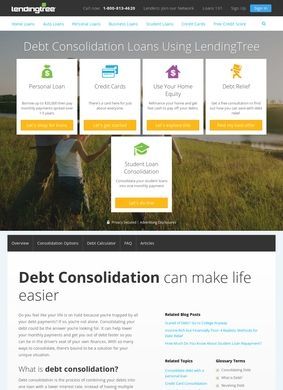
Lending Tree: Debt Consolidation is the debt-focused entry point into LendingTree, an American online marketplace that matches consumers with lenders instead of issuing loans itself. The premise is simple. A person fills out a short questionnaire, and the platform returns several real loan offers from its network so they sit next to each other for comparison. For debt consolidation specifically, Lending Tree: Debt Consolidation pulls personal loans of up to $50,000 from a pool of more than 700 lending partners, with advertised rates starting as low as 6.74 percent APR on a three-year, $20,000 loan.
How the comparison process works
The mechanics are worth understanding before anyone gets excited about a headline rate. Lending Tree: Debt Consolidation runs a soft credit inquiry to generate quotes, so checking offers does not ding a credit score, and the marketplace charges consumers nothing to use it. The offers arrive without obligation, which is what separates a comparison tool from a single lender's application form. Someone carrying a few high-interest credit card balances can see what a consolidating personal loan would cost across multiple banks in one sitting, then walk away if none of the numbers improve on what they already pay. That last point is the catch the marketing tends to soften: a lower advertised APR is the floor for the most qualified borrowers, and the rate any individual is offered depends entirely on their own credit profile.
Credit inquiries and offer terms
Debt consolidation is one room in a much larger building. Lending Tree: Debt Consolidation shares its infrastructure with the wider LendingTree marketplace, and that breadth is the strongest argument for treating the site as a starting reference rather than a single-purpose tool. Home loans run the full range: purchase mortgages, refinancing, HELOCs, and cash-out refinancing, with 30-year fixed APRs quoted from 5.95 percent. Home equity loans appear separately, starting around 7.12 percent. Auto loans, small business loans, business lines of credit, and a spread of credit cards, including balance transfer, travel, cash back, and bad-credit options, round out the lending side.
Beyond debt consolidation loans
Lending Tree: Debt Consolidation also pushes into adjacent territory that most loan marketplaces leave alone. It compares auto, home, renters, and health insurance, and it lists banking products such as high-yield savings accounts, checking, and CDs. Someone consolidating debt today might reasonably circle back to the same site months later for a balance-transfer card or a savings account, and the consistency of the comparison format across all of these is genuinely useful. Whether that one-stop scope is a convenience or a distraction depends on how much a visitor trusts a single intermediary to surface the best deal in every category at once.
Insurance and banking products
Supporting all of this is a deep library of editorial content. Lending Tree: Debt Consolidation publishes guides, rate analyses, and loan statistics across every vertical it covers, and for the debt consolidation audience that material does real work. A reader weighing a consolidation loan against a balance-transfer card or a debt management plan can find the tradeoffs explained on the same domain that will then quote them a loan. The obvious tension is that the publisher of the explainer also profits when a reader converts, so the guidance, however competent, is never fully disinterested.
Guides and rate analyses
The numbers LendingTree puts forward to establish its standing are large: 149 million people helped, $297 billion in loan funding facilitated, and three decades in operation. Those figures speak to reach and longevity, and for a marketplace whose entire value rests on the size and quality of its lender network, scale is not a vanity metric. A bigger pool of 700-plus partners means more offers per questionnaire, which is the whole point of using Lending Tree: Debt Consolidation over applying to one bank directly.
Scale of the lender network
On outside reputation, LendingTree as a company holds a 4.6 out of 5 on Trustpilot across tens of thousands of reviews, with positive feedback concentrating on ease of use and the breadth of offers returned. Negative reviews tend to flag follow-up marketing contact from partner lenders after a quote request. None of that is unique to Lending Tree: Debt Consolidation specifically, but it gives an honest picture of what the post-questionnaire experience can look like.
Checking reputation and limitations
Still, the structure that makes the platform powerful is the same one that should give a careful borrower pause. LendingTree earns by routing qualified leads to lenders, which means the offers a person sees are shaped by which partners are willing to pay for that match, not by an exhaustive survey of every loan on the market. The comparison is real, the soft pull is genuinely harmless, and the editorial depth is stronger than what competitors typically bother with.
How LendingTree earns revenue
What Lending Tree: Debt Consolidation cannot tell a visitor is whether the three or four offers on screen are the best three or four available anywhere, and for a product whose entire promise is finding the lowest rate, that is the doubt that lingers after the questionnaire is done. The published evidence suggests Lending Tree: Debt Consolidation is a reasonable first stop for anyone mapping out consolidation options, not a substitute for checking one or two direct lenders afterward.