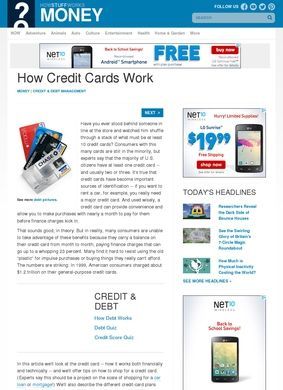
What does it take to grasp what happens when you swipe a credit card and how the money moves behind that one tap? That question is exactly what How Stuff Works: Credit Cards sets out to answer, and it does so by treating the card as both a financial instrument and a physical object. The piece, written by Melanie Radzicki McManus, walks through the mechanics step by step: how the bank extends a line of credit, how a merchant gets paid, how the billing cycle closes, and how the balance you carry turns into a finance charge. It reads less like a sales pitch for any one card and more like a patient explanation of a system most people use daily without quite understanding.
The article lives inside the Money section of the site, under Personal Finance and then Credit and Debt Management. That placement shapes what the writing does, because the tone assumes you want to understand the subject rather than be sold on a product. One thing the structure does well is start at the beginning, with the history, before asking you to follow the money flow. The explainer earns that sequence.
The history of credit cards
How Stuff Works: Credit Cards spends real time on where these things came from. Diners Club arrived in 1950, American Express followed in 1958, and BankAmericard appeared in 1959. Those dates are not filler. They anchor the idea that the modern card is a fairly young invention, and they set up the explanation of why the bank settlement system looks the way it does today.
Card dimensions and technical specifications
The technical detail goes further than most explainers bother to. How Stuff Works: Credit Cards notes the ISO dimensions of a standard card, 85.6 by 54 millimetres. That kind of specific measurement shows the writer cared about getting the object itself right alongside the abstract finance. From there the article moves into how a bank credit card system functions: the merchant gets settled, the cardholder gets billed across a cycle, and payments flow back. Reading it, you come away with a clearer picture of the plumbing than you would from a typical bank's own help page.
Interest rates and finance charges
Finance charges get plain treatment too. How Stuff Works: Credit Cards puts the average interest rate around 18 percent and notes that some cards push past 30 percent. Numbers like that do more work than any warning paragraph could, because they let a reader do the arithmetic on what a carried balance really costs over a year. The writing never reaches for vague caution when a concrete figure will do the job better.
Consumer borrowing at scale
The scale of consumer borrowing comes through hard data. How Stuff Works: Credit Cards cites U.S. credit card debt at roughly 825 billion dollars at the end of 2020, and pulls Experian figures showing the average person holds about four cards. Putting those two numbers side by side reframes the whole subject: this is a product almost everyone carries, often several times over, and the financial stakes are proportional.
Comparing cards as a borrowing decision
What I find genuinely useful is the framing of how to shop for a card. How Stuff Works: Credit Cards compares the diligence involved to shopping for a car loan or a mortgage, which is a sharp way to make the point that a credit card is a borrowing decision deserving real scrutiny. It then covers the different plan types you might encounter and how your credit history shapes which cards are even available to you. That last point is the one most beginners miss, and the piece does not skip it.
Fraud protection and online safety
Fraud gets its own attention as well, with guidance on protecting yourself both online and in person. It is practical material, the sort a first-time cardholder or a parent explaining the topic to a teenager would find directly applicable. The coverage stays grounded in everyday behaviour instead of drifting into vague reassurance.
How the article holds up over time
Where How Stuff Works: Credit Cards holds up is consistency. The explanations build on each other, the figures are concrete, and the writing never assumes you already know the jargon. If there is a limitation, it is that the article is a fixed explainer and rate environments shift over time, so a reader checking today's exact percentages would want to confirm current numbers elsewhere. The conceptual scaffolding, though, remains solid regardless of where rates sit.
How Stuff Works and its reference catalogue
The wider site context adds value too. How Stuff Works: Credit Cards is one article within a reference catalogue that spans Science, Tech, Home and Garden, Auto, Culture, Health, Money, Animals, Lifestyle, Entertainment, and Quizzes. A newsletter signup is available for anyone who wants to keep up with new material. That breadth tells you the credit card piece was written by an outfit whose habit is explaining complicated things to general readers, and How Stuff Works: Credit Cards carries that house style well.
Stack it against the alternatives a curious person might reach for, and the difference shows. A bank's own page wants you to apply. A finance blog often wants the affiliate click. How Stuff Works: Credit Cards reads as an explanation written for the reader's understanding, with the history, the specs, the debt figures, and the shopping advice all serving comprehension first. The conceptual framework it builds is durable even as the specific rate numbers age.