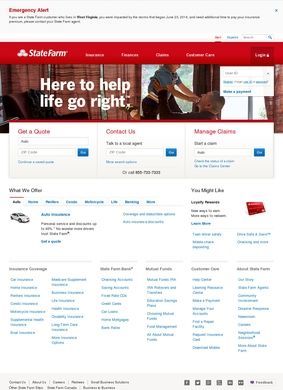
State Farm is a US insurance and financial services company that has operated since 1922 and now sits behind more than 96 million policies and accounts, sold and serviced through roughly 19,000 agents across the country. For a single carrier the spread of coverage is wide, and the website reflects that by trying to be a starting point for almost any kind of risk a household or small business carries. Someone arriving to price car coverage will find that the same site also handles their roof, their retirement savings, and the workers' compensation policy for the business they run on the side.
Vehicle coverage beyond the standard policy
The vehicle side is where most visitors land, and it goes well past the standard car policy. Beyond passenger cars, State Farm writes coverage for motorcycles, boats, ATVs and off-road vehicles, RVs and motorhomes, and travel trailers or campers. That breadth matters for anyone who owns more than one type of machine, because keeping a boat and an RV and two cars under one carrier is usually simpler than tracking renewal dates across three companies.
The off-road and powersports lines in particular are not something every major insurer bothers to underwrite, so their presence in the State Farm catalogue is worth noting for owners of those vehicles. A boat owner who also tows a camper behind a pickup can, in theory, sit down with one agent and walk out with every vehicle covered, which is a meaningful saving of time even before any multi-policy discount enters the conversation.
Property policies for homeowners and renters
Property coverage is built out to a similar depth. The site lists homeowners insurance alongside condo, renters, and rental property policies, plus manufactured home coverage and personal articles policies for valuables that a standard home policy treats only as a capped category. A renter who assumes insurance is something only homeowners buy will find a product aimed squarely at them, and a landlord with a few rental units has a dedicated line instead of a workaround. The personal articles option is the kind of add-on that tends to get overlooked until a wedding ring or a camera goes missing and the homeowner discovers the sublimit.
The way these property lines are separated is worth pausing on. Many carriers fold condo and renters coverage into a single afterthought, but here each gets its own product with its own logic, which makes a difference when the underlying risks are genuinely different. A condo owner insures the interior and their belongings while the association covers the structure; a renter insures only their possessions and liability. Treating those as distinct rather than identical suggests the underwriting reflects how people actually live, and a buyer reading through the options is less likely to end up over- or under-insured for their living situation.
Life and health protection plans
Where the catalogue gets genuinely broad is in the life, health, and protection categories. State Farm offers life insurance, Medicare supplement plans, supplemental health, disability coverage, and pet medical insurance, the last of which has only recently become common among general insurers. On the protection front there is personal liability and umbrella coverage for people whose assets outgrow the liability limits on their auto and home policies, and identity theft protection that fits the same logic of guarding against a low-probability but expensive event.
None of these are vehicle or property lines, yet they are sold through the same agent relationship, which is the practical advantage of a full-line carrier over a string of single-product specialists. Pet medical insurance is a good example of State Farm following demand rather than tradition: a decade ago few household insurers touched it, and its inclusion now says something about how the company reads what its customers actually buy.
Coverage for small business owners
Small business owners get a section of their own, and it is more than a token gesture. The commercial lines include business owners policies, commercial auto, contractor insurance, workers' compensation, surety and fidelity bonds, farm and ranch insurance, and commercial umbrella coverage. A contractor who needs both a bond and a commercial auto policy, or a farmer who needs property, liability, and equipment coverage in one place, can reasonably handle all of it without leaving State Farm. The farm and ranch line in particular signals that State Farm still serves rural and agricultural customers, a segment that some urban-focused insurers have quietly stepped away from. The surety and fidelity bonds are another sign of a company willing to handle the less glamorous corners of commercial insurance that a small contractor genuinely needs to win contracts.
The financial services arm rounds out the picture. Mutual funds, annuities, educational savings accounts, and retirement planning sit alongside the insurance products, so a customer can keep their long-term savings and their coverage with State Farm and the same agent who already knows their household. Whether that is the right move depends on the individual's situation, since a dedicated investment firm may offer more product choice, but having one point of contact for both protection and savings does simplify things considerably for anyone who values a consolidated relationship over maximum product choice.
Inside the digital account tools
The digital tooling deserves attention because it is where a large legacy insurer can easily fall behind, and State Farm has not. There is an online account portal and a mobile app that handles policy management, claims filing and tracking, bill payment, AutoPay enrollment, and digital insurance cards. The app carries a 4.8 out of 5 rating with more than a million reviews on the App Store, which for a utility app tied to bill paying and claims is an unusually strong showing.
Filing a claim from a phone and then watching its status update is the kind of feature that turns a stressful moment into a manageable one, and the digital card means a driver who forgets the paper one is not stuck at a traffic stop. AutoPay enrollment and in-app bill payment cover the routine chores that otherwise generate phone calls, and the fact that State Farm has invested in making those tasks self-service points to an operation thinking about long-term retention alongside acquisition.
A few honest caveats keep the assessment grounded. A carrier this large is not automatically the cheapest, and the agent-based model means pricing and service quality can vary by location and by the individual agent a customer is assigned. The very breadth that makes State Farm convenient also means a buyer who only needs one narrow product might find a specialist that does that one thing better or cheaper. The catalogue is a strength for bundlers and a neutral fact for anyone shopping a single line.
The overall picture is of a carrier that has kept pace with what households and small businesses actually need, from off-road vehicles and pet insurance to surety bonds and retirement savings. The multi-policy math is where State Farm tends to pay off, and the breadth of the catalogue makes bundling genuinely practical, not an abstract perk. Anyone pricing a single narrow line may find a specialist undercuts State Farm on that one product, but consolidating several types of coverage under one carrier, with one agent and one renewal calendar, is a straightforward case to make on the evidence here.