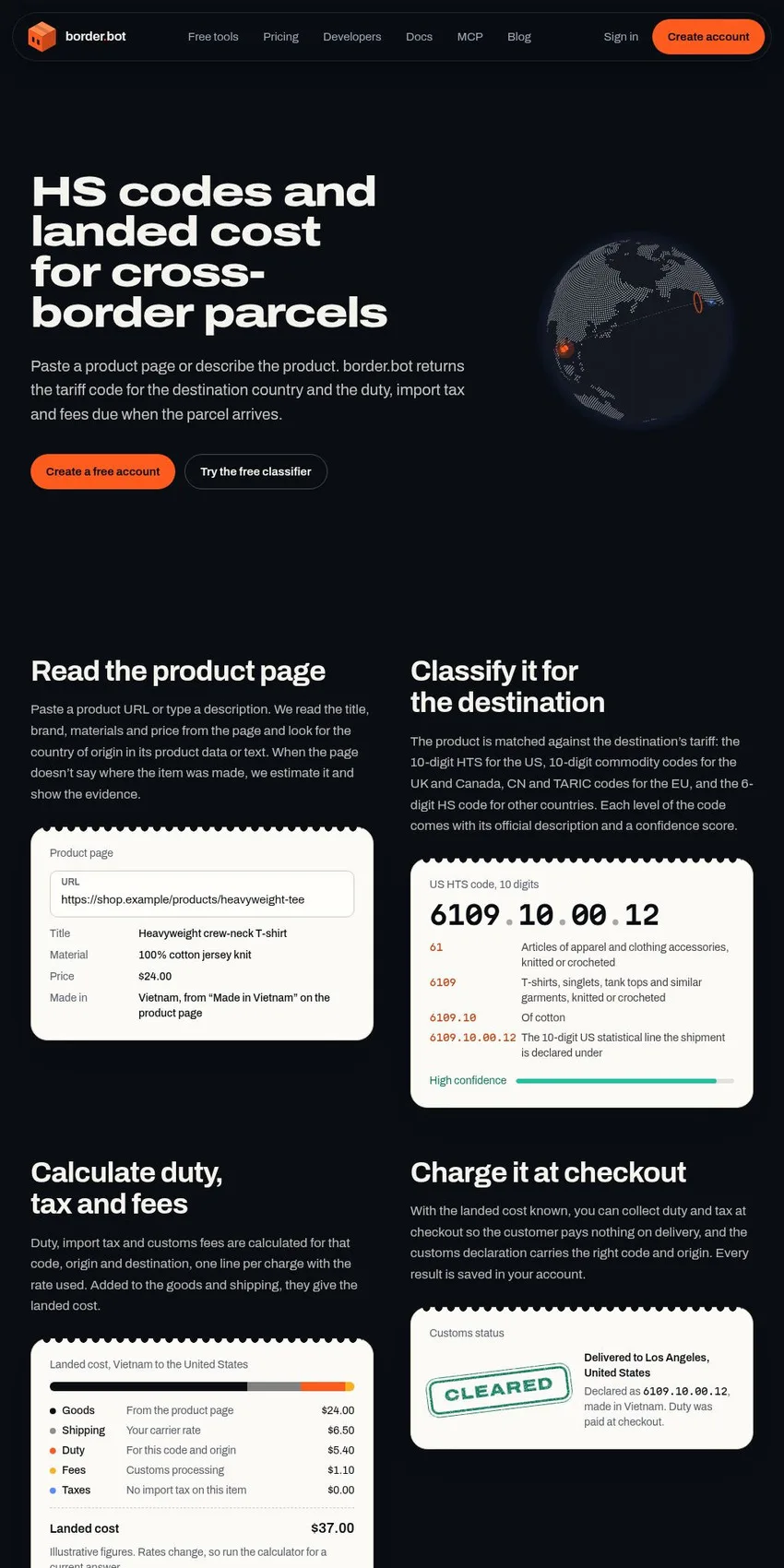
Thirty-four AI clients, including Claude, ChatGPT, Codex, Cursor and Gemini CLI, can be linked to the border.bot platform's MCP server, so that enquiries about a product's customs code and how much it will cost at its destination are resolved directly within the conversation with the assistant. This is the most unusual feature of the service. The rest remains a standard customs compliance tool, designed for retailers who send parcels abroad: classifying products under HS and HTS codes and calculating customs duty, import VAT and fees due upon the parcel's arrival – in other words, what cross-border trade refers to as the 'landed cost'.
In border.bot, the workflow begins with a product page or a free-form description. The system reads the title, brand, materials and price, searches for the country of origin in the page's data, and when the page does not specify it, estimates it and displays the evidence on which the estimate was based. Next comes classification under the destination's nomenclature: the ten-digit HTS for the United States, ten-digit codes for the United Kingdom and Canada, CN and TARIC codes for the European Union, and the six-digit HS code for other countries. Each level of the code (chapter, heading, subheading) is accompanied by the official description, a confidence score, the reasoning behind the selection and the closest alternatives, whilst results with low confidence are flagged for verification.
The final cost calculation in border.bot covers the United States, the United Kingdom, Canada and all 27 EU Member States, with a separate line item for each tax and duty applied, including a check against the de minimis threshold and the total expressed in the destination currency. Measures that apply only under certain conditions are listed separately and are not included in the total, whilst the courier's brokerage fees are not included. For an online shop wishing to collect duties at checkout—so that the customer pays nothing upon delivery—the line-by-line breakdown is more important than the final figure, as it allows each component to be checked individually.
In addition to the tools themselves, border.bot publishes a seven-step guide to estimating import duties into the US, an article on the suspension of the US de minimis regime, a piece on the temporary 3-euro customs duty applied by the EU to parcels worth less than 150 euros, as well as pages containing HS codes, country-specific import rules and a glossary. The guides are practical and up-to-date, which is particularly important in a field where thresholds and rates change frequently.
Credits, tier levels and free tools
Pricing at border.bot is based exclusively on prepaid credits, with no subscription, no quotas and no minimum commitment. The starter pack costs $19 for 100 credits, followed by packs of 500 and 2,000 credits, whilst the 10,000-credit pack, priced at $990, brings the cost down to 10 cents per credit. Credits do not expire; they belong to the workspace and are shared amongst team members, API keys and MCP connections; a failed call automatically refunds the credits, and the refund appears in the account history.
The classification in border.bot comes in three variants with different logic. 'Mini', at one credit, combines semantic search with a reranker and does not use a language model at all. Pro, also costing one credit, rewrites the product description using customs terminology, narrows the search to relevant chapters and ranks candidates according to interpretation rules, drawing on precedents. Max, costing three credits, dispatches an agent to navigate the tariff tree, review previous decisions and identify the product online. Extracting data from the product page, deducing the country of origin and analysing cumulative duties for a specific code and origin are free, whilst a landed cost calculation, finding the code required by the destination import agency and generating an air waybill each cost one credit.
Without an account, any visitor receives three free queries every 30 days, split between the classifier, calculator and country-of-origin identifier, with Cloudflare Turnstile protection against abuse; the IATA air waybill generator, which checks the checksum and calculates the taxable weight, has a separate allocation. A new account receives ten credits. The free threshold is low, but it is clearly stated.
For integration, the REST API operates with JSON over HTTPS, authentication via a workspace key, errors returned with explicit codes (such as `insufficient_credits` or `rate_limited`), and idempotency keys that prevent double charging when a request is repeated. The website also offers Markdown versions of the pages, plus llms.txt files, a sign that border.bot was designed from the outset to be read and used by AI agents.
Who is responsible for the results
border.bot's terms of use are unusually straightforward. The service states that it is an information tool and makes it clear that it is not a customs broker, representative or tax adviser: the codes, duties, sanctions checks and checks for restricted goods are estimates produced partly by AI systems, and the importer remains legally responsible for everything they declare. For high-value or regulated goods, the platform itself recommends confirmation by a licensed customs broker or a binding decision from the customs authority. Liability towards business customers is capped at the greater of $100 or the amount paid over the last 12 months, with the contract governed by the laws of England and Wales; Consumers in the UK and the EU may cancel a credit purchase within 14 days.
It is worth reading border.bot's privacy policy before uploading an entire catalogue. Every classification, calculation and verification is permanently stored so that the result can be explained later to a customs authority, and complete logs of requests are retained for 400 days. Product descriptions are sent to AI model providers such as Google and Anthropic (and, for certain tasks, OpenAI or Mistral); the database and hosting are located in the United States; payments are processed via Stripe; and authentication is handled by WorkOS. The website does not use analytics or advertising cookies, which, for a commercial tool, is a notable choice.
Contact details are limited to a single email address, used for support, invoicing, partnerships and security reports, each with its subject line pre-filled. There is no telephone number, postal address, contact form or opening hours, and neither the about page nor the legal documents mention any individual, registration number or registered office; the operator appears solely under the trading name Border Bot. I searched for independent reviews on Trustpilot, Product Hunt and in general search results and found none. For a service entrusted with product data and, during screening, the names of business partners, the lack of an identifiable operator and any external verification remains the most serious concern.
For an online retailer who sends small parcels daily to the US, the UK or the EU and who currently pays a broker for every classification enquiry, border.bot offers step-by-step documented codes at a price of less than 20 cents per result. The first sensible test is to run the three free trials on the trickiest items in your own catalogue (textiles with mixed compositions, sets, items with no country of origin listed on the page) and compare the results with the codes already declared. Importers of regulated goods would do well to follow the platform's own advice and keep a licensed broker in the loop.