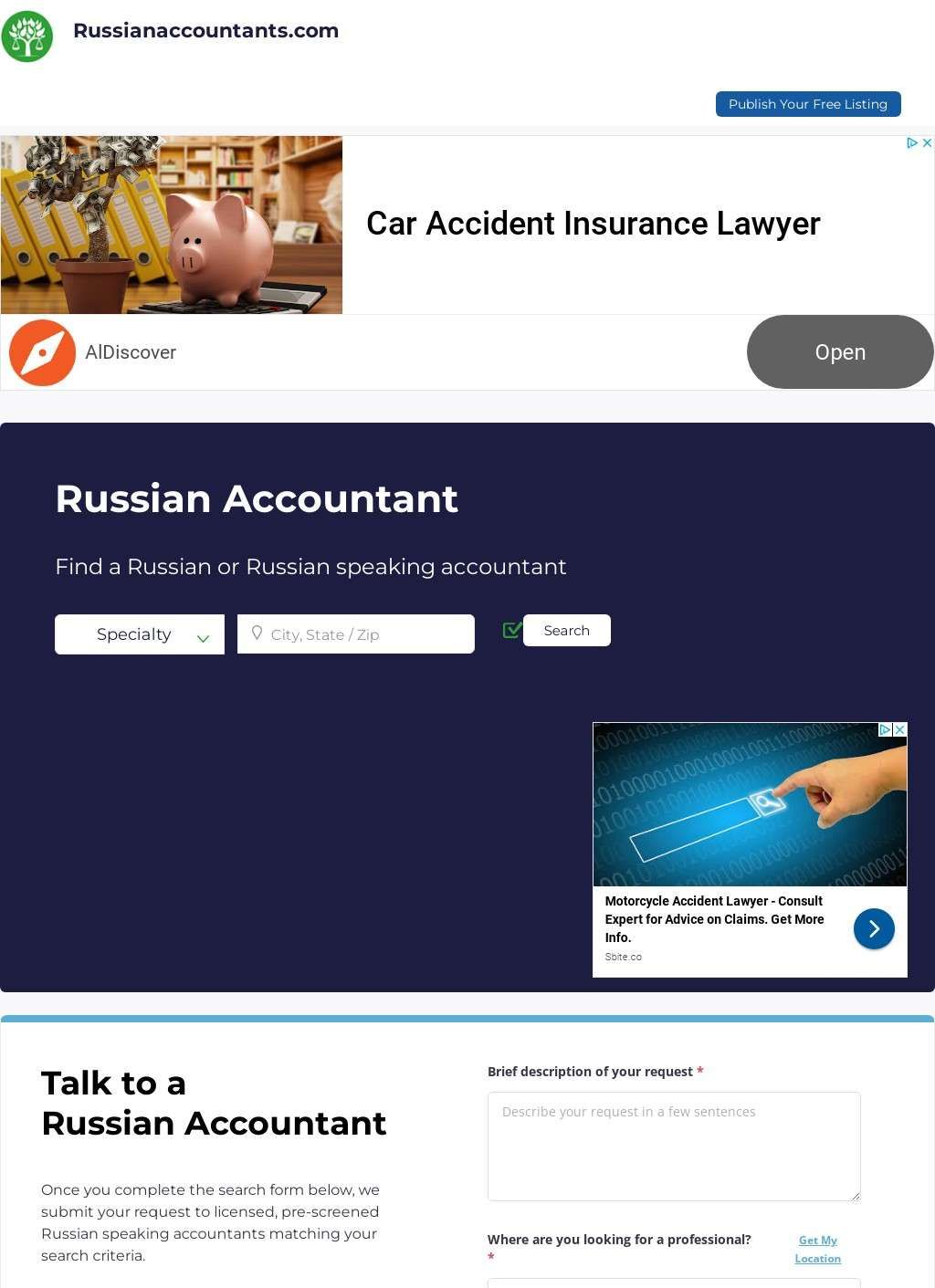
Narrow on purpose: you fill in what you need and where you are, and within two business days the site routes your request to a Russian-speaking accountant who has already been screened. That is the whole machine. Russian Accountants does not keep books or file your taxes itself. It sits between people who want financial help in their own language and the professionals who can give it, across the United States and Canada, with a few listings reaching as far as Russia.
How the matching process works
For a Russian-speaking immigrant trying to sort out a first U.S. tax return, or a small business owner who would prefer to discuss audit findings without translating jargon in their head, that language match is the entire point of Russian Accountants. Plenty of competent CPAs exist; far fewer of them can talk through trust and estate questions or international tax exposure in fluent Russian. The site bets that the shared language is worth a short wait and a form submission, and for the right person that bet is reasonable.
Language as the primary filter
The spread of work the accountants behind Russian Accountants cover is wider than a niche referral service usually manages. General accounting and bookkeeping are there, as you would expect, but so are tax services, international tax, CPA services, audit and assurance, and startup accounting. Then it pushes into territory that usually belongs to wealth firms: trust and estate accounting, retirement planning, wealth management, and investment services. That range suggests the network is meant to follow a client through different life stages, from a freelancer who needs a tax return to a family thinking about estate structure.
Services offered across life stages
International tax deserves a mention on its own. Anyone with income or assets straddling the U.S., Canada, and Russia runs into reporting rules that trip up generalists, and pairing that work with an accountant who understands both the language and the cross-border context is a genuinely useful filter. It is the kind of specialization that is hard to locate by walking into a local office.
International tax for cross-border situations
Geographically, the coverage leans toward big metros. New York, Los Angeles, Chicago, Miami, and Seattle are named, with Canada folded in and Russia at the edges. That tilt makes sense, since Russian-speaking communities and the accountants who serve them concentrate in those cities. Someone in a smaller town may find the matching lighter, though the model does not depend on being walking distance from anyone. The accountant works with you wherever the screening lands.
Geographic coverage and availability
One structural detail is worth knowing before you treat this as an endorsement engine: listings are free to publish. Russian Accountants says it screens and pre-qualifies the professionals it routes requests to, which is more than many open directories bother with, but free publication plus matching means the platform's incentive leans toward volume of connections. The vetting claim is the load-bearing pillar here, and the site asks you to trust it without showing the criteria.
Vetting and accountability concerns
Here is where caution belongs. There is no phone number on the site. No email address. No physical office you could look up. Every interaction funnels through one submitted request form, where you hand over your name, location, phone, email, and a description of what you need, and then you wait up to two business days for a reply. A missing public email is normal; businesses drop it to dodge spam, and a form does the same job. But the absence of a phone line or any address at all is a different matter for a service that positions itself as a trusted middleman for your financial affairs.
Limited contact options for users
Think about what you are being asked to do. You submit personal contact details and a sketch of your financial situation to an intermediary you cannot call, write to directly, or visit, on the promise that a screened professional will surface within two days. For some users that is a perfectly acceptable trade, especially if the eventual accountant turns out to be solid and the introduction saves hours of searching. For others, particularly anyone handling sensitive estate or investment matters, the lack of a direct line to the platform itself will feel like one layer of accountability missing. It does not sink the service, but it should temper how much you lean on Russian Accountants before you have actually spoken to a matched accountant and judged that person on their own merits.
Response time and information testing
The two-business-day promise deserves fair treatment, because it is concrete and that is rare. A specific turnaround beats the vague "we'll be in touch" that most contact forms offer. If Russian Accountants hits it consistently, the experience could feel brisk and the wait would be a small price for a vetted introduction. Whether the site does hit it, you only find out after you have already submitted your information, which loops back to the trust question. There is no way to test responsiveness before handing over your details.
It is worth picturing what this replaces. Without Russian Accountants, a Russian speaker in Miami or Seattle would be cold-searching local listings, calling offices to ask whether anyone speaks the language, and hoping the answer holds up once real work begins. That convenience is genuine, and it is the strongest argument in the platform's favour even given the limited contact picture.
Searching for what others say about Russian Accountants specifically turns up very little. The results that do appear belong to other firms with similar names, including a UK chartered accountancy practice with a small batch of Trustpilot reviews and a separate outfit called Taxory, neither of which has anything to do with this site. So the independent track record, the kind you would normally weigh before sharing your details, is effectively a blank for this exact business.
That blank is not proof of anything bad. New or low-profile platforms often have no review footprint, and a referral directory may generate satisfaction that lands on the individual accountants' pages rather than the matchmaker's. Still, when a service asks for personal financial information and offers no contact channel beyond a form, the absence of outside confirmation removes one of the few external checks a careful person would want. The screening claim rests entirely on the platform's own word.
Russian Accountants is a plausible, specific idea executed with a spare public face. The screening claim and the language match are the assets; the limited contact channels and the empty review record are the liabilities. The language-matched specialization is legitimate and not easily replicated by a general search. What the execution does is shift the trust burden onto you upfront, because there is no way to evaluate the platform itself before you engage, only the accountant it eventually surfaces.
What to expect when using the service
A Russian-speaking individual or business owner in one of the major U.S. or Canadian cities listed, who values discussing tax or estate matters in their first language, is the obvious fit for Russian Accountants. The sensible approach is to submit the request with only the essentials, then judge the matched accountant directly: ask about credentials, where they are licensed, and their experience with your specific issue. Treat the introduction as a lead, and let the accountant who actually shows up demonstrate their value from there.