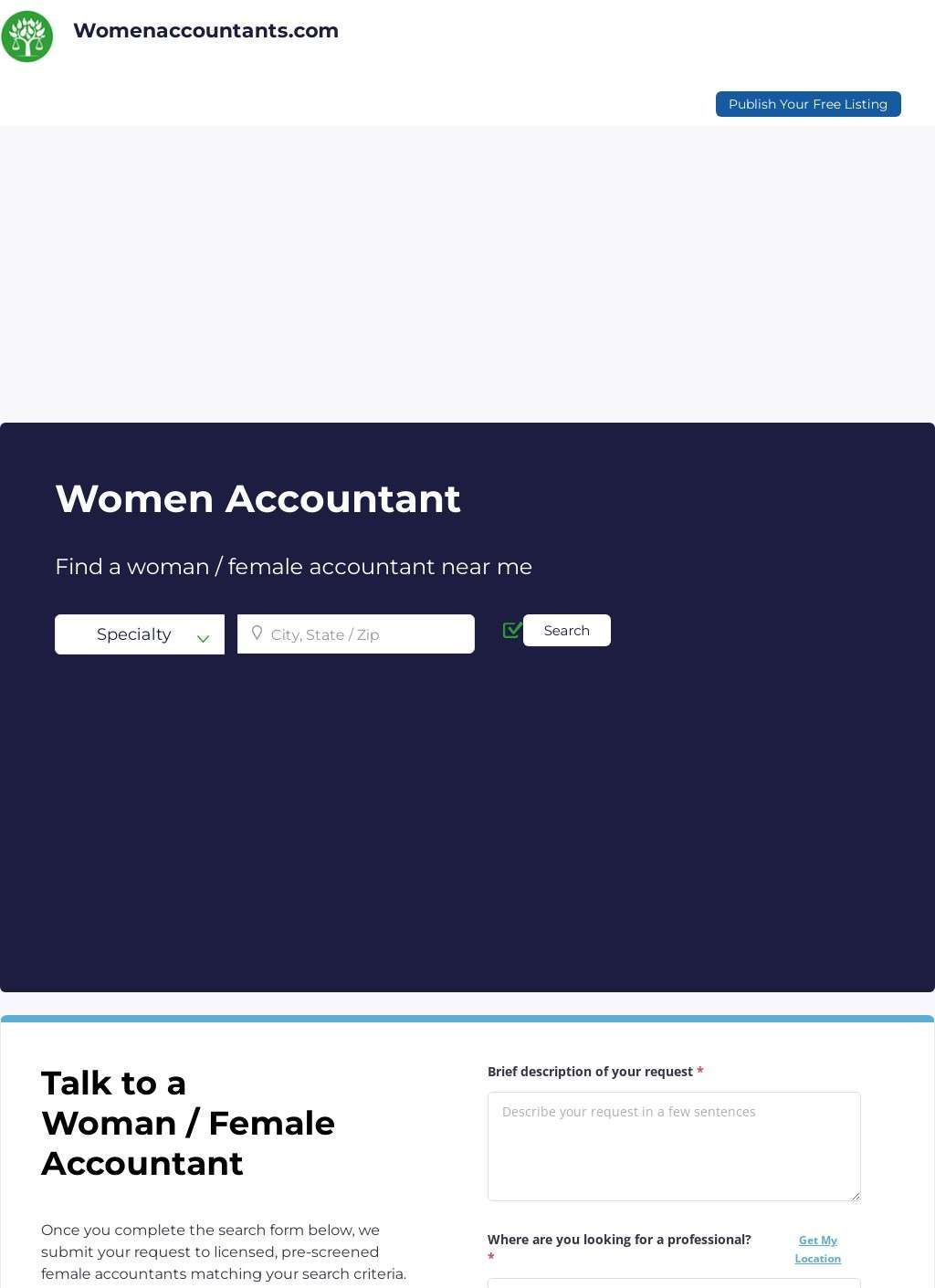
Type in a city and a specialty, and Women Accountants returns a shortlist of female accounting professionals who handle that exact work, with a promise to route your request to a match within 24 hours. The site narrows its job to one thing: connecting people and small businesses with women who do accounting, across more than 40 US cities. That focus shows up in how Women Accountants is built. You browse by specialty or by city, you read a few profiles, and you submit a request that gets forwarded to a relevant professional instead of dumped into a generic inbox.
Specialties beyond tax filing
The specialties on offer go well past simple tax filing. The list runs through general accounting, bookkeeping, CPA services, tax preparation, financial advisory, retirement planning, wealth management, audit and assurance, and international tax. That last one is worth pausing on, because international tax is genuinely specialized work that a lot of small directories never bother to tag. Someone with a cross-border income question is not served by a plain "find an accountant near you" search, and Women Accountants at least gives that person a category to click. Whether the matched professional turns out to be the right fit is a separate question, but the taxonomy Women Accountants uses is honest about the range of work its listed accountants claim to cover.
Weighing pre-screening claims
Profiles are described as pre-screened, and some get spotlight placement. Pre-screening is a claim the site makes about itself, so treat it as any self-reported vetting deserves: a starting point, not a guarantee, and worth verifying once you are talking to an actual person. The spotlight listings are the familiar paid-or-featured tier you see on most match services, sitting at the top of results. None of that is a mark against the platform; it is how these networks fund themselves. It just means the order of profiles reflects more than pure relevance, and a careful user will scroll past the spotlight and read the rest.
How the request form works
The request form is the engine of Women Accountants. Instead of leaving you to cold-email a dozen strangers, the platform takes your stated need and points it at accountants who fit the practice area and location. The 24-hour response target is a concrete number anyone can test on a first submission without risking anything. If the reply lands inside a day, the model works as advertised. If it does not, that is useful information too. Plenty of lead-routing sites quietly avoid naming a turnaround at all, so the fact that Women Accountants prints a deadline gives a first-time user something to measure it against.
Registration path for women accountants
For the accountants themselves, registration is open: a woman running a practice can list it on Women Accountants and appear in those city and specialty searches. This is the supply side of any match service, and the directory only works if enough professionals sign up to make the searches return real results. The site does not, on its public pages, say how many practitioners are currently listed, so it is hard to judge depth in a mid-sized city versus a major metro. A search in New York or Los Angeles will almost certainly surface more names than one in a smaller market, and that gap is worth keeping in mind before assuming every one of those 40-plus cities is equally well stocked.
Newsletter for tax season updates
A monthly newsletter signup rounds out the user-facing features. It is a small addition, but it points toward operators trying to build a returning audience rather than treating every visit as a one-off lead capture. Content could go either way: useful tax-season reminders or forgettable filler. There is no way to judge without subscribing.
Inside the HeritageWeb network
One detail in the plumbing tells you something about who runs this. The help center lives at help.heritageweb.com, which places Women Accountants inside the HeritageWeb network of niche professional directories. That is neither good nor bad on its own, but it does reframe what Women Accountants is. This is not a scrappy independent project built by one accountant; it is a vertical in a larger directory operation that presumably runs the same playbook across other professions.
Weighing editorial focus versus template
The upside of that is infrastructure, the request routing, the profile system, the newsletter machinery, all of which tend to be more reliable when a parent company maintains them. The thing to watch is whether the women-in-accounting angle is a genuine editorial focus or mainly a search-friendly label on a generic directory template. The specialty list and the Women Accountants registration path lean toward the former.
Contact options and their limits
On reaching anyone, the site keeps it lean. A Contact link sits in the footer, and communication funnels through the on-site message and request form with that 24-hour reply target attached. No phone number and no physical address appear anywhere on the public pages. For a match-style platform this is a defensible choice, since the whole point is that you talk to individual accountants, not to a central switchboard, and the form is the front door by design. Still, the absence of a phone line or a stated business location means there is no instant fallback if the form stalls or a user simply prefers to call. The social accounts, Facebook, X, LinkedIn, and Instagram, are linked, which at least gives another channel to reach the operators and a place to gauge whether the brand is active.
Checking for outside reviews
The credibility picture has a real gap, and it is worth being straight about it. A search for outside opinion turns up nothing specific to the service: no Google reviews, no Trustpilot or Yelp presence, no third-party ratings of Women Accountants itself. What surfaces instead is general industry writing about women in accounting and rankings of accounting firms, none of which speaks to this platform's track record. That does not mean the service is bad. Lead-routing platforms collect fewer public reviews than consumer-facing businesses by nature, and a first-time user here is taking the 24-hour promise and the pre-screening claim largely on trust, with no chorus of past users to confirm either. Women Accountants asks you to be the one who finds out whether it delivers.
Weighing the service overall
Weighing it all, Women Accountants does the core job clearly. The search-by-specialty and search-by-city structure is sensible, the specialty range is broader and more specific than the category usually gets, the request form sets a measurable expectation, and the backing of an established directory network means the basic machinery is unlikely to fall over. Against that, you have a self-reported vetting claim, featured listings that shape the results, no public reviews to lean on, and a contact setup that lives or dies on a single form. The gender-specific framing is the whole reason to choose this over a general accountant-finder, and Women Accountants delivers on that framing at the search level even if it cannot prove every profile behind it.
Someone who specifically wants to work with a woman accountant and values that filter gets a reasonable shortcut to a shortlist here, provided they treat the pre-screening claim as unproven and confirm credentials themselves. The published evidence supports the search machinery and the response promise; it does not support any independent claim about the quality of the individual accountants. The platform points you at candidates; it does not vouch for them in any way you can confirm from the page.