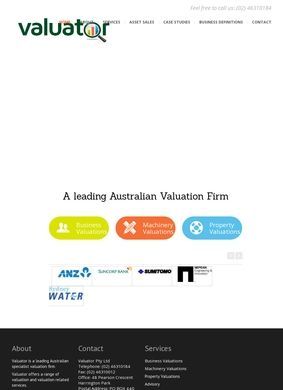
Harrington Park sits in the south-western corner of Sydney, and Valuator is the valuation and advisory practice based there. The scope is wider than the name alone implies. Alongside the formal valuation work, Valuator runs a sales and broking arm, which means the same firm that puts a number on a business can, if the client wants it, handle the process of selling it. That combination is not common and shapes how the whole operation reads.
Valuation services across three asset types
The valuation side of Valuator covers three distinct asset types: businesses, commercial property, and machinery and plant. Business valuations are the core, the kind of formal assessment owners need when buying or selling, resolving a dispute, or satisfying a lender or the tax office. Commercial property is the second line. The third, machinery and plant, is more specialised and not something every accounting practice keeps in-house. Having all three under one name is useful in practice because a real-world deal often touches all of them at once. A manufacturing business changing hands has a going-concern value, a building, and a floor full of equipment, and each needs its own assessment by someone who actually knows the asset class.
Preparing memorandums and brokering sales
Where Valuator gets more interesting is the transaction side. Valuator prepares information memorandums, the documents a seller hands to a prospective buyer to lay out the numbers and the story of the business. The firm also facilitates transactions and acts as a broker for business sales, real estate, and plant and machinery. In theory Valuator can value an asset, package it for sale, find a buyer and shepherd the deal to completion.
Weighing the dual valuer-broker role
That breadth is worth examining honestly. On the practical side, a seller working with Valuator from valuation through to settlement avoids the friction of files moving between an accountant, a broker and an agent who may not talk to each other. On the other side, a valuation report is most credible when the valuer has no stake in the deal closing. A firm that also earns broking fees on the same sale sits in a different position from an independent valuer who simply writes the report and walks away. Neither arrangement is wrong, and plenty of regional practices run exactly this model, but a client should be clear about which hat Valuator is wearing at any given point. The dual function is not hidden; both sides are presented openly on the site.
How the memorandum ties both arms together
The information memorandum service sits right at the join between the two arms and is worth noting separately. A memorandum translates a dry valuation into something a buyer can read and act on: the financials, the assets, the customer base, the reason for the sale. Most owners have never written one and would struggle to pitch their business honestly without underselling it. Valuator, having already completed the valuation, is well placed to draft it, since the numbers and supporting evidence are already in hand. Bundling the memorandum, the valuation and the facilitation into one engagement is the logical conclusion of how Valuator is set up, and it explains why the broking and valuation arms read as a single practice instead of two businesses sharing a website.
Assessing industrial machinery value
The machinery and plant line is the part that separates Valuator from a suburban accountant who values businesses as a sideline. Putting a defensible figure on industrial equipment is its own discipline. It involves age, condition, make, residual life, replacement cost against the secondary market for used gear, and whether the equipment is worth more installed and running or stripped out and sold piecemeal. A firm that lists this as a regular service, and pairs it with plant and machinery broking, has handled the asset class often enough to be comfortable with the full range of questions a lender or buyer will ask. For anyone in manufacturing, transport, agriculture or a trade with a serious equipment base, that is a more relevant capability than a generic valuation menu that stops at commercial real estate.
Institutional partnerships behind the practice
The client profile of Valuator leans toward businesses and organisations needing formal professional work rather than residential owners after a quick market appraisal. The site carries partner logos pointing to relationships with major financial institutions and utility companies. Those logos are worth reading carefully, since a logo on a page confirms a relationship exists but says nothing about its depth. For valuation work specifically, though, the association still tells a prospective client something concrete. Banks and large utilities engage valuers under procurement standards and panel arrangements, so a firm appearing in that company has usually had to meet requirements on credentials, professional indemnity and reporting format. For a business owner weighing whether a Harrington Park practice can produce a report a lender will accept, that is the useful piece of information on the page.
Absence of public reviews
A search for third-party reviews or commentary tied to Valuator comes back empty. The results that appear point to unrelated valuation outfits with similar names, a common problem in this field given how many firms cluster around the same word. The absence of public ratings is not a mark against the work. A lot of B2B valuation engagements come through referrals, accountants and lender panels that leave no public record, and satisfied corporate clients rarely post star ratings anywhere. It does mean a prospective client cannot lean on a trail of testimonials and instead has to weigh Valuator on its stated credentials, its institutional associations and a direct conversation. That is a reasonable way to evaluate a professional services firm in this segment, but it is the honest picture of what is publicly available.
Pulling it together: Valuator is a focused regional practice covering the three asset types that come up most often in a business sale, with the option to carry the same client through broking and settlement if they want a single point of contact. The service list is specific, the lines between the different offerings connect to each other sensibly, and the institutional logos add some external reference point where public reviews do not exist. The dual valuation-and-broking model is worth understanding upfront, but Valuator is transparent about it rather than obscuring the arrangement. A buyer or seller in the south-west Sydney corridor with a business, a commercial site or a yard full of plant to value will find the spread of services here well matched to that kind of work.
Business address
Valuator Pty Ltd
43 Pearson Cresent ,
Harrington Park,
NSW
2567
Australia
Contact details
Phone: 1300 716 595