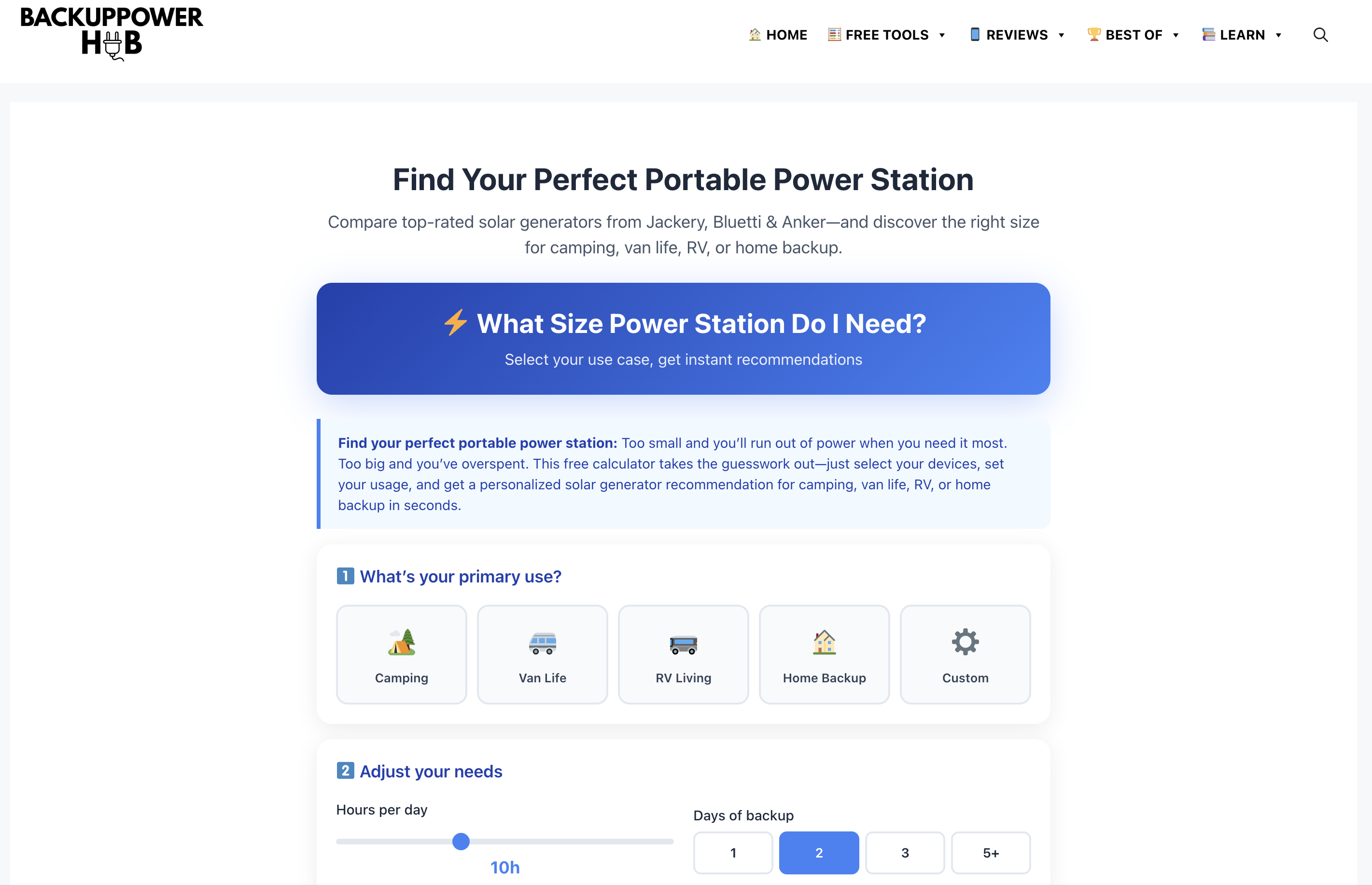
A power station review that logs the surge capacity of a circular saw under load is doing something categorically different from one that calls a unit "excellent for outdoor use." Backup Power Hub: Portable Power Station Reviews & Buying Guides publishes watt-hour measurements, surge figures, and runtime numbers for named models under named loads, then ties those figures to a composite score out of 10 weighted by use case. A station optimized for an off-grid cabin scores on different criteria from one rated for a weekend camping trip, and the scoring framework on Backup Power Hub: Portable Power Station Reviews & Buying Guides makes that split explicit, each use case scored separately rather than collapsed into a single universal rank.
Methodology and scoring framework
Searches for Backup Power Hub: Portable Power Station Reviews & Buying Guides surface only the site's own pages alongside unrelated roundups from Popular Mechanics, CNET, Wirecutter, OutdoorGearLab, TechRadar, and Consumer Reports, none of which cite or reference it. No entries appear on Google reviews, Trustpilot, Yelp, or the BBB. The external record is simply absent. Someone who calibrates trust by counting third-party scores will find nothing to count here, and no volume of strong on-site content fully compensates for zero corroboration from independent sources.
Comparing models across different use cases
What Backup Power Hub: Portable Power Station Reviews & Buying Guides does supply in place of that external record is a disclosed methodology: aggregated owner feedback from external platforms combined with specification-based testing, with testing numbers cited per model and scoring weights explained per use case. The framework is specific enough to evaluate on its face. Generic adjectives do not substitute for measurements in the individual unit reviews. Brand head-to-heads between EcoFlow and Bluetti, or Jackery and Anker SOLIX, occupy their own section, addressing the comparison question most buyers are trying to resolve. Whether that methodology is applied consistently across all 65-plus models cannot be confirmed from outside the site, but the framework is more auditable than one that publishes summary verdicts without explaining the criteria.
Coverage scope across brands
Backup Power Hub: Portable Power Station Reviews & Buying Guides spans more than 65 models from EcoFlow, Jackery, Bluetti, and Anker SOLIX across a content library of over 400 articles. Use-case categories run from home backup to camping, RV living, and off-grid power, with budget tiers from under $500 through the $2,000-plus range. Coverage includes buying guides, brand comparisons, setup tutorials, and solar charging optimization guides. Over 400 articles in a single-product-category vertical represents a sustained editorial commitment. Many competing sites publish a dozen reviews and treat that as sufficient; Backup Power Hub: Portable Power Station Reviews & Buying Guides is operating at a different scale of coverage.
Interactive tools for sizing and solar planning
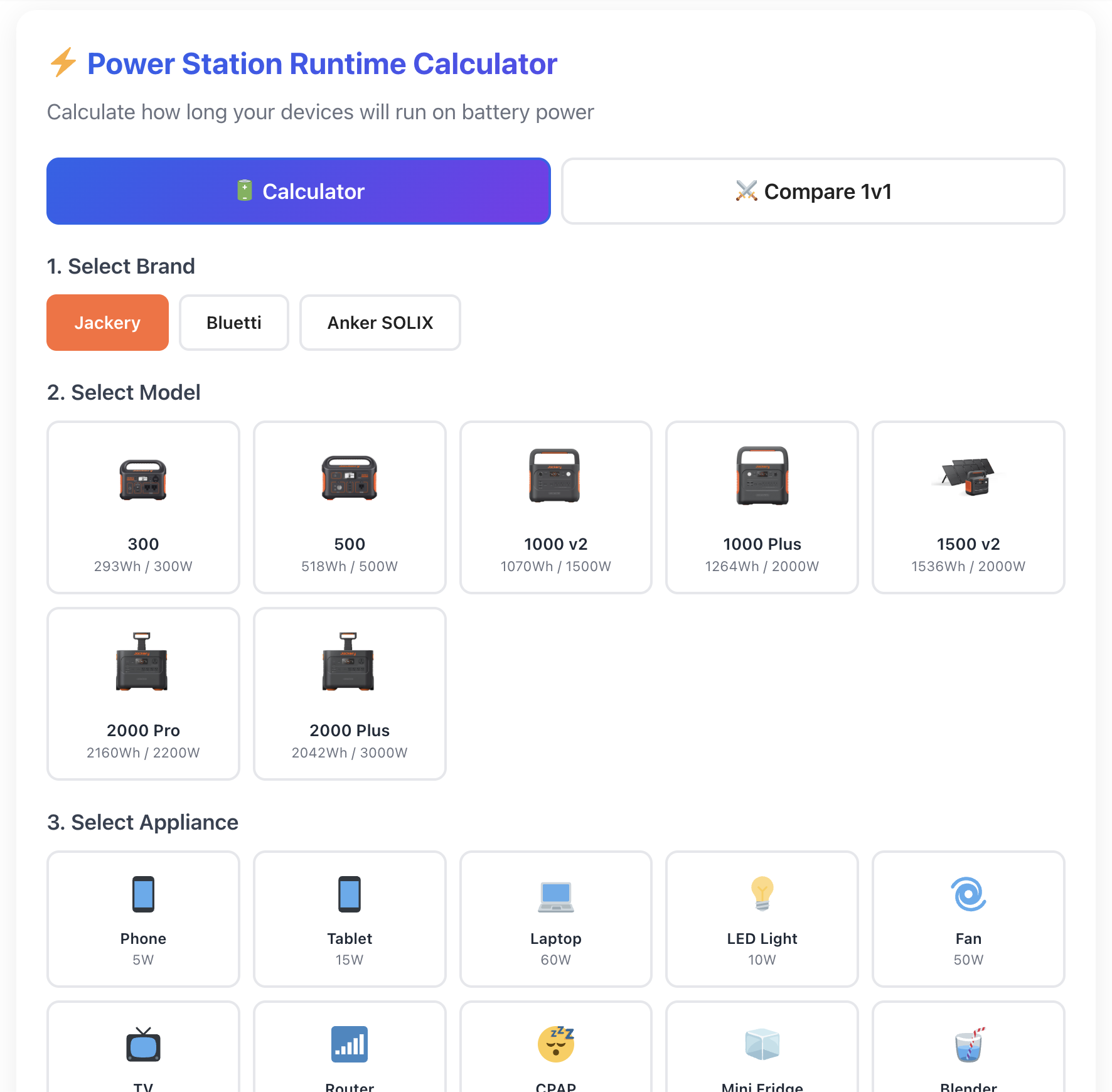
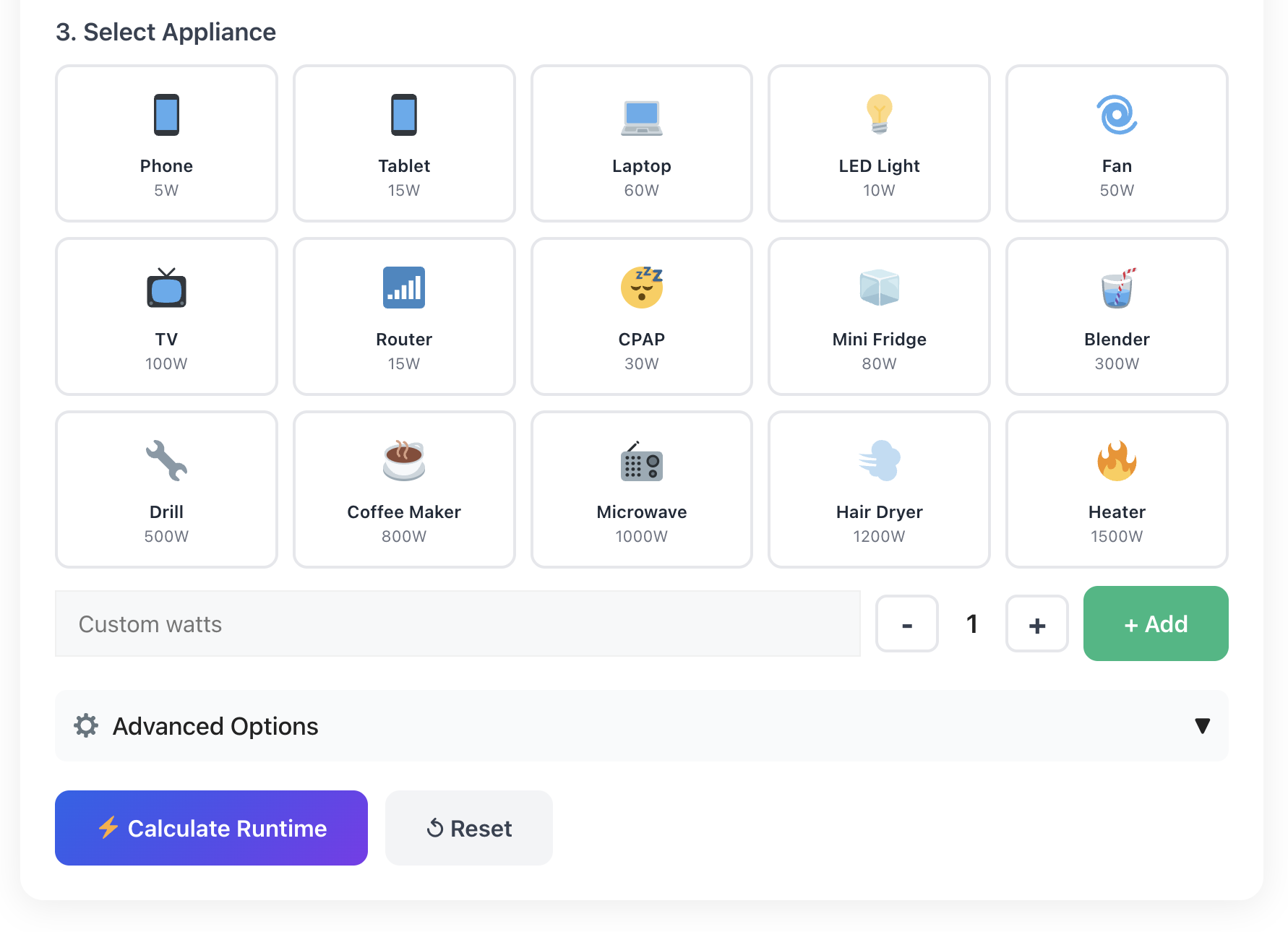
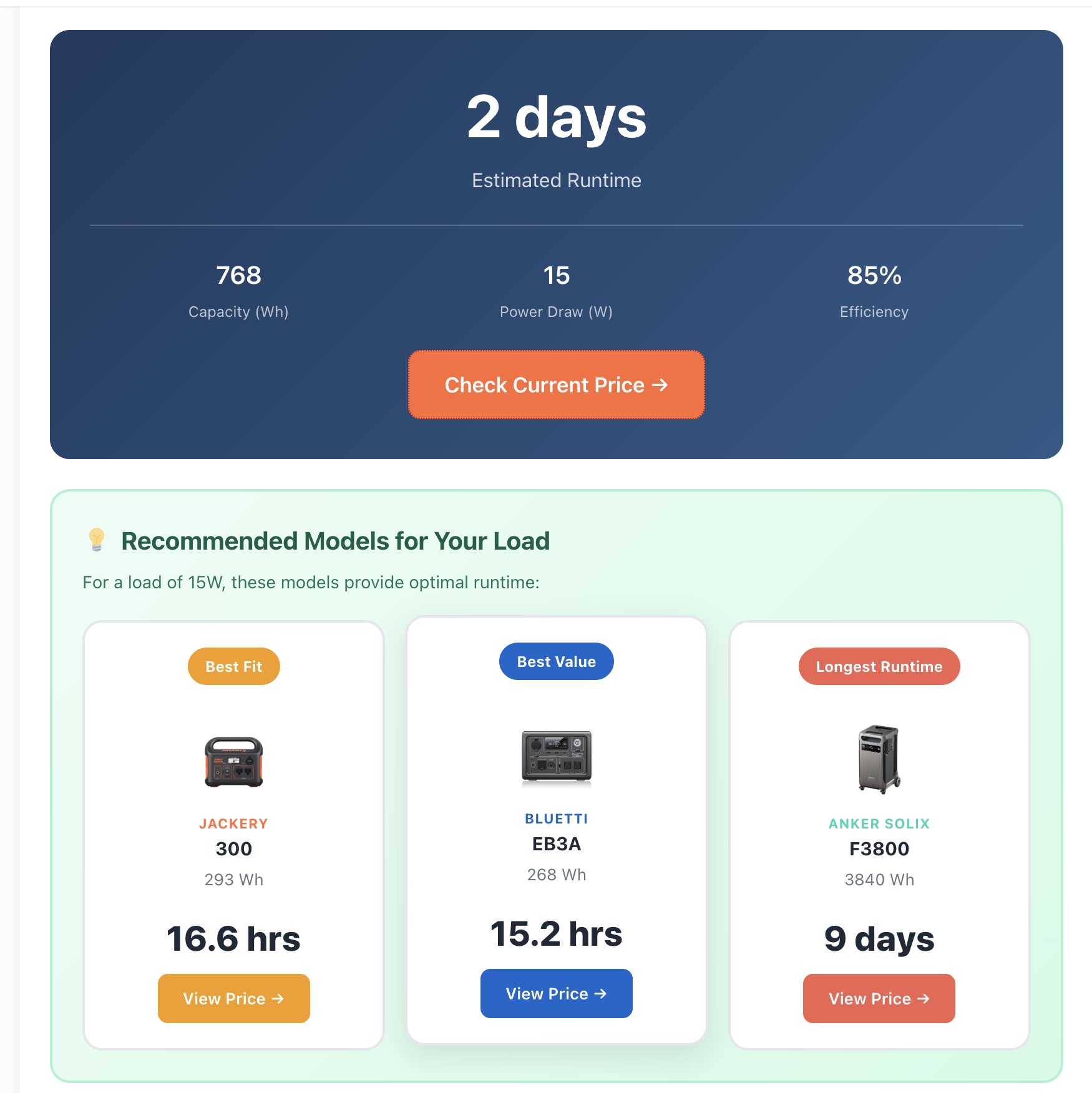
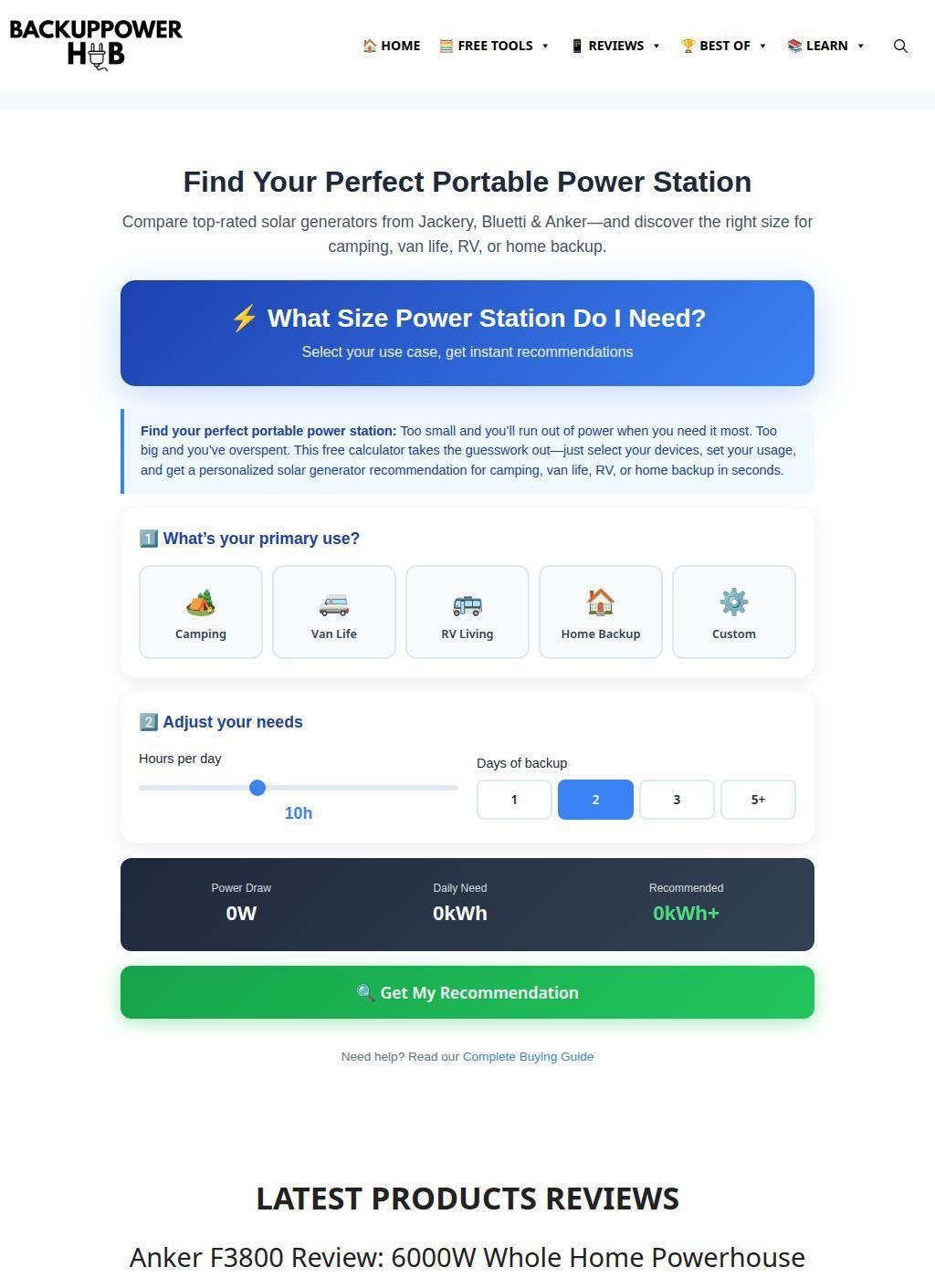
Three interactive tools extend Backup Power Hub: Portable Power Station Reviews & Buying Guides beyond a ranked article list. The Power Station Sizing Calculator converts a buyer's appliance loads into a personalized unit recommendation by working through watt-hours and the distinction between continuous and surge wattage. That distinction is where first-time buyers frequently miscalculate, and an error on an $800 unit is an expensive return.
The appliance compatibility checker tests whether a specific station will run a specific device, since a CPAP machine, a space heater, and a circular saw draw power in ways that are not interchangeable. The solar charging time simulator estimates charge times before panels are purchased, adding a planning layer that most review sites skip entirely. Together these tools address the purchase process at three distinct points: shortlisting, sizing, and solar configuration. No competing review resource listed alongside Backup Power Hub: Portable Power Station Reviews & Buying Guides in this category offers all three in one place.
How the solar charging simulator works
The solar simulator deserves particular attention. Most review archives confirm panel compatibility in a binary yes-or-no format. Estimating actual charge duration requires knowing the station's input ceiling, the panel's rated wattage, and efficiency losses at typical sun angles. Backup Power Hub: Portable Power Station Reviews & Buying Guides packages that calculation into an interactive tool, which prevents the common outcome of a buyer purchasing panels that are technically compatible but take eighteen hours to charge a unit marketed as completing a full cycle in four.
Editorial transparency and affiliate disclosure
The About Us page carries a stated editorial transparency policy. In a category where affiliate incentives routinely pull reviewers toward high-commission models regardless of performance, a disclosed policy is at minimum an auditable commitment. The affiliate structure itself is not hidden. A contact email is accessible from the footer. No physical address or phone number appears on the site. The email alone does not offer the same grounding that a registered address would, though the absence is less consequential for a purely informational resource with no transactional component than it would be for a service business taking payments.
Absence of external corroboration
Backup Power Hub: Portable Power Station Reviews & Buying Guides occupies an unusual position in this space: a large, methodologically documented resource with no external footprint at all. The three pre-purchase tools solve problems that competing review archives routinely ignore. The runtime and surge figures cited for named models are the kind of data buyers need and rarely find assembled in one place. The real problem is the complete absence of outside corroboration.
What independent verification would require?
No third-party ratings, no citations from established tech or outdoor publications, no independent confirmation that the published testing numbers are accurate. The on-site methodology is more auditable than competing review sites that offer no criteria at all, but a buyer deciding whether to route a $2,000 purchase decision through a single uncorroborated source is working with a meaningful asymmetry of information. The content is good enough to use as a research layer; it is not good enough to be the only one.