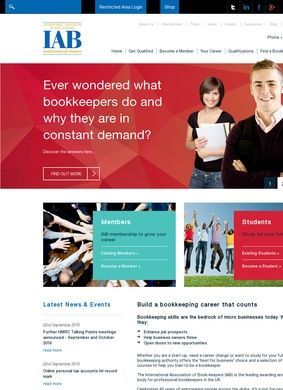
Picking up IAB Bookkeeping Courses for the first time, the most immediately useful thing to understand is that IAB is not a training company. The Institute of Accountants and Bookkeepers is an Ofqual-regulated awarding organisation and a UK professional membership body. IAB Bookkeeping Courses are the qualification strand of that work, delivered through a network of approved training centres rather than by the institute itself. That distinction shapes everything: the institute sets the syllabus, writes the assessments, and issues the certificate; the centre teaches. For a student, the result is a credential whose standard is held constant across every approved provider.
Bookkeeping and payroll qualifications
Qualifications run across two main subject areas. Bookkeeping sits at Levels 1 through 4 in both manual and computerised variants. Payroll covers Levels 1 to 3 with the same manual and computerised split. The parallel tracks reflect something practical: a lot of working bookkeepers run software for most of their records but keep some by hand, so building both paths into IAB Bookkeeping Courses at every level is more than a curriculum formality. Someone can start at Level 1 and move through a structured ladder to Level 4, a real professional standing with regulated weight behind it.
Official study textbooks
One quieter strength of IAB Bookkeeping Courses is that the institute publishes its own study textbooks for every level. When the syllabus and the supporting text come from the same organisation, students revising for assessment are not working from a third-party interpretation of what might be examined. For self-directed learners or those going through an approved centre with limited guided study time, that alignment is a practical advantage, because it cuts down on the guesswork about which topics the examiner actually expects a candidate to know.
Business practice support
The site also lists content aimed at people already in practice, past the study stage. Two professional development offerings appear by name: "Managing Your Finances" and the "Bookkeeping Business Roadmap." These are for someone who can keep books but wants help running bookkeeping as a business, which is a different skill and often a harder one. A body whose members are frequently sole practitioners has a clear reason to offer this kind of material.
Anti-Money Laundering training
Anti-Money Laundering training runs across eight modules, and here IAB Bookkeeping Courses connects to a legal obligation, not an optional professional extra. The institute also acts as an AML supervisor for practitioners under UK money laundering regulations, so the training and the supervision come from one source. A working bookkeeper has to hold AML supervision somewhere; having it under the same roof as the qualification removes an administrative step and makes the compliance side of the job easier to manage.
Membership fees and grades
Membership follows the standard professional tier structure: Associate (AIAB), Member (MIAB), and Fellow (FIAB), with a student grade for those still working toward a qualification. Annual fees run between 105 and 155 pounds by grade. AML supervision is priced separately at 195 to 225 pounds a year. Both sets of figures are published plainly. Supervision and membership are recurring costs, and an organisation that states them openly is easier for a sole trader to plan around.
Networking and professional community
The social infrastructure is lighter but worth noting. The institute runs monthly coffee mornings, Q&A sessions, and ambassador networking groups. None of that is the core reason anyone qualifies through IAB Bookkeeping Courses, but for a sole trader working alone, regular contact with others in the same trade has genuine day-to-day value. The membership is described as both UK-based and international, which extends the useful network beyond a single market and gives someone moving between countries a continuity of professional standing they would otherwise have to rebuild from scratch.
The institute is registered as a company limited by guarantee in England under company number 01119378. That is the constitutional form you would expect from a long-standing professional body rather than a commercial training brand, and it carries implications for governance and accountability that a privately owned course provider does not have. Members sit on an institute, not a customer list, and that structural difference tends to show in how complaints and standards are handled over time.
The clearest alternative for comparison is the AAT. IAB Bookkeeping Courses tend to be described as more tightly bookkeeping-focused and, by most accounts, a more direct entry into the profession than the AAT's broader accountancy pathway. Both carry Ofqual regulation, so the credential standing is comparable. A bookkeeper who wants a recognised qualification, a grade of professional membership, and AML supervision handled through one organisation will find IAB Bookkeeping Courses addresses all three. The published levels, textbooks, and fee structure are detailed enough to make the commitment clear before any enrolment decision.