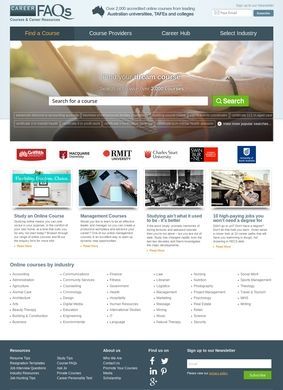
Where does an Australian who wants to study online but cannot decide on a course start? Career FAQs answers that by pulling together more than 500 accredited online and distance education courses from universities, TAFEs, and registered training organisations, then sorting them across 70-plus industry areas. Accounting, healthcare, IT, the trades, business: each sits in its own lane so a prospective student can compare what is on offer without bouncing between a dozen provider websites. The premise is simple and useful, and the catalogue is the reason most people will arrive here.
How the referral model shapes what you see
It helps to understand how the platform makes its money, because that shapes what you are looking at. Career FAQs runs as a referral marketplace. When it sends a prospective student to an education provider, it collects a commission. That model is common in the course-comparison space and there is nothing untoward about it, but visitors should know that the listings reflect partner providers, so the catalogue is curated toward institutions that pay for referrals and does not cover every option available in Australia. Worth keeping in mind when you treat the comparisons as a starting point and verify the fine detail with the provider directly.
Browsing and filtering the course catalogue
The browsing experience is the strongest part. Filtering by industry first, then narrowing to a qualification level, makes the catalogue navigable even for someone who only knows roughly what field they want to enter. With over 500 courses on file from named, accredited bodies, the breadth covers both vocational training and degree-level study, which means a school leaver and a mid-career worker looking to retrain can both find something relevant.
Accreditation as a credibility marker
Accreditation matters in this category, and the site leans on it as a selling point. Listing courses from established universities and TAFEs gives the catalogue a credibility that a loose aggregator of random training offers would lack. The trade-off is that you are seeing a partner roster and will need to cross-check tuition fees, start dates, and entry requirements on the institution's own pages before enrolling.
Career resources beyond course listings
Career FAQs is more than a course finder, and the supporting material is what gives the site repeat value. There is a large library of over 500 resume and cover letter templates, written by humans rather than auto-generated, plus guides on job hunting, interviews, and salary negotiation. A "Find a Career" section lets users browse pathways by industry, which pairs naturally with the course catalogue: read about a career, then see what study leads into it.
Personal development content and trends
The site also runs personal development content, articles on workforce trends, and a "News & Views" section covering education and career commentary. None of this is original, and similar advice exists across the web, but having it sit alongside the course listings is genuinely convenient. Someone weighing up a career change can research the field, find the training, and grab a resume template in one place, which is the practical case for the whole platform.
Trustpilot reviews and user volume
The external reputation picture is reasonable. Career FAQs carries around 710 reviews on Trustpilot with a four-star rating, a sample size large enough to mean something. That volume suggests a steady stream of real users passing through, and a four-star average points to broadly positive experiences without tipping into the suspiciously perfect territory that smaller review counts sometimes show.
Contact details buried in the navigation?
Contact transparency is where the site falls short. There is a "Contact Us" link in the navigation, but the homepage does not surface a phone number, an email, or a physical address. A phone number for Career FAQs Pty Ltd does turn up in third-party business listings, so the company is reachable, yet a visitor should not have to leave the site to find it. For a platform built on guiding people through significant study and career decisions, putting contact details one click deeper than necessary is real friction. The Trustpilot footprint and registered-company status do enough to offset doubt about legitimacy, so this reads as a polish issue, not a credibility problem.
Best approach to using this platform
The overall picture lands favourably with one caveat held in view. The catalogue is the draw, the career resources add real day-to-day usefulness, and the reputation signals are solid. The referral model means you are looking at a curated partner list, so it works best as a research and shortlisting tool, with the final decision made after going direct to the provider.
Career FAQs works best as a shortlisting tool: compare accredited options side by side, grab the resume templates, then go directly to the provider to confirm fees, intake dates, and entry requirements. Treated that way, Career FAQs is a practical planning resource for Australian students weighing online study.