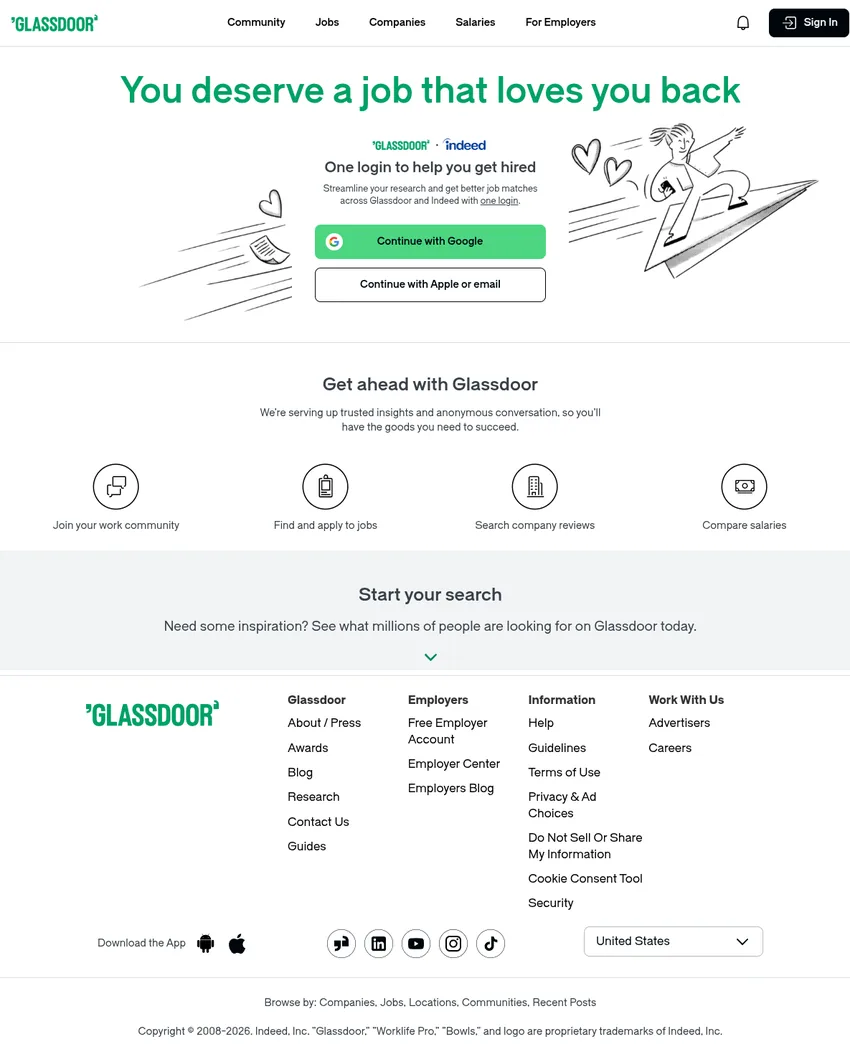
An offer letter shows up with a salary on it, and the person holding it has no way of knowing whether the number is fair. Friends will not say what they earn. The recruiter certainly will not. This is the gap Glassdoor was built to close: enter a job title, a location, and a few details about experience, and the site returns a free personalized estimate drawn from millions of reported salaries, before any negotiation starts and before anything gets signed.
Pay data is the anchor, but the platform outgrew it long ago.
Founded by Robert Hohman, Rich Barton, and Tim Besse, Glassdoor now operates as a subsidiary of Recruit Holdings, the Japanese company that also owns Indeed and that paid a reported 1.2 billion dollars for it. The current site folds anonymous company reviews, a job search engine, an interview question archive, a semi-anonymous professional community, and a steady output of labor-market research into one account.
Salary tools and the job board
The salary section is the most concrete thing on Glassdoor. There is a search across reported pay for specific titles at specific companies, a salary calculator, and an offer analyzer sitting in the site header, which lets someone paste in a pending offer and see how it compares with what the market pays for the same work. The site's own pitch is comparison against millions of salaries, and the estimates come back tied to role, location, and experience level. All of it is self-reported by users, a caveat worth keeping in mind, though self-reported pay at this volume still beats guessing.
The job search engine layers that data onto millions of listings. Filters go past the usual title and location: postings can be screened by company rating, by salary, and by whatever the seeker has flagged as important, so low-rated employers drop out before a single application gets wasted. Seeing a listing side by side with the pay reports and the reviews of the company that posted it is the practical reason to run a search on Glassdoor instead of on a plain job board.
Anonymous reviews and interview prep
The review database is the feature Glassdoor is known for. By the site's own count it covers more than 600,000 companies worldwide, with ratings and written accounts from current and former employees posting under the cover of anonymity. Those same ratings feed back into the job search filters, so the two halves of the site reinforce each other. Someone weighing an offer will trust a dozen inside accounts of what management is like over anything said in the interview room.
The interview archive runs on the same engine. Candidates who went through a company's hiring process post the questions they were asked, and Glassdoor keeps the whole collection free, so preparation for a first-round screen at a specific firm can start from what earlier applicants faced there. Millions of questions are in the pool, and a resource like that has no obvious equivalent elsewhere and costs nothing beyond creating an account.
Moderation and the fake review problem
Anonymity is the whole value of the model and its whole weakness at once. People write freely because nothing traces back to them, and the same shield covers a bitter ex-employee, an HR team quietly polishing its employer's numbers, or a rival with an agenda. Glassdoor maintains a public trust page on fighting fake reviews that explains how submissions get moderated, and publishing that page at all is itself an acknowledgment of the problem. No moderation catches everything, though. The sensible way to read any employer's page is in bulk: one furious post means little, while forty posts repeating the same complaint about management mean a great deal.
Bowls and the community
The Community section, called Bowls, came out of Glassdoor's Fishbowl acquisition and works as a semi-anonymous forum about life at work. Conversations there run looser than the structured reviews: salary threads, industry chatter, layoff talk, the questions nobody would attach their name to on LinkedIn. It is uneven in the way every open forum is uneven. Even so, for candid, current talk inside a specific industry it reaches places the formal review format cannot, and it gives the site a live pulse between the more static review pages.
Research reports, awards, and the employer side
Glassdoor Research converts the platform's data into job reports, job-market analyses, worklife trend studies, and an Employee Confidence index, and mainstream business press cites this output routinely. The annual Best Places to Work awards, billed as Employees' Choice, are assembled from the same employee feedback that powers the reviews, which grounds the ranking in something measurable. For anyone who follows labor trends, the research arm alone justifies a bookmark.
The blog, running under the tagline "Get Hired. Love Your Job.", publishes career advice sorted into job search and hiring, interview tips, salary and benefits, workplace culture, and research. The feed is active and mixes audiences, with practical job-seeker pieces sitting next to posts aimed at recruiters and employers; the employer-facing pages present the same publication as "Work in Progress". One recent title, "7 job search rules Emily Durham wants you to break", gives a fair sense of the register: casual and direct.
Then there is the paying side.
Employers can post jobs, respond to reviews, and buy employer-branding insights, which means the companies being rated are also Glassdoor's customers, and the parent company makes its money from the hiring side too, through Indeed. Nothing in view suggests scores get bent for advertisers, but the structural tension deserves naming: the site's credibility with job seekers is exactly the asset it sells to employers.
The verdict splits by use. As a pre-negotiation salary check and an interview prep source, Glassdoor is close to indispensable, and it costs nothing. As a way to judge a single employer it demands more care, because anonymous, self-selected reviews reward reading in aggregate and punish anyone who treats one angry post as the final word.
Read with that discipline, the site puts more free, decision-relevant information about employers in one place than any obvious alternative. Read lazily, it will confirm whatever the visitor already feared about a company, but Glassdoor only supplies the raw material; the judgment still has to come from the person reading it.






Business address
Glassdoor, LLC
300 Mission St, 16th Fl,
San Francisco,
CA
94105
United States
Contact details
Phone: (800) 318-3229
Not sure how to know if an interview went well? Learn the 9 signs to watch for that hint that you're likely to get the job.
Learn when to ask about salary in an interview, exactly what to say, and how to answer 'What are your salary expectations?'…
25-year recruiting veteran, Amy Miller, breaks down the job search mistakes experienced professionals make and their fixes.
Damola Adamolekun, Red Lobster's CEO, shares 6 career lessons on career pivots, industry turnarounds, and AI.